Re-gifting
By Fuchsia Voremberg
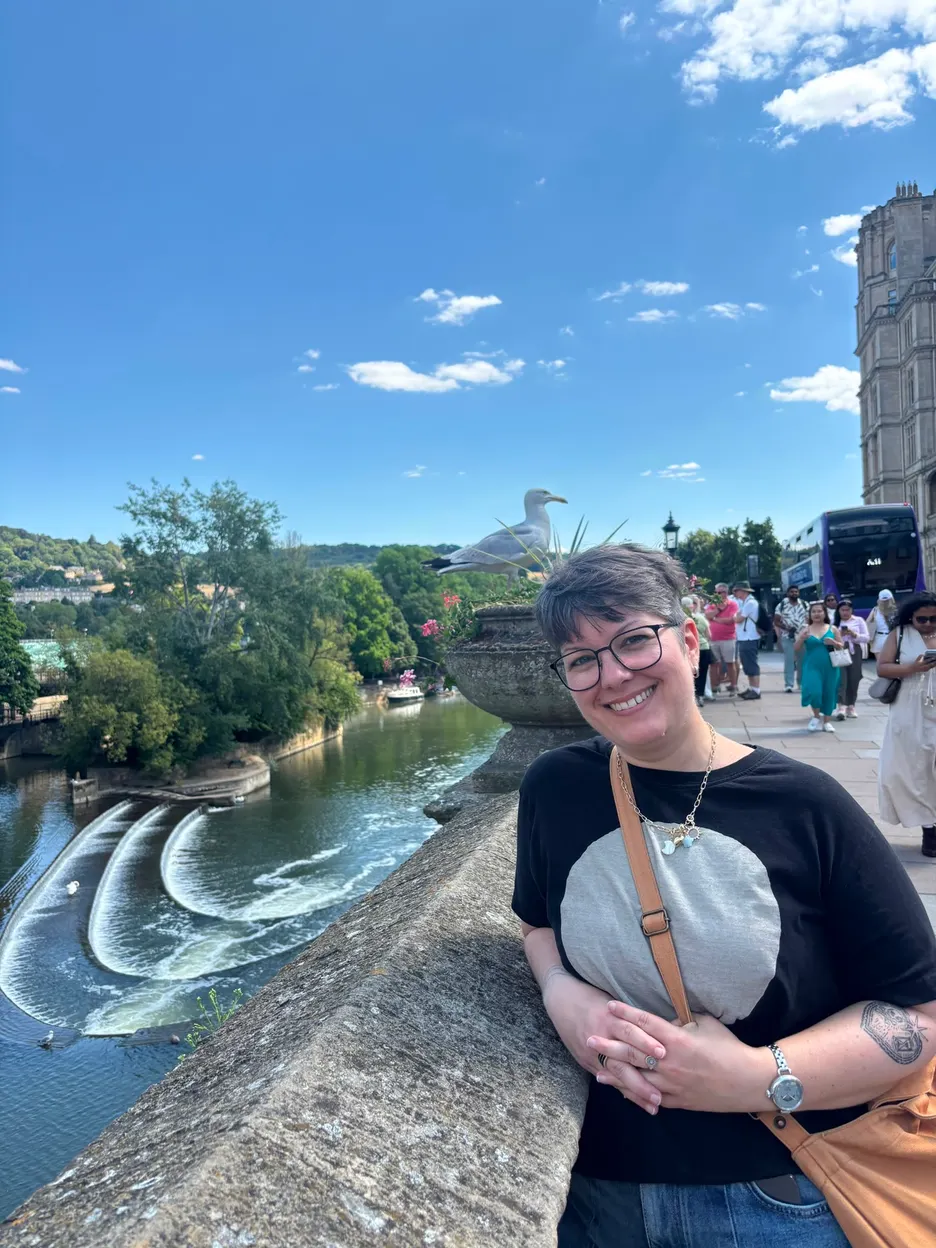
Just over a year ago I packed up some of my things, put the rest in storage, and moved from the US to the UK to pursue an MA in the History of the Book at the Institute of English Studies (IES), part of the School of Advanced Studies at the University of London. Prior to this move I had been working in middle management for more than a decade, far outside the realms of rare books. However, I had been aware of the History of the Book MA at IES for many years and when the opportunity came to return to university and pursue my interest in books, I knew exactly where I wanted to go.
My love of books started early, and I became an avid reader at a young age. As an undergraduate I studied Literature and quickly followed it up with a Master of Fine Art in Poetry, but that was all nearly twenty years ago now. In the meantime, I found a love of printed media and learned how to letterpress print. Additionally, I learned silk screen and linoleum block printing as part of a print collective in Seattle, Washington. These skills set the foundation for appreciating how books are made and the immense skill and craft that goes into an antiquarian book.
When I’m asked to explain what exactly Book History is (which is often), I liken it to Art History. Instead of the general historical medium being art it is, instead, all about books. In that way, the IES MA is also similar in scope, in my mind, to the kind of training a student might get in an MA in Art History. During the course at IES, I studied books going back to handwritten medieval manuscripts and the beginning of printed books, to advances in printing technologies in the nineteenth and twentieth centuries, all the way up to the digital books of today. Additionally, the course traces a path through the connected histories of reading and collecting, how books are made, the history of printing and paper manufacture, the changing designs of bindings and the evolution of typography. Overall, it is a well-rounded program that offers an important grounding in an under-acknowledged field of historical study.
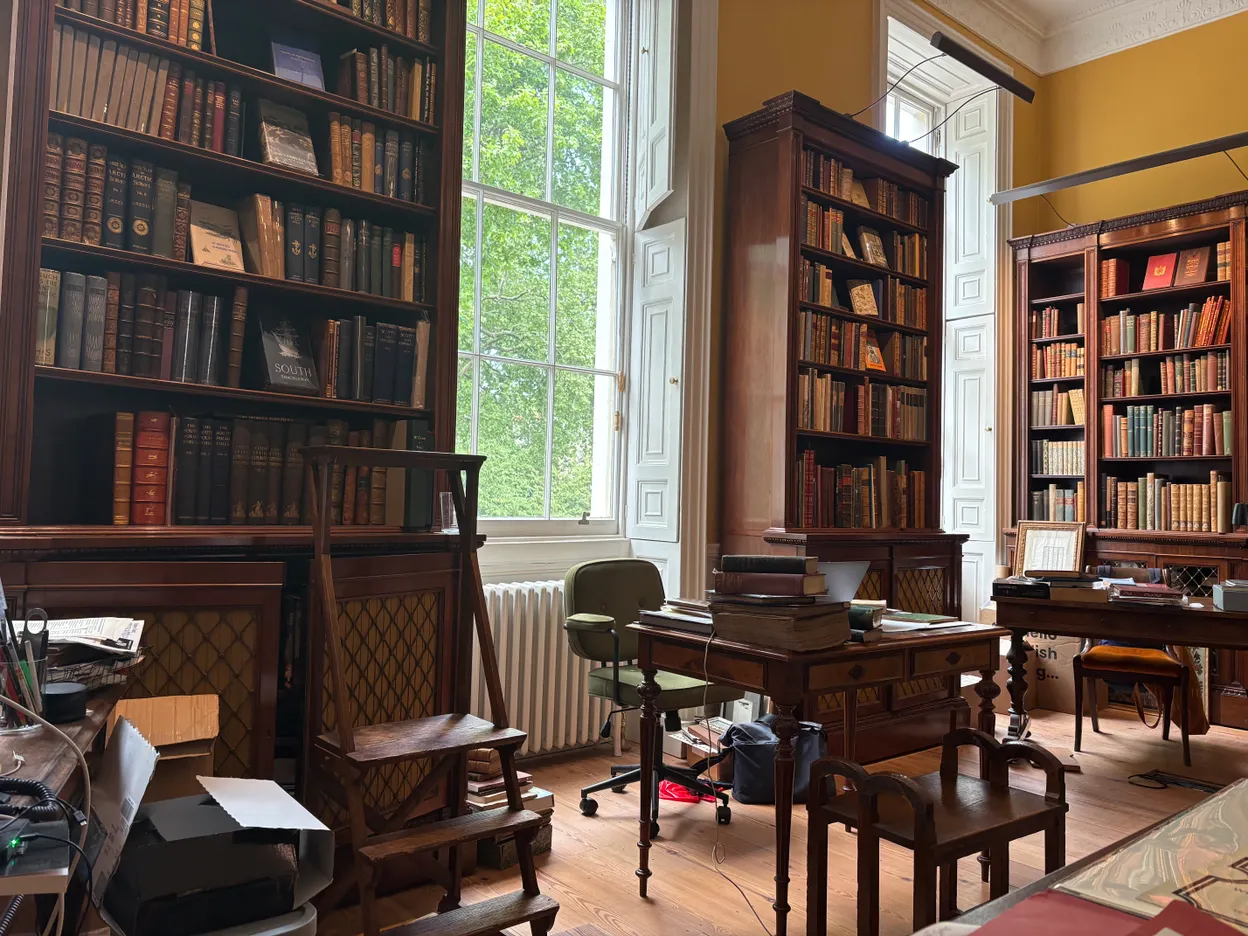
In conjunction with IES, Maggs Bros. offers a scholarship for one student each year, and last year I was fortunate enough to be the recipient. The scholarship also includes the opportunity to undertake a spring internship at their Bedford Square location. The internship component of the History of the Book MA is an optional, hands-on part of the IES course experience and can be undertaken for credit, or not, as befits the interest of the student. Each internship offers its own unique insight into working with archival materials, rare books, ephemera, manuscripts, and the wider book trade. Due to my prior research in nineteenth century American merchant logbooks, I was paired with Sam Cotterell in the Travel Department to work on similar maritime items. Although I catalogued many things while working with Sam, the two items highlighted here were my favourites.
Dinner, Pipe etc. etc. being over, we wended our way back to the Ship, but – it is with Grief I saw it –...– to me the appearance of things seemed greatly altered, the “little hills” appeared literally to “skip and hop”, and not only the Hills, but verily the trees also – yea, and the houses.
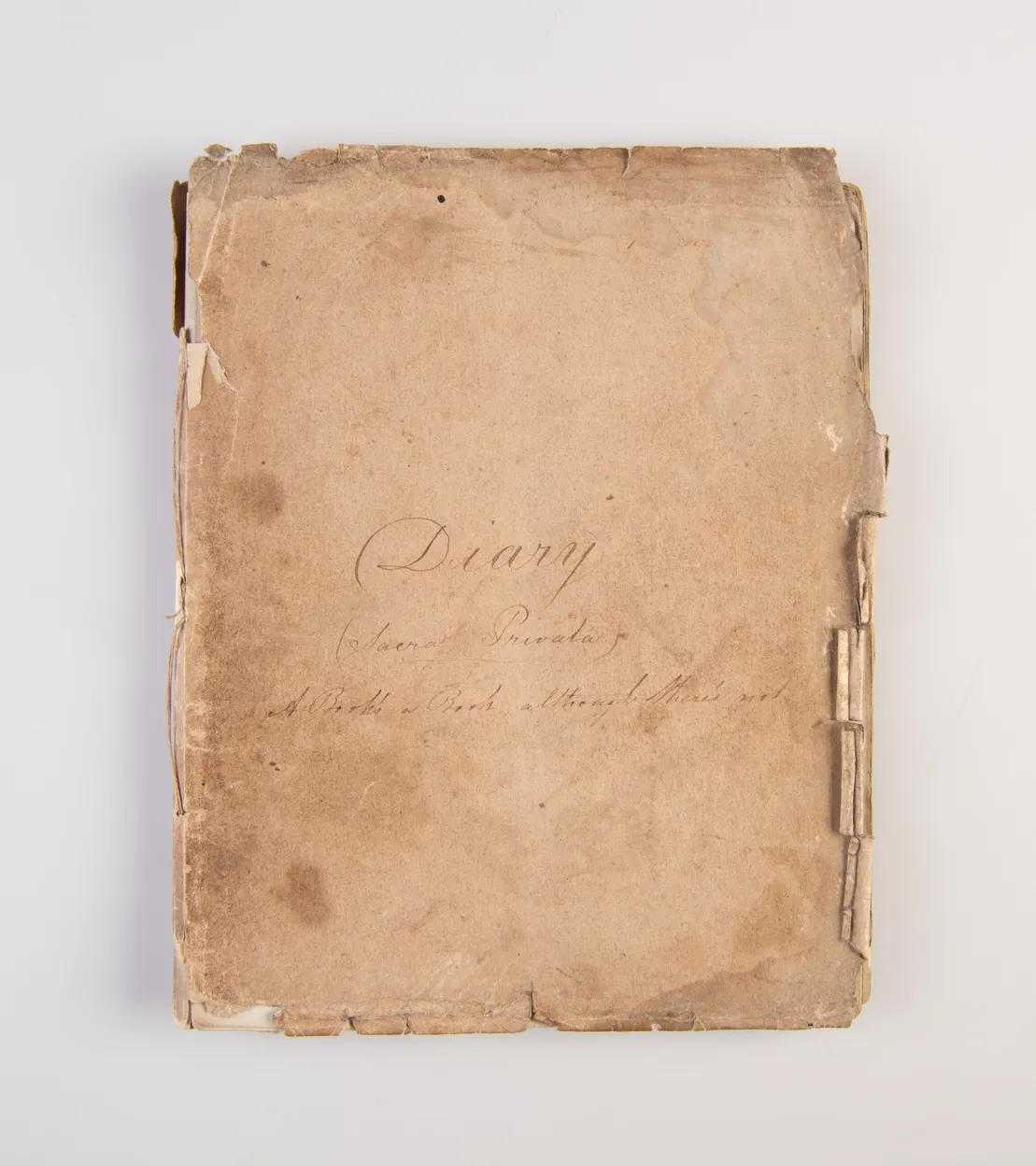
One of the first projects I worked on was a diary in paper wrappers written by Samuel Whitchurch Sadler (1821– 1886), a British Naval officer on the HMS Revenge. Sadler’s diary recounts a Mediterranean voyage from March to September 1841. One of the most difficult features of working with manuscripts is deciphering the writing, but fortunately, Sadler’s penmanship was quite good and after a little while it became fairly easy to read. Unlike other naval manuscripts, which can be formulaic and technically dry, this was a personal journal and so mostly recounted escapades with other officers during shore leave. Such tales included, sneaking back onto the ship after hours, riding donkeys past Mt. Etna, and exploring the cave of St Paul in Malta.
At the beginning of the journal, Sadler regrets not writing of his previous experiences and vows to ‘write in this little book just the thing that comes uppermost in my mind’ so that he ‘would sometimes put down a thought or two that may be of Service hereafter.’ Reading through this journal felt less like a glimpse of the past and more like an invitation to partake in someone’s fondest memories.
My Birthday was on the 3 of...this Month, I do not know if they kept it up at home but I certainly passed it rather dull on board.
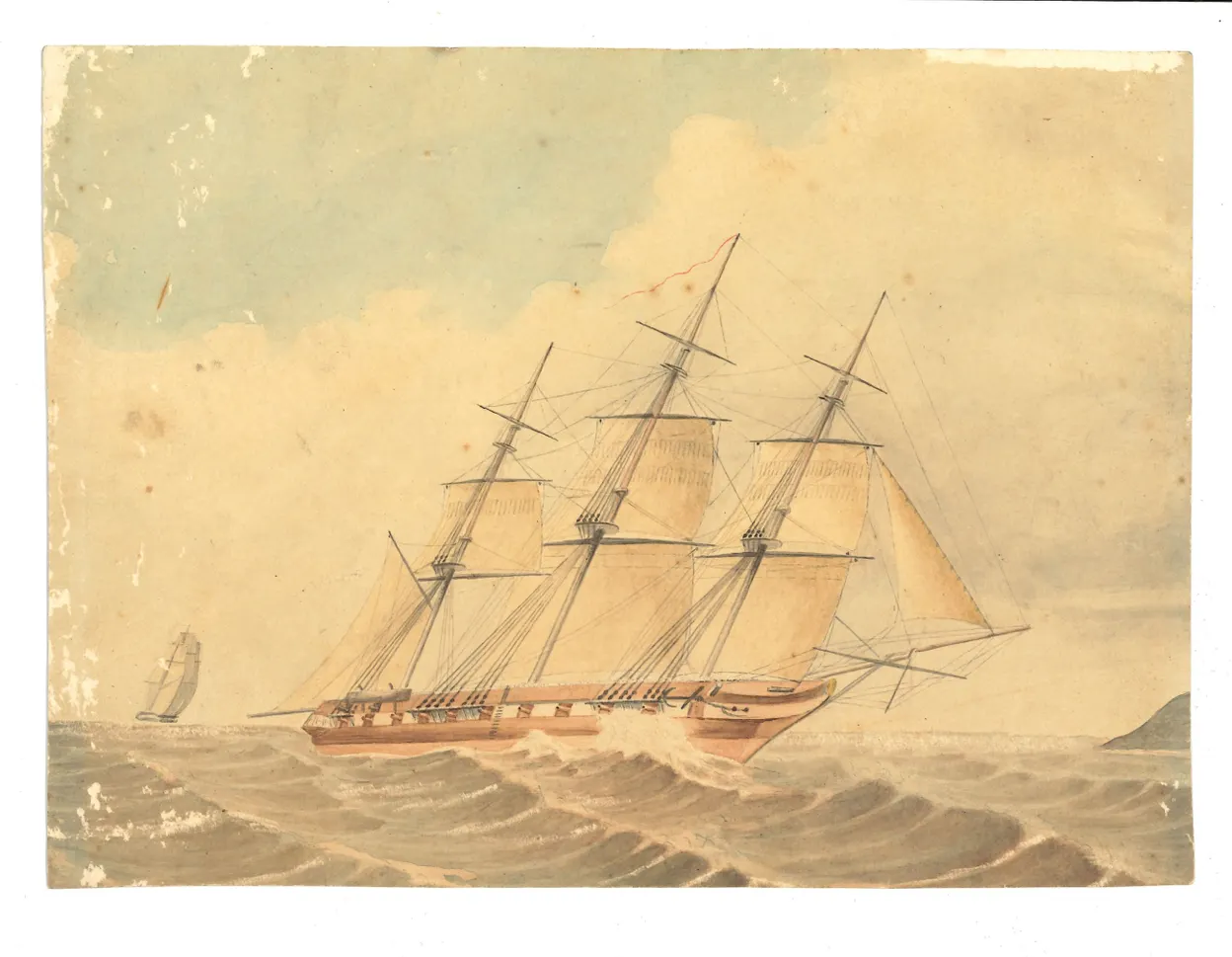
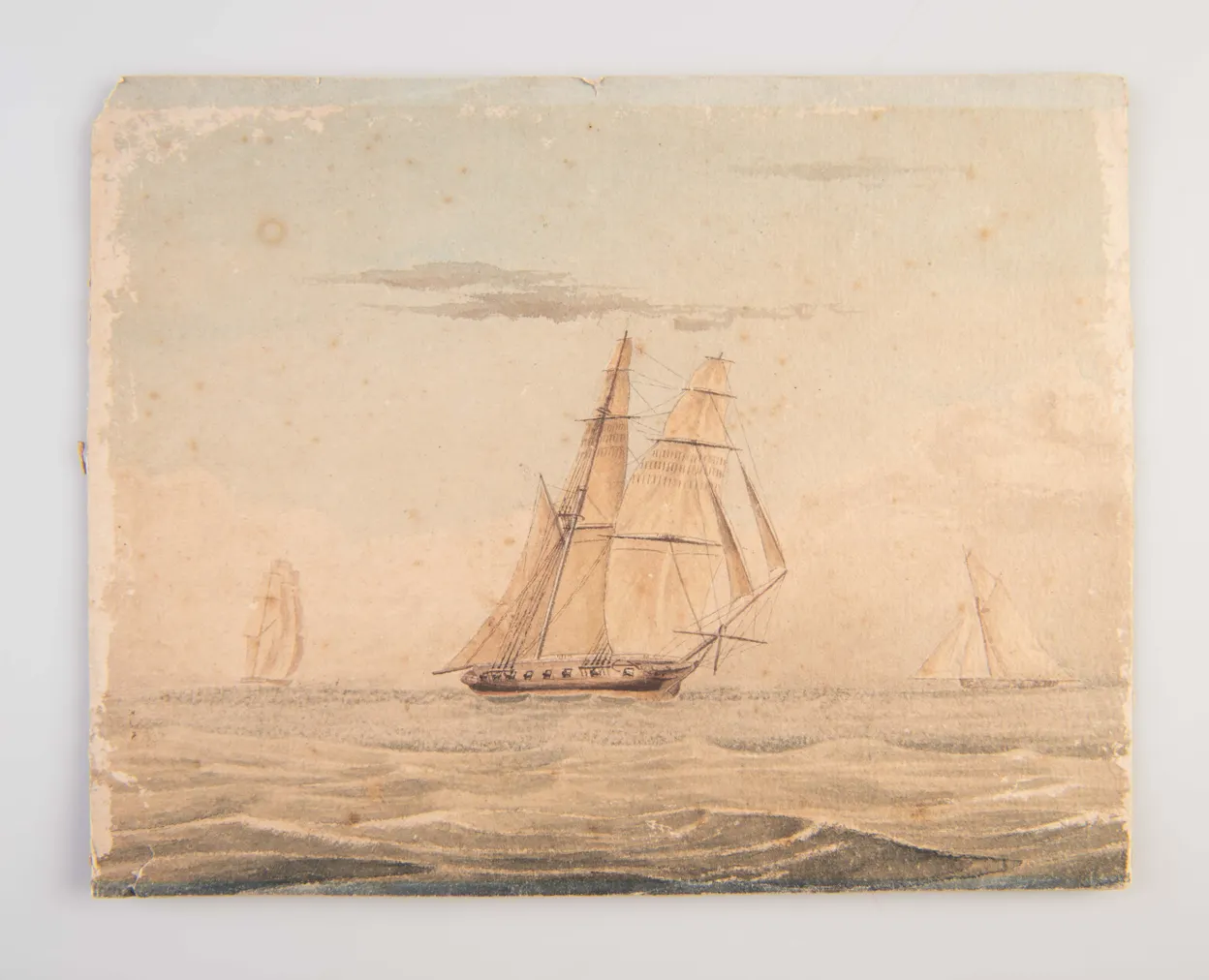
In his later years, Sadler would go on to write ten sea-based adventure novels aimed at young adults, his most popular being The Adventures of Marshall Vavasour, Midshipman (1873). Even at the age of twenty when he wrote this journal, Sadler’s writing was already very engaging and had me chuckling to myself more than once. Accompanying the diary are three watercolour paintings by Sadler’s brother, Henry Whitchurch Sadler (d. 1845). Two of them are ship portraits, one of the HMS Ringdove, and one of the HMS Pantaloon, two ships where the brothers served together, the other is of the locks at Dover Harbour. Sadly, Henry died as a young man and the watercolours remaining with his brother’s journal all this time feels quite poignant.
As an aspiring writer, it is possible that Sadler wrote other dairies which have not survived or have just not turned up. I often wonder what the rest of his career was like and how he ended up, nearly thirty years later, writing adventure novels. He passed away in Woolwich in September of 1886, the same year his last novel, The Adventurous Voyage of the "Polly" and Other Yarns, was published.
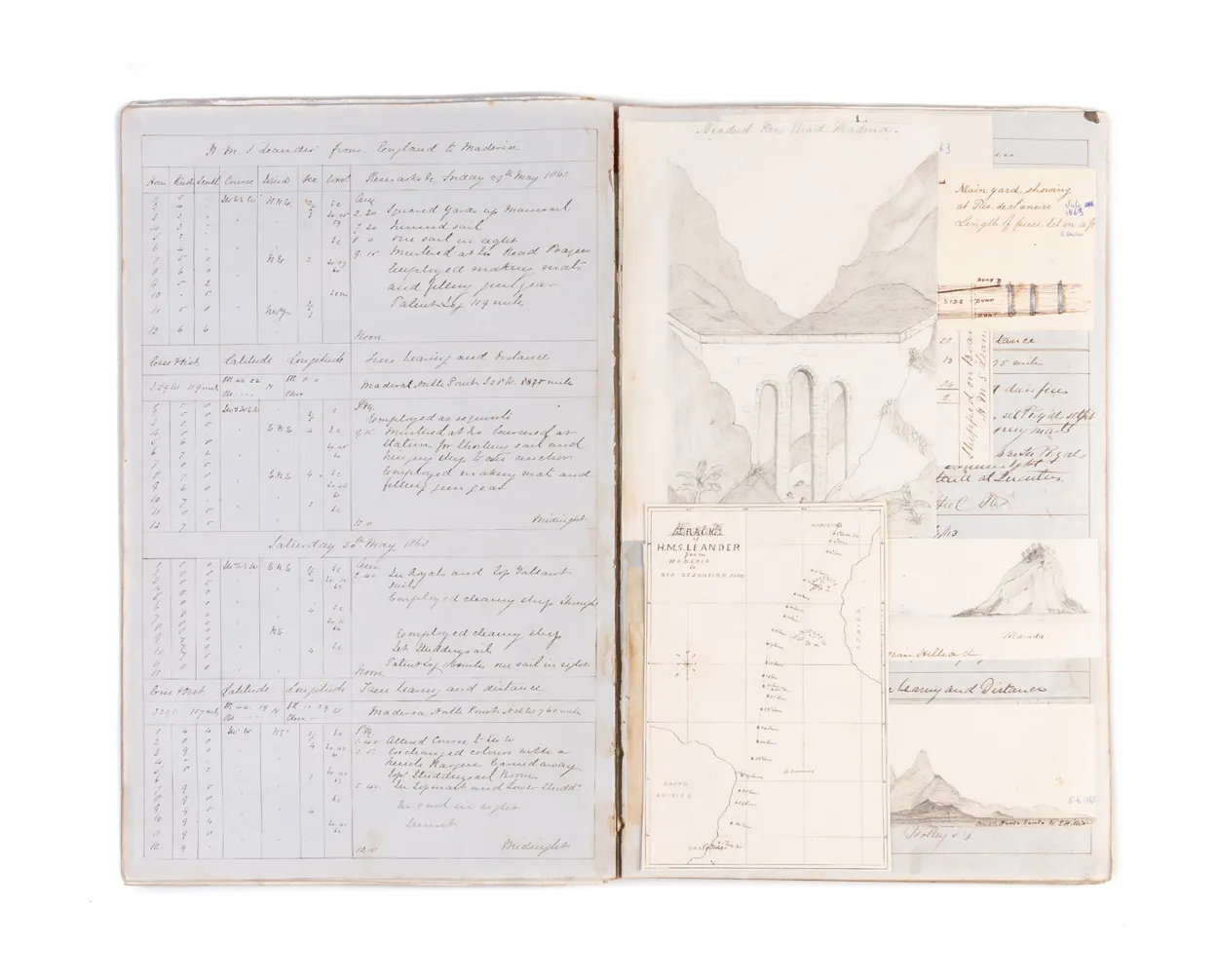
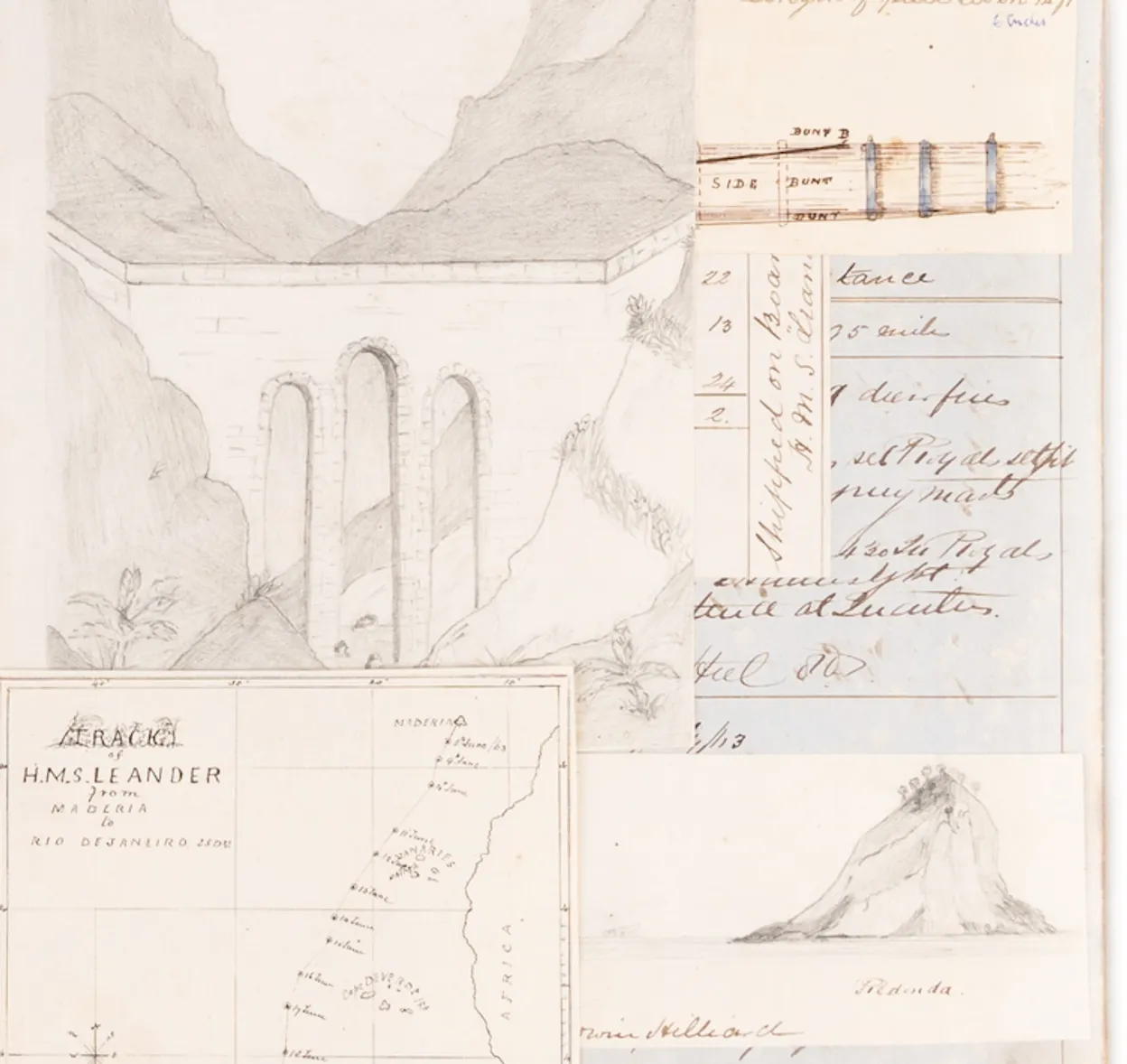
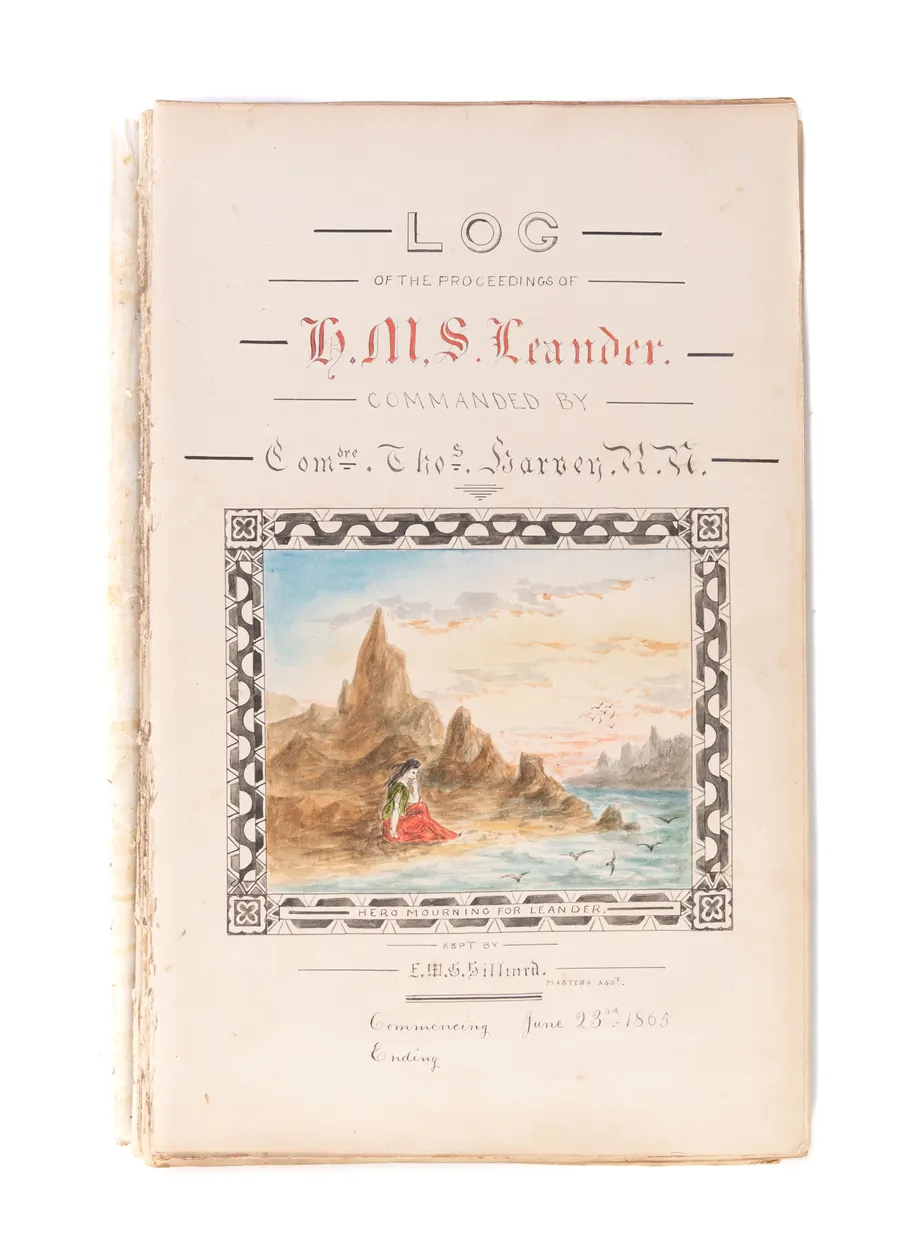
Of all the items I catalogued, the four unbound logs kept by Edwin Hilliard were among my most favourite. Hilliard’s logs spanned from 1862 to 1867 and detail his time aboard the HMS Leander, Lizard, and Formidable, but what makes his logs so interesting are the ninety-one drawings, watercolours, and maps that were thoughtfully tipped-in throughout. Although clearly drawn in another journal or on scraps, the images are matched up to the log, sometimes multiple images overlapping each other, creating a layered visual narrative. The many drawings illustrate Hilliard’s keen eye and contain scenic details of cliffsides, birds, clouds, coastal towns, lighthouses, ships, and icebergs that give them a photographic quality. Some of the drawings are quite small but still manage to capture the sensibilities of a true artist.
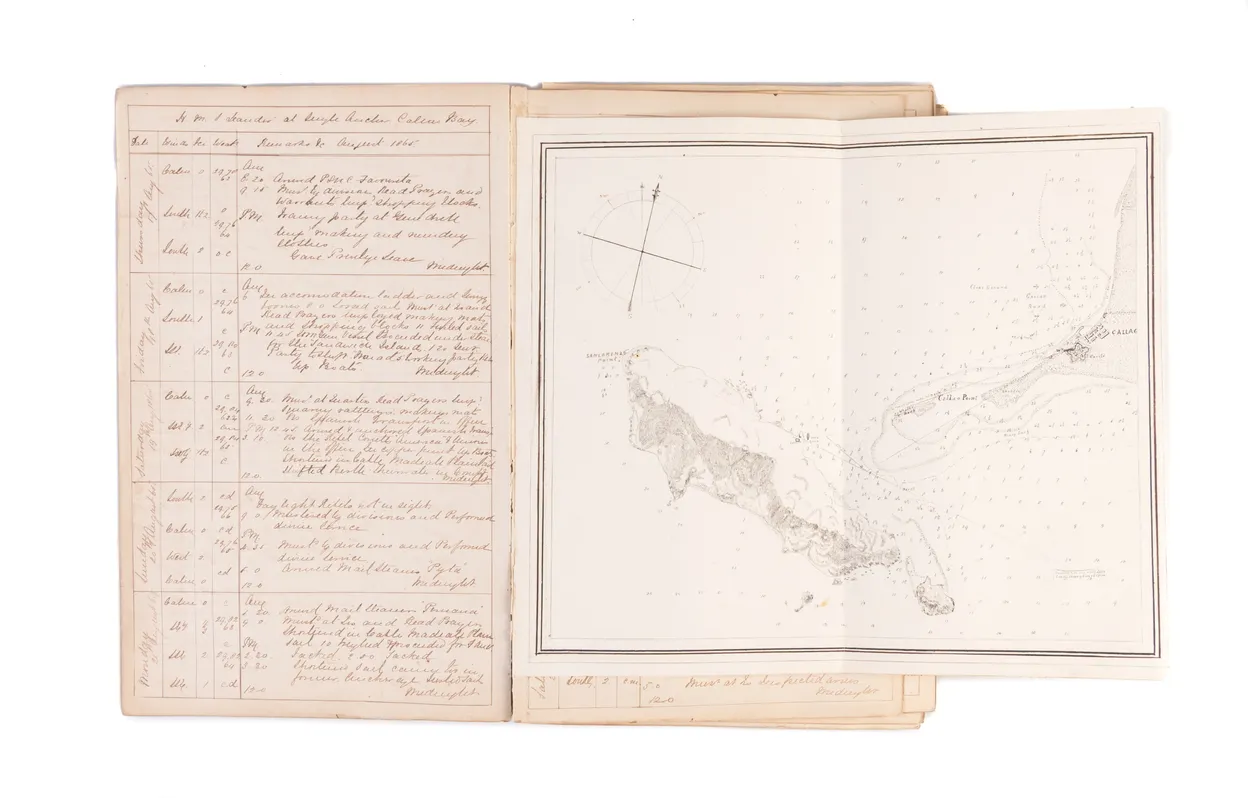
Along with these drawings, many hand-drawn maps add further detail to the journey, including eight folding charts. These maps depict several passages around Cape Horn, a voyage that is still a very treacherous endeavour. The Leander, which passages take up the majority of the logs, was a wooden ship that had been retrofitted with a ‘screw,’ an early form of propeller, so the ship could essentially be under sail or powered. During these early years of steam power, ships such as this were often sailed, using the screw only in times of need. Carefully depicted in these hand drawn tracks, Hilliard has marked which legs were taken under sail or steam, giving detailed insight into these mid-century voyages during a time of significant technological change.
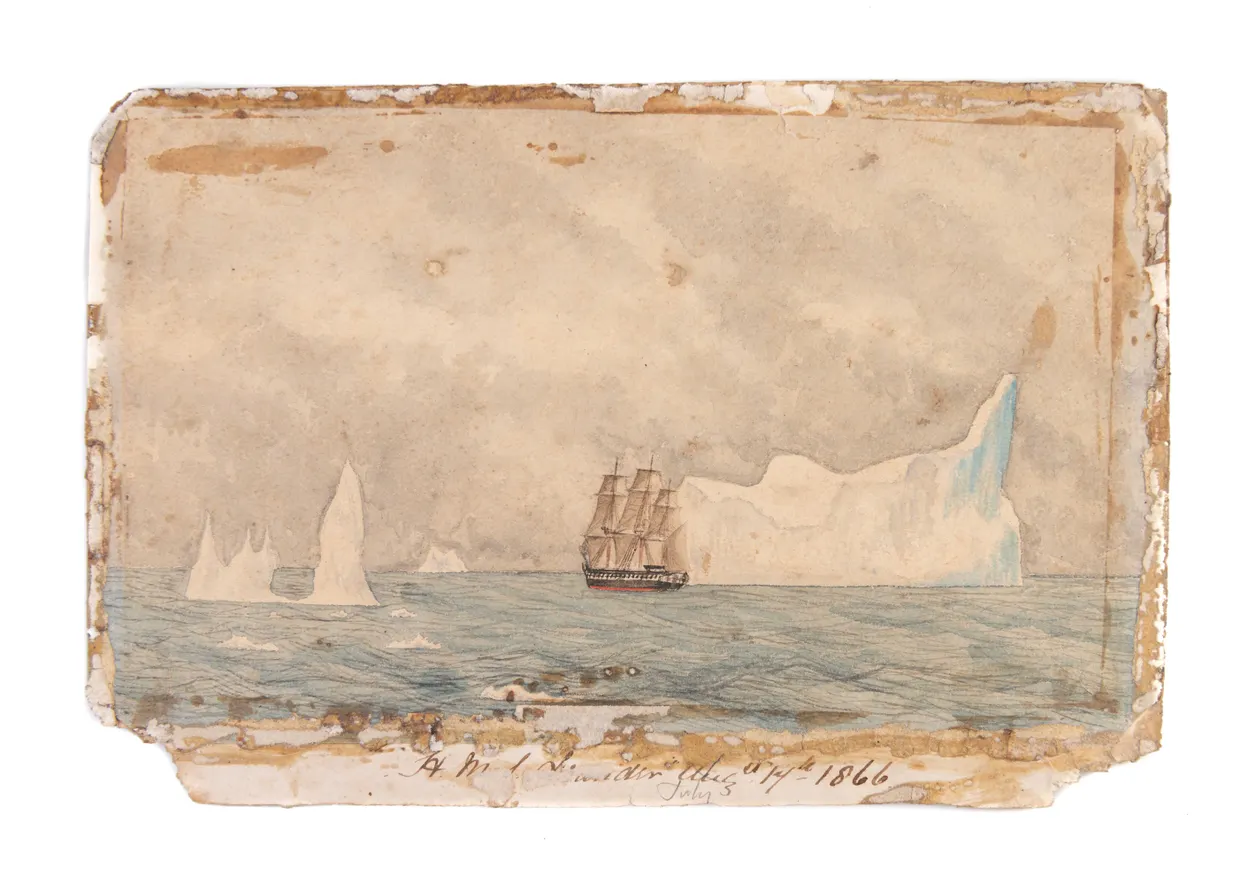
Some of the most beautiful features of this log are the watercolours of icebergs. One loose watercolour shows the Leander under sail, dwarfed by a towering iceberg. The vantage point of this image is from the air, which may at first seem strange, but considering how much time mariners spent aloft in the rigging of their own ships they would have been familiar enough with what the seas and other ships looked like from this perspective to have imagined their own in the same circumstance. Hilliard devotes another page entirely to paintings of icebergs. Here, the watercolours have been cut into circles and pasted onto the page in a stylised layout. In the days long before photography, these images must have been quite a sight for Hilliard’s family and friends.

These manuscripts cover both the visual and the imaginative spaces that exist in nineteenth century maritime journals, their execution displaying only a small portion of the creative endeavours pursued by sailors.
The ability to participate directly in the lives of historical objects is what initially drew me to this type of work and I have found that in addition to my own impact on them they have, unexpectedly, had a great impact on me. Through my internship, as well as my course at IES, I have had the opportunity to handle and engage with many amazing items I would otherwise not have experienced. I often consider what a true privilege it is to be a small stop on the lengthy journey of these treasured books, journals and logs. The opportunity to handle and experience them outside an archive or a museum has been such a pleasure. It is my sincere hope that they find a place where they continue to be treasured and their stories and images may be both admired and protected for future voyagers through maritime history.
And for me, as of this October I am now a full-time bookseller for Maggs, which will hopefully be a lengthy stop in my own personal journey where I get to put my IES training to use and care for each item that comes my way.