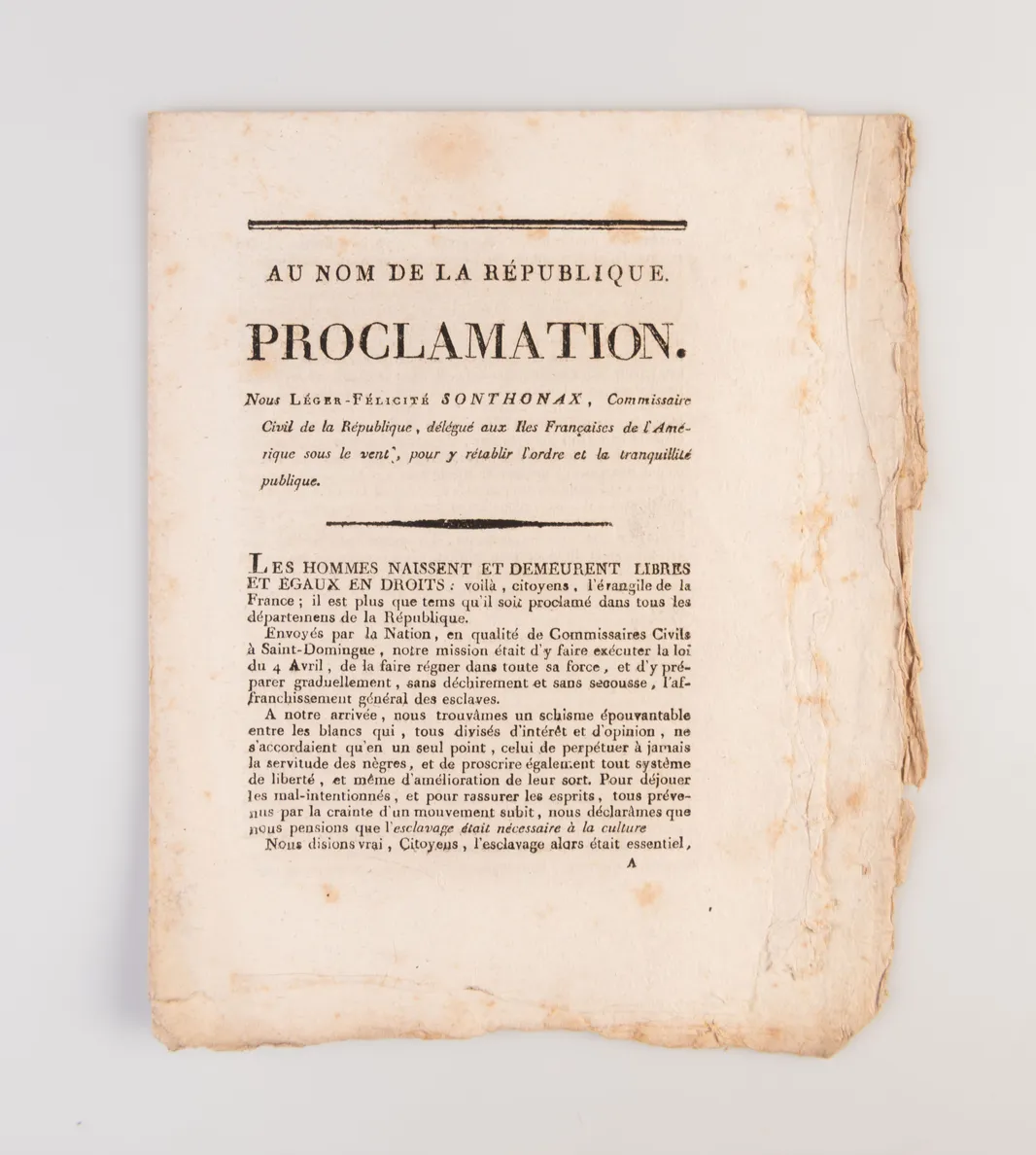
Exceedingly rare: this must be one of the first printings of Sonthonax's abolition proclamation, five months before it was made official. It famously begins, “Les hommes naissent et demeurent libres et egaux en droits: voilà, citoyens, l’évangile de la France; il est plus que tems qu’il soit proclamé dans tous les départemens de la République.” [“Men are born and remain free and equal in rights; this is, citizens, France’s gospel; it is time that it be proclaimed in all departments of the Republic.”]
OCLC records only one copy, located at the BnF, which is incorrectly catalogued as dating to 1794. Before France officially abolished slavery in all of its colonies on 4 February 1794, Sonthonax was forced, in the hopes of winning over the Haitian revolutionaries, to declare slavery abolished in Saint Domingue on 29 August 1793 at Cap-Haïtien (then Cap Français) – the date and place given on this pamphlet. Indeed, it is quite clear from the text that this pamphlet specifically relates only to slavery in Saint Domingue (in spite of the bold proclamation of the beginning sentence), as Sonthonax states that he and others were “envoyés par la Nation, en qualité de Commissaires Civils à Saint-Domingue”. He also states that “Ne croyez cependant pas que la liberté dont vous allez jouir, soit un état de paresse et d’oisiveté. En France, tout le monde est libre, et tout le monde travaille; à Saint-Domingue, soumis aux même lois, vous suivrez le même exemple.” [“Freedom does not mean living in a state of laziness. In France, everyone is free, and everyone works. In Saint Domingue, ruled by the same laws, you will follow the same example.”]
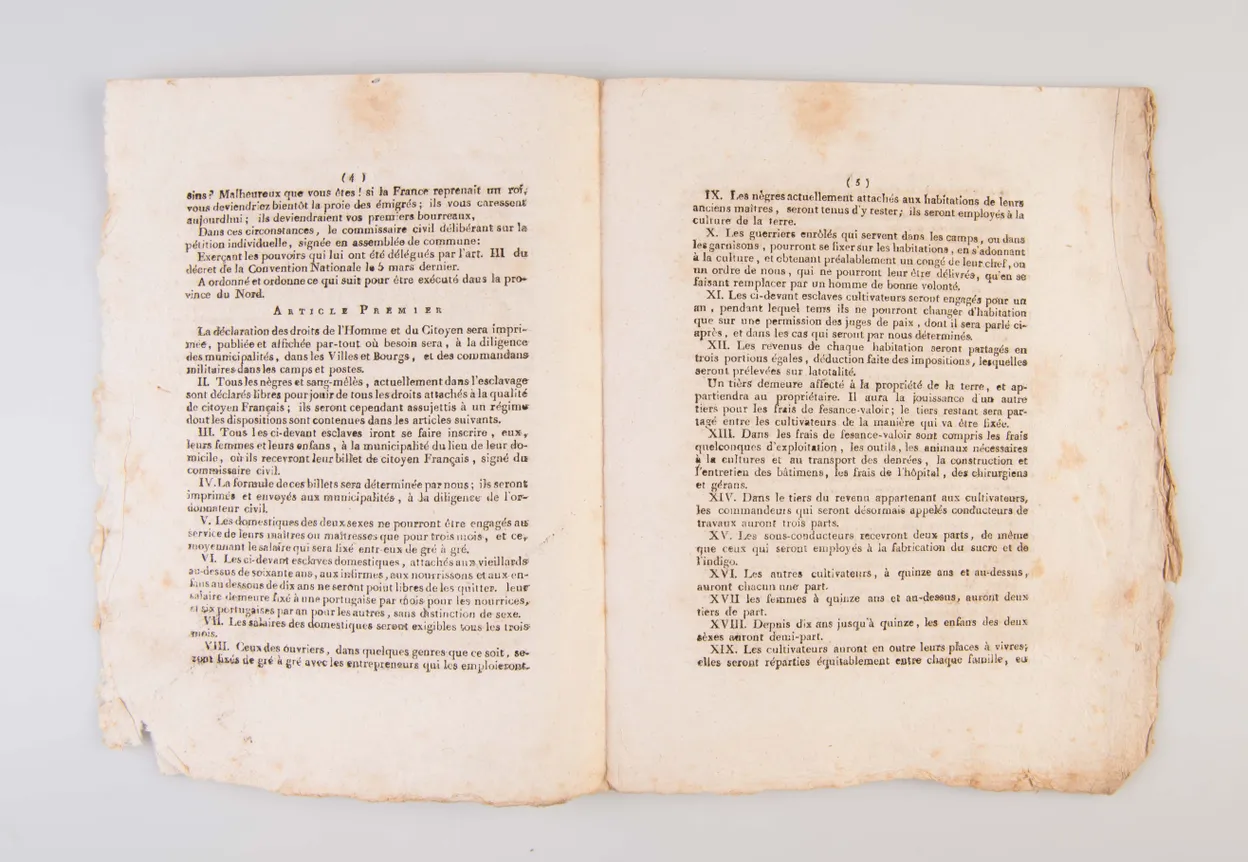
The decree contains 38 articles, the first of which commits to the printing and distribution of the Declaration of the Rights of Man [la déclaration des droits de l'Homme et du Citoyen]. The second article states, "All Black and mixed-people currently in slavery are declared free to enjoy all the rights attached to the status of French citizenship; they will however be subject to a regime whose provisions are contained in the following articles." Article three states that all liberated people are required to register themselves at their town hall so as to receive a certificate of French citizenship.
As the French government was heavily invested in continuing lucrative sugar crops, the remaining articles largely concern labour conditions. For example, in the event that liberated people are hired by their former owners, it can be for no longer than three months for which they must receive a wage. Importantly, employment was mandatory and failure to secure a position was punishable by imprisonment: one month in the first instance, three in the second, and a year's public labour in the third.
Importantly, article 38 states: "Les dipositions du Code Noir demeurent provisoirement abrogées" [the provisions of the Code Noir remain provisionally repealed]. While slavery was abolished in Saint-Domingue in 1794, this article can't help but feel like an omen. Napoleon re-instated it in 1802 so as to better contend with the Haitian Revolution.
This copy of Sonthonax’s decree is somewhat of a mystery, imprint wise. There is no information provided about either the place of printing or the printer; rather, the only date and place provided relate to the timing of the declaration itself. The proclamation was originally printed in both broadside and 4to format by P. Catineau in Cap Français, as attested by copies (in both formats) held by the Johns Carter Brown Library. However, the 4to format one printed by Catineau is collated as 6,[2]pp., whereas the present example is 8pp.
It is likely that the present decree was printed in France for government officials only. This copy was found in the papers of Laurent Jean François Truguet, French minister of the Navy and the Colonies. As Truguet himself never travelled to Saint Domingue, and was working in Paris at the time, it would have been unlikely for him to possess a copy printed in the colony. Given the divided public opinion on the abolition of slavery, as well as Sonthonax’s leading words about the possibility of abolishing slavery in all of France’s colonies, it is likely that the French government did not want the text of the proclamation widely disseminated throughout France. (Aside from the opening lines, Sonthonax also declared that “La République Française veut la liberté et l’égalité entre tous les hommes sans distinction de couleur …”). A small print run by a government printer solely for government officials would explain the scarcity of the present document. This copy of the declaration therefore provides insight into the printing history of the work and speaks to the dissemination of the decree in France.
Jennings, L.C., French Anti-Slavery: The movement for Abolition of Slavery in France, 1802-1848 ... (Cambridge, 2006); Thomas, Hugh, The Slave Trade (London, 2006), p.546.