POPE (Alexander). & GRAY (Thomas) and

Bound volume of five works printed by Guyonne-Elisabeth-Josephe de Montmorency-Laval, Duchesse de Luynes on her private press, including a rare translation of Thomas Gray's Elegy in a Country Church-Yard and Alexander Pope's Windsor Forest.

POETRY BY POPE AND GRAY PRINTED ON A FRENCH ARISTOCRATIC WOMAN'S OWN PRESS

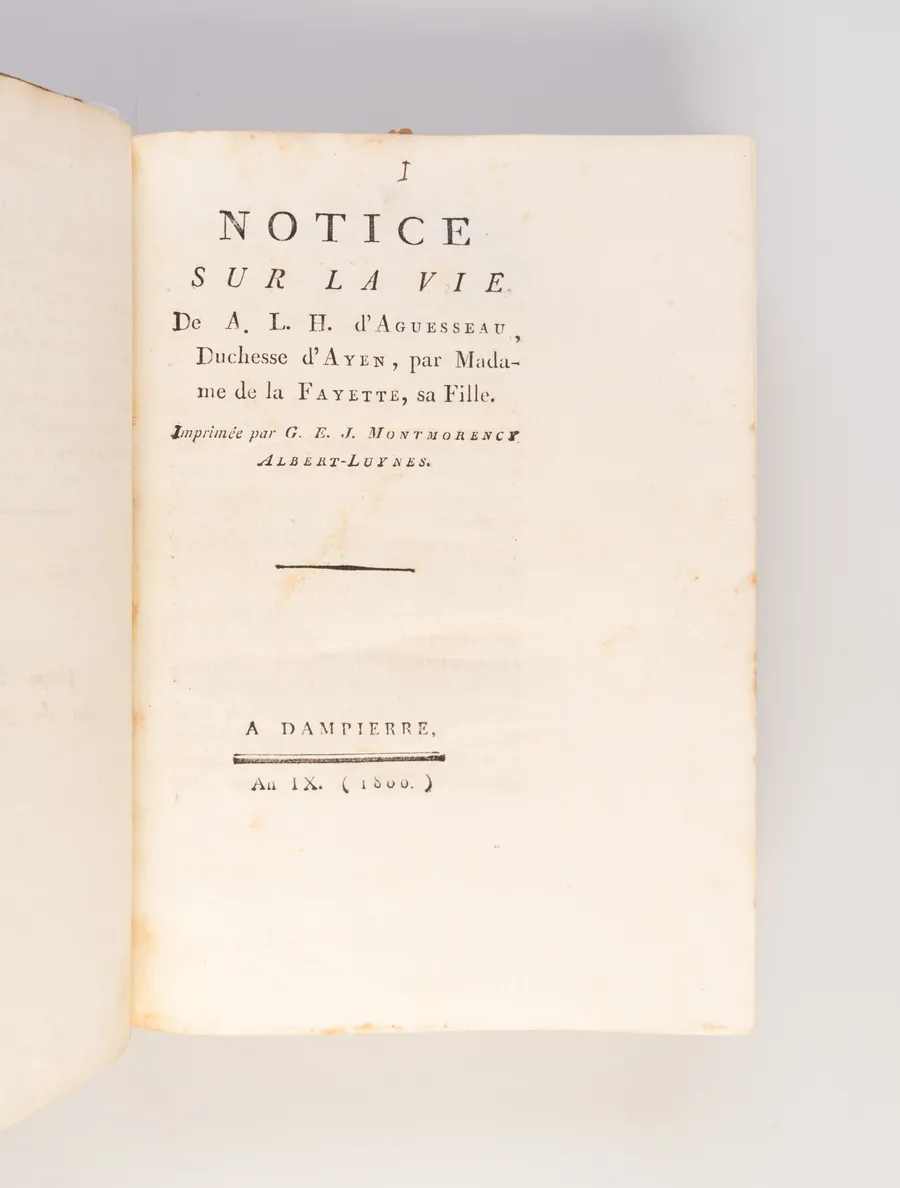
1. LA FAYETTE (Adrienne de Noailles, marquise de). Notice sur la Vie De A. L. H. d'Aguesseau, Duchesse d'Ayen, par Madame de la Fayette, sa Fille. First Edition. 135 pp. Lightly foxed at the edges of a few leaves but otherwise fine. À Dampierre, (An IX), 1800. A short memoir of Anne-Louise-Henriette d’Aguesseau, Duchess of Noailles, Princess of Tingry (1737-1794) who was executed in Paris during the Terror. Written by her daughter, Adrienne de La Fayette (1759-1807).

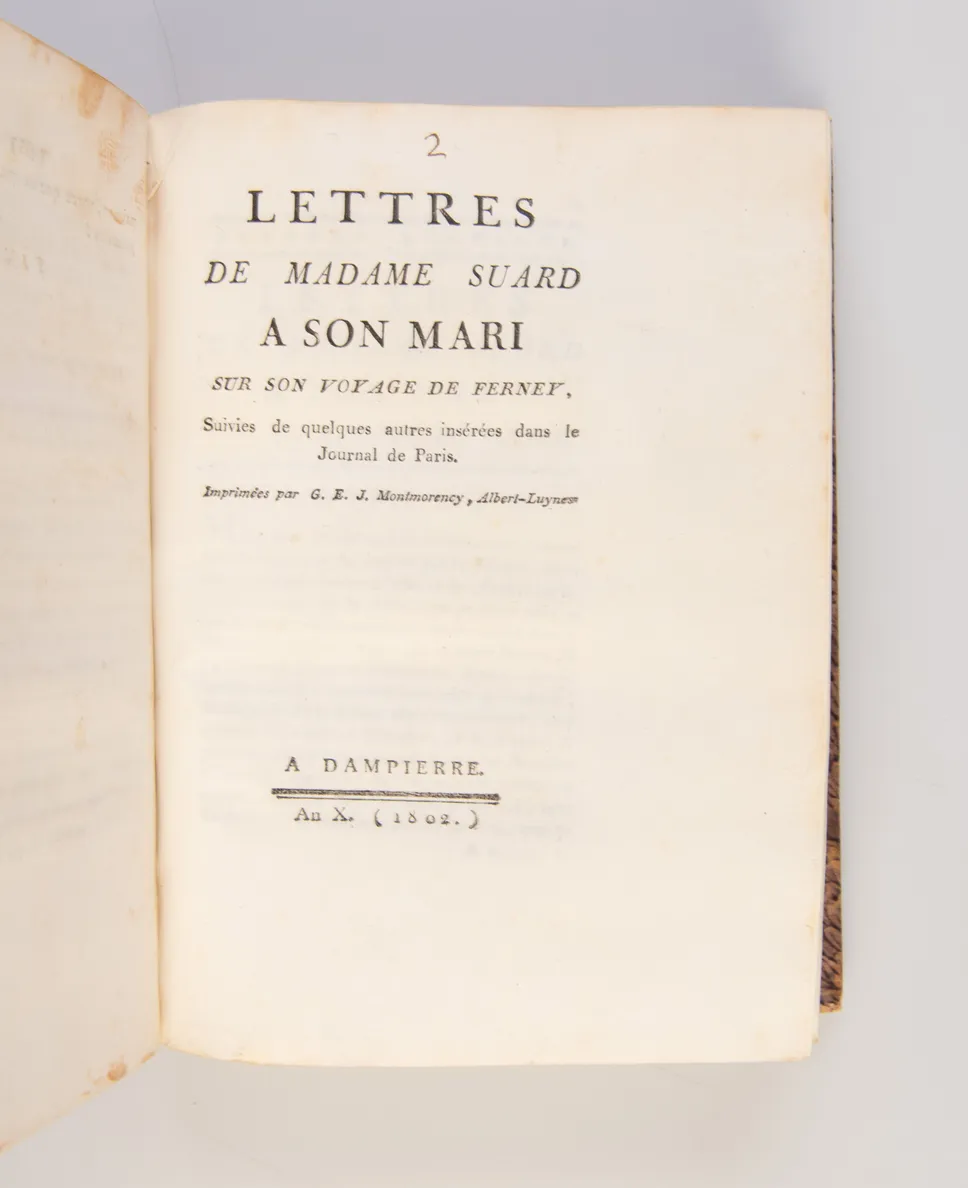
2. Lettres de Madame Suard a Son Mari sur son Voyage de Ferney. 139, [1]pp. A few minor spots but otherwise a very clean and neat copy. A Dampierre, (Year X), 1802. A collection of letters by Amélie Suard (1743-1830) which provide an important insight into the intellectual circles in Paris during and after the Revolution and also include details of her relationship with Voltaire who she had met when she was young and continued to correspond with throughout his life.

3. Recueil de Pièces de Poësie Dêtachêes, A l'usage de quelques Amis habitant la campagne...second partie. À Dampierre, (An X), 1802. COLLATION : A-Z 2A-P4 2Q2: 158 leaves, A2r-A3v paginated iii-vi, A4v-2Q2r paginated 8-307, [T. de Luynes p. 45, the first part had been published in 1800]. A collection of poetry to be enjoyed in the countryside.

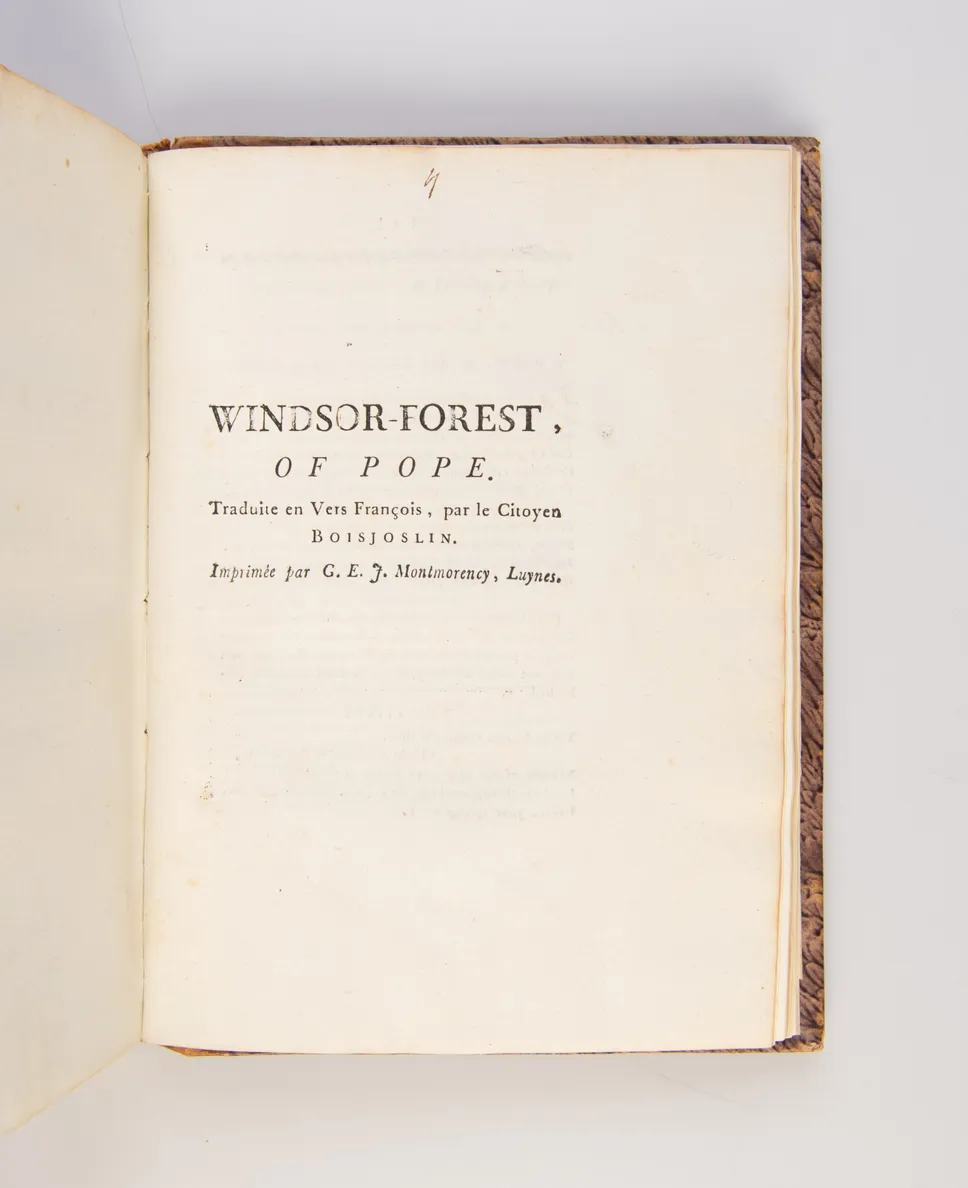
4. [POPE (Alexander)]. Windsor-Forest of Pope. Traduite en Vers François par le Citoyen Boisjoslin. First Edition thus. 47pp. A few small spots in places but otherwise fine. Imprimée par G. E. J Montmorency, Luynes [s. l. n. d.]. A translation of Pope's poem by Jacques-François-Marie Vieilh de Boisjoslin (1760-1841).

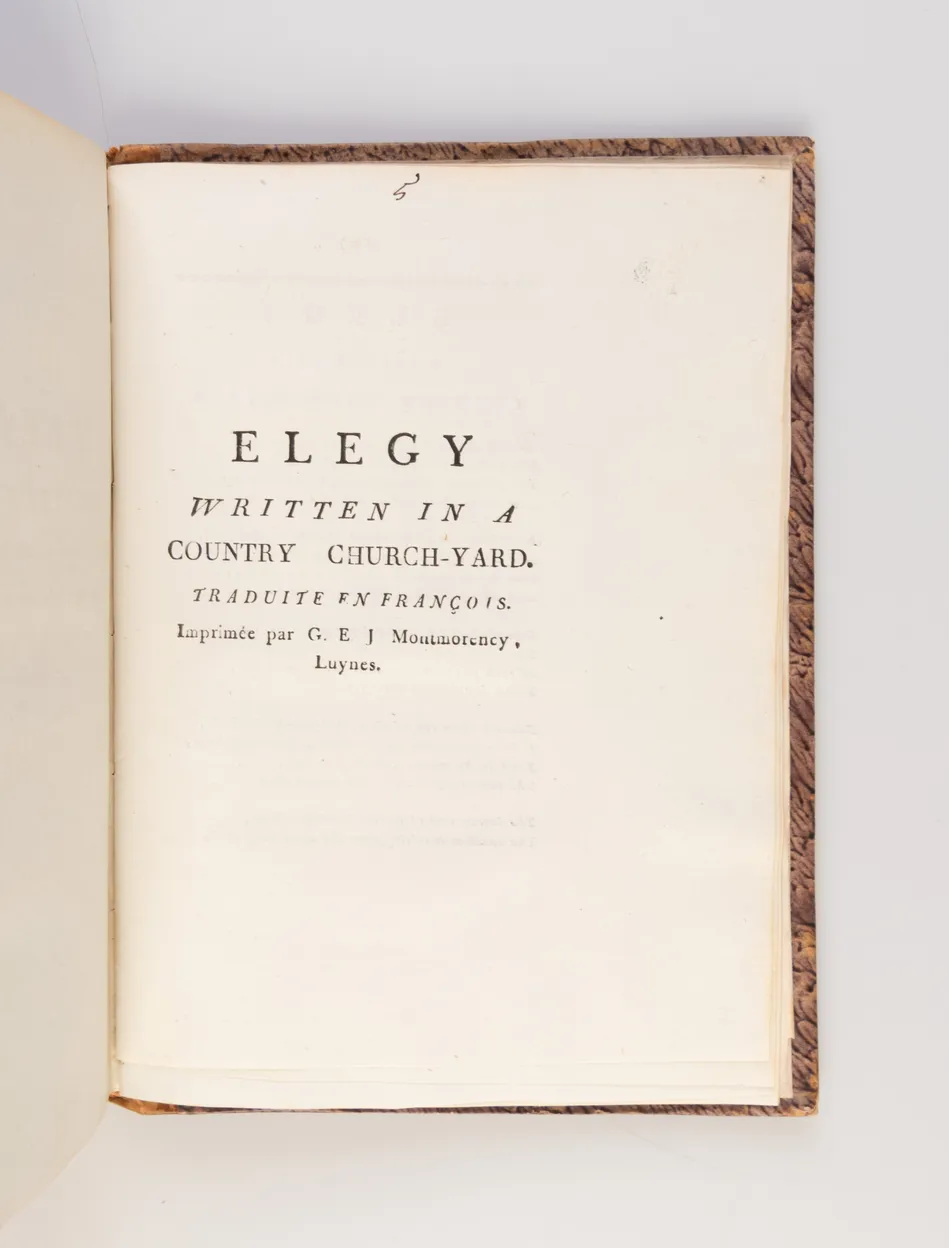
5. [GRAY (Thomas)]. Elegy written in a Country Church-Yard. Traduite en François. [Dampierre], Printed by G. E. J. Montmorency-Luynes, [n.d., but 1797]. 13, [1, blank]pp. A very clean copy. English text with facing-page translation into French.

[Bound at the end]: Large folding engraved plan of the Chamber of Deputies for the session of 1819-1820.

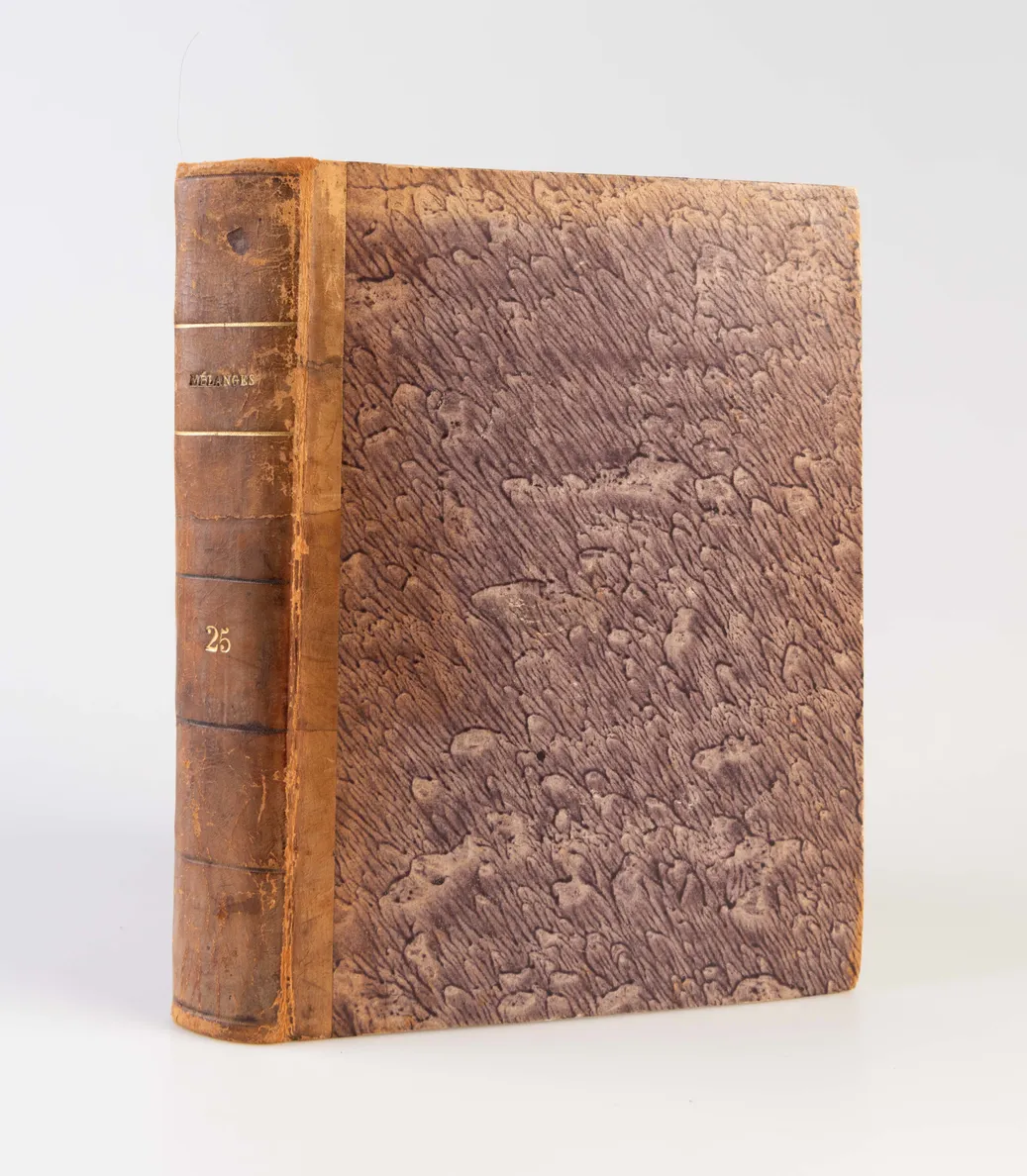
Binding: Early 19th-century French half sheep over marbled boards, smooth spine ruled and lettered ["MÉLANGES" / 25"] in gilt, yellow edges, plain endpapers (edges a little rubbed but otherwise a very neat volume).
£25,000
On Hold
Enquire
POPE (Alexander). & GRAY (Thomas) and
Bound volume of five works printed by Guyonne-Elisabeth-Josephe de Montmorency-Laval, Duchesse de Luynes on her private press, including a rare translation of Thomas Gray's Elegy in a Country Church-Yard and Alexander Pope's Windsor Forest.

A remarkable volume of works printed by Guyonne-Elisabeth-Josephe de Montmorency-Laval, Duchesse de Luynes (1755-1830) on her own press at her home, the Château de Dampierre (South West of Paris, just over 10 miles away from Versailles). The five works collected here include a printing of Thomas Gray's famous Elegy in a Country Church-Yard (with facing-page translation into French), Alexander Pope's Windsor Forest

"The events of the revolution in France, which compelled so many of the aristocracy to become emigrés, persuaded the Duc de Luynes that it would be wise to retire to the country, and he and his wife and family spent the troubled years of the 1790s living quietly and discreetly at the Château de Dampierre. His wife, Guyonne de Montmorency-Laval, had at court been a lady-in-waiting to Marie-Antoinette; a post for which she seems to have been singularly ill-suited she was something of a blue-stocking and in addition was a strong masculine character who always dressed in an extraordinarily unfashionable manner, and at times in men's clothes - and which she disliked heartily. Country life must have wearied her, and when in company with Madame Récamier she visited the printing house of Ballanche, she was unable to restrain her enthusiasm. Hoisting up her skirts, she set herself before a case of type and quickly and accurately set up a passage, to the amazement and admiration (so we are told) of all the workmen. She had found the ideal hobby. A press and equipment were quickly installed at Dampierre, and in 1797 the first book from the press was issued: Robinson Cruse, with an interlinear French translation by the Duchesse, From then until 1810 a steady stream of books came from the press— translations of Gray's Elegy, of the life of Dean Swift, anthologies of verse 'for the use of friends living in the country", and many others. The Duchesse appears to have done most of the typesetting and presswork, as well as editing the texts herself. But she was not interested in binding, and the books were sewn into paper covers by an Irish lady. Mme Felz, who lived at the Château. In 1810, however, an imperial decree by Napoleon forbade all such private presses, and the Duchesse was compelled to abandon her hobby. Instead of printing she devoted herself to writing, and more than forty volumes of her manuscripts survive" (Roderick Cave, The Private Press (1971) p.59).

The printing work of Mme. De Montmorency deserves far more scholarly attention. The press at Dampierre has been discussed by Roderick Cave but this information was mostly based on a 19th-century article in Le Livre. Little else has been written about an extraordinary woman who seems to have found her calling as a printer and produced some of the most unusual books of the 18th and early 19th-century.

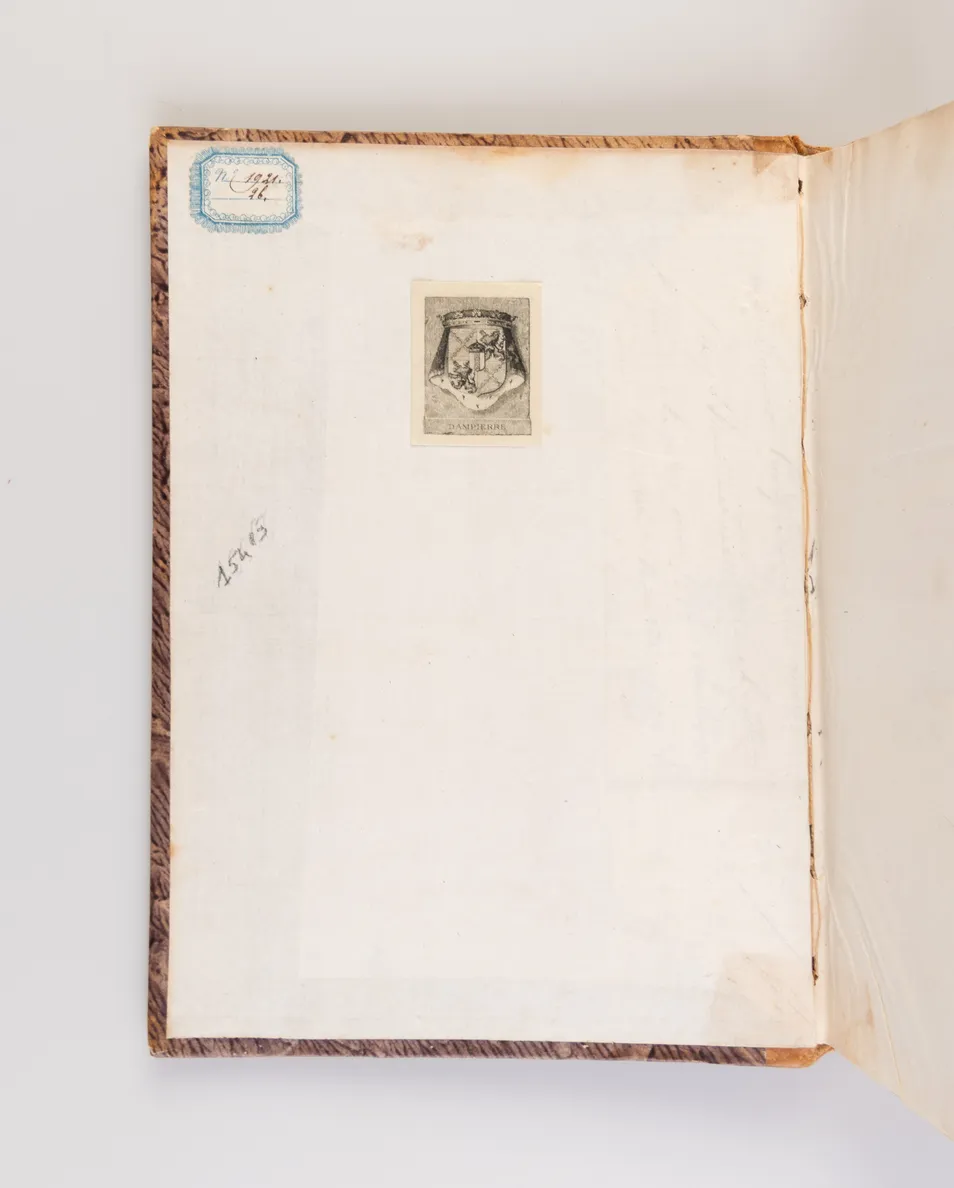
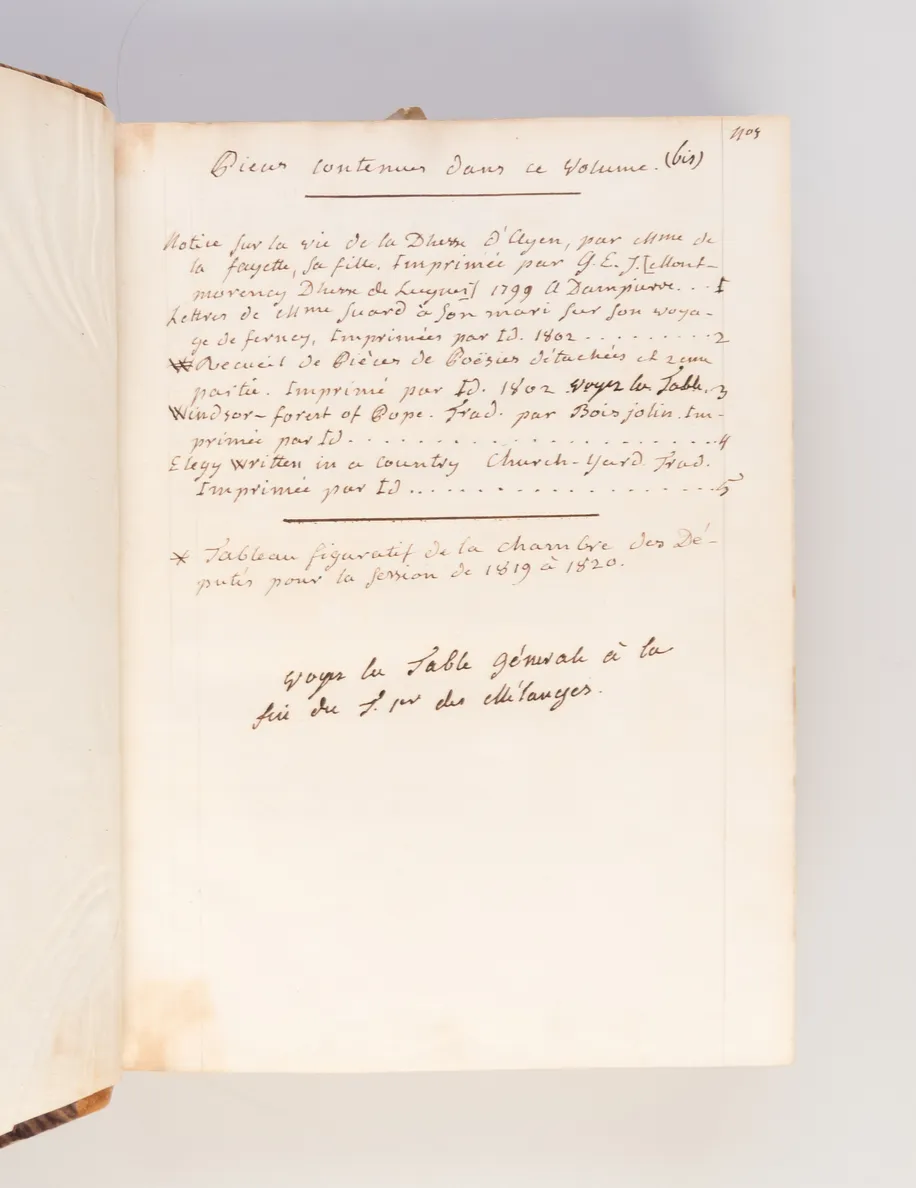
Provenance: Château de Dampierre, small armorial book label on the front pastedown and a printed shelf label completed in manuscript. Manuscript table of contents before the printed works which may well be in the hand of the Duchess.

Stock No.
258271
Mailing List

Mailing List

Be the first to receive catalogues, short lists and news from our booksellers
Subscribe