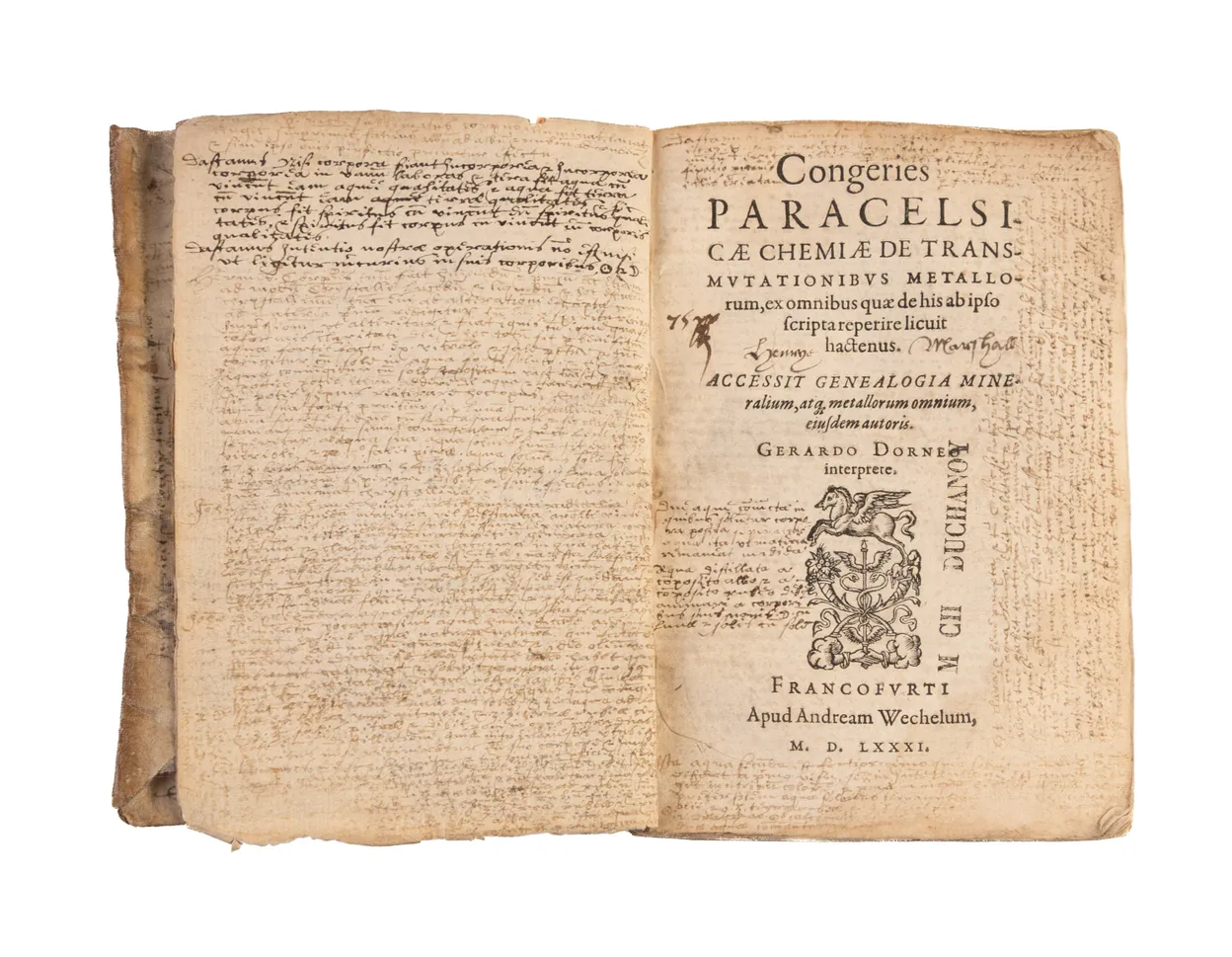
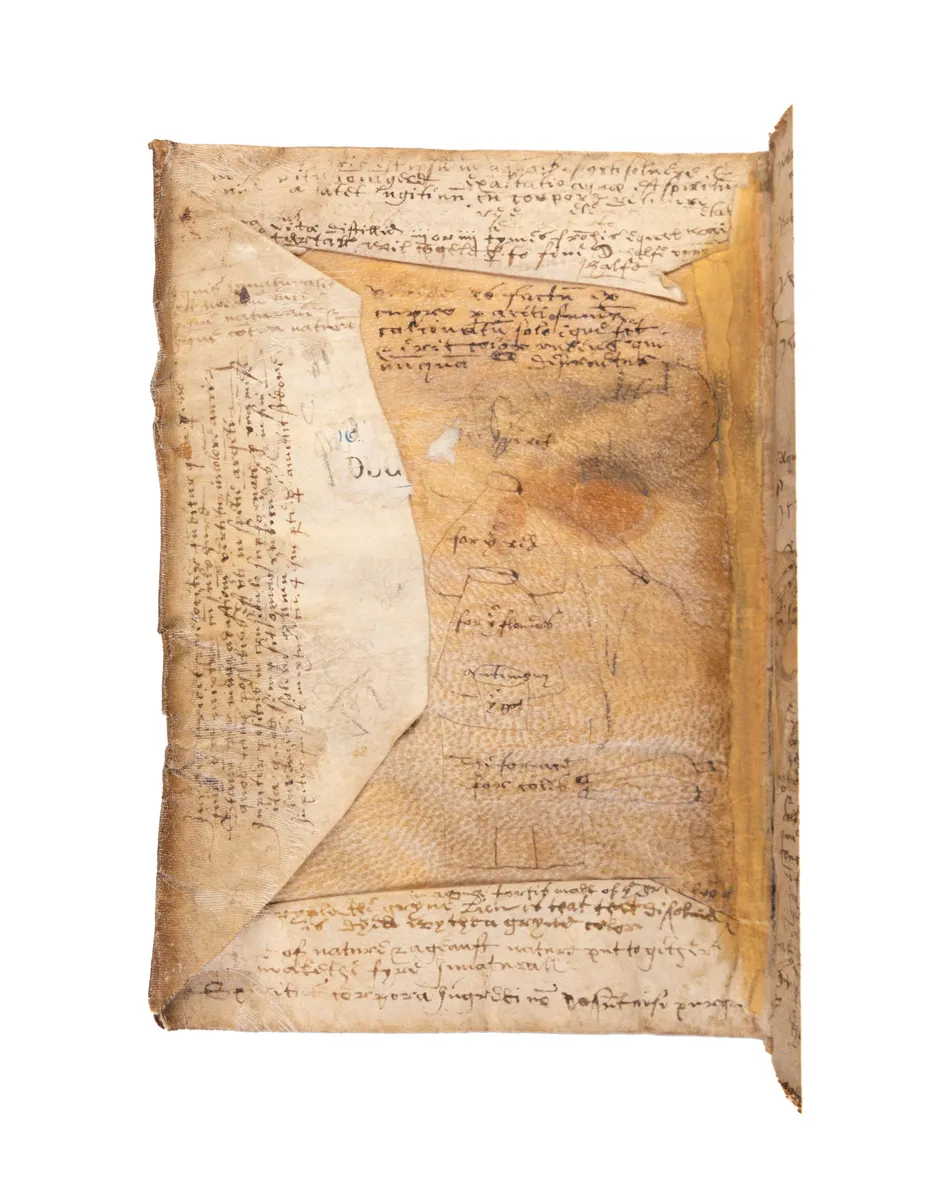
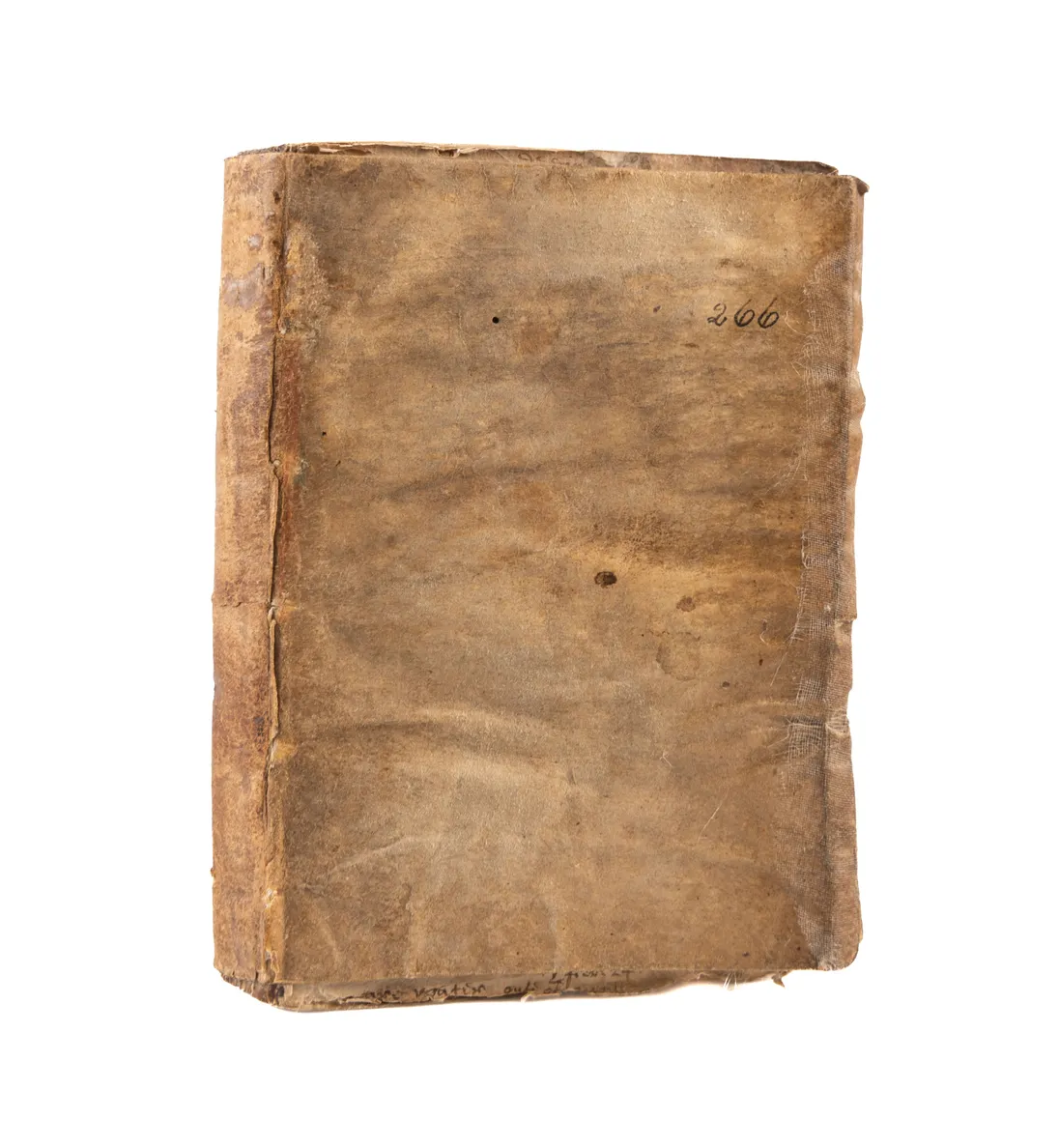
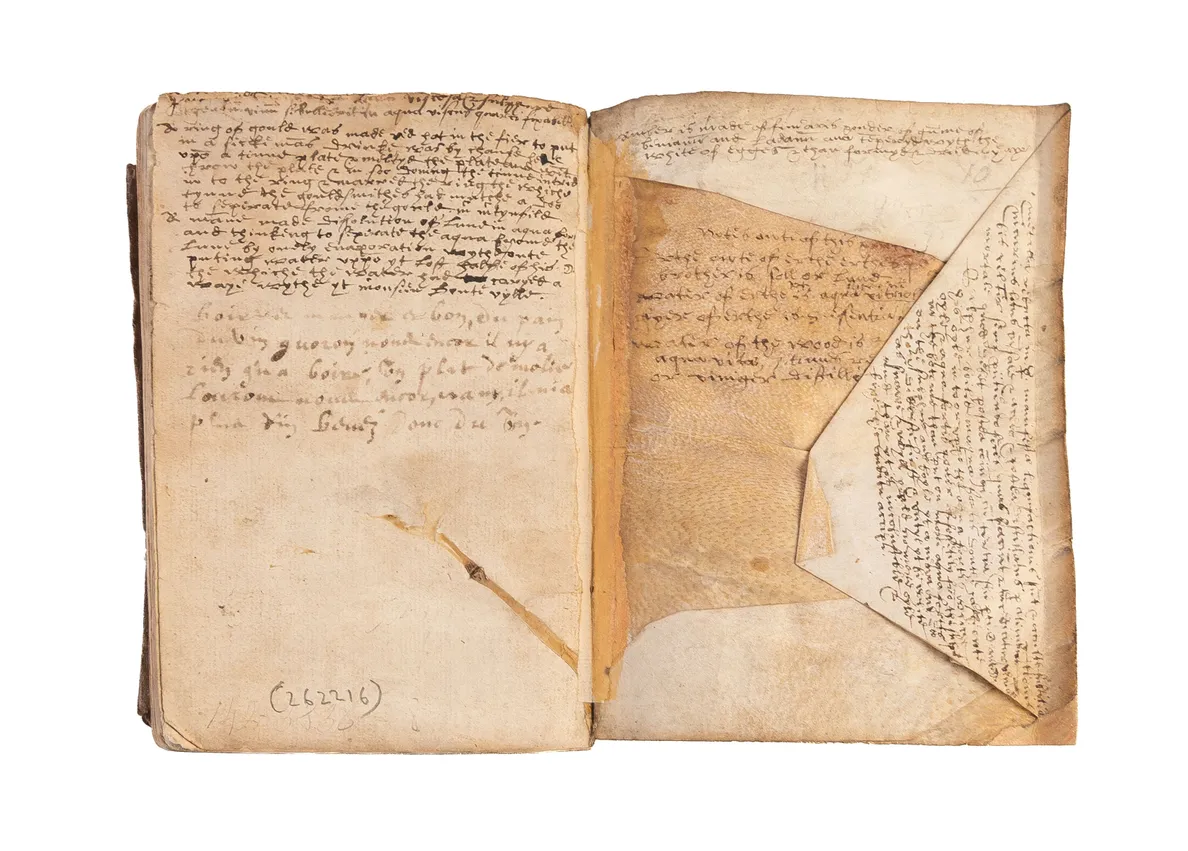
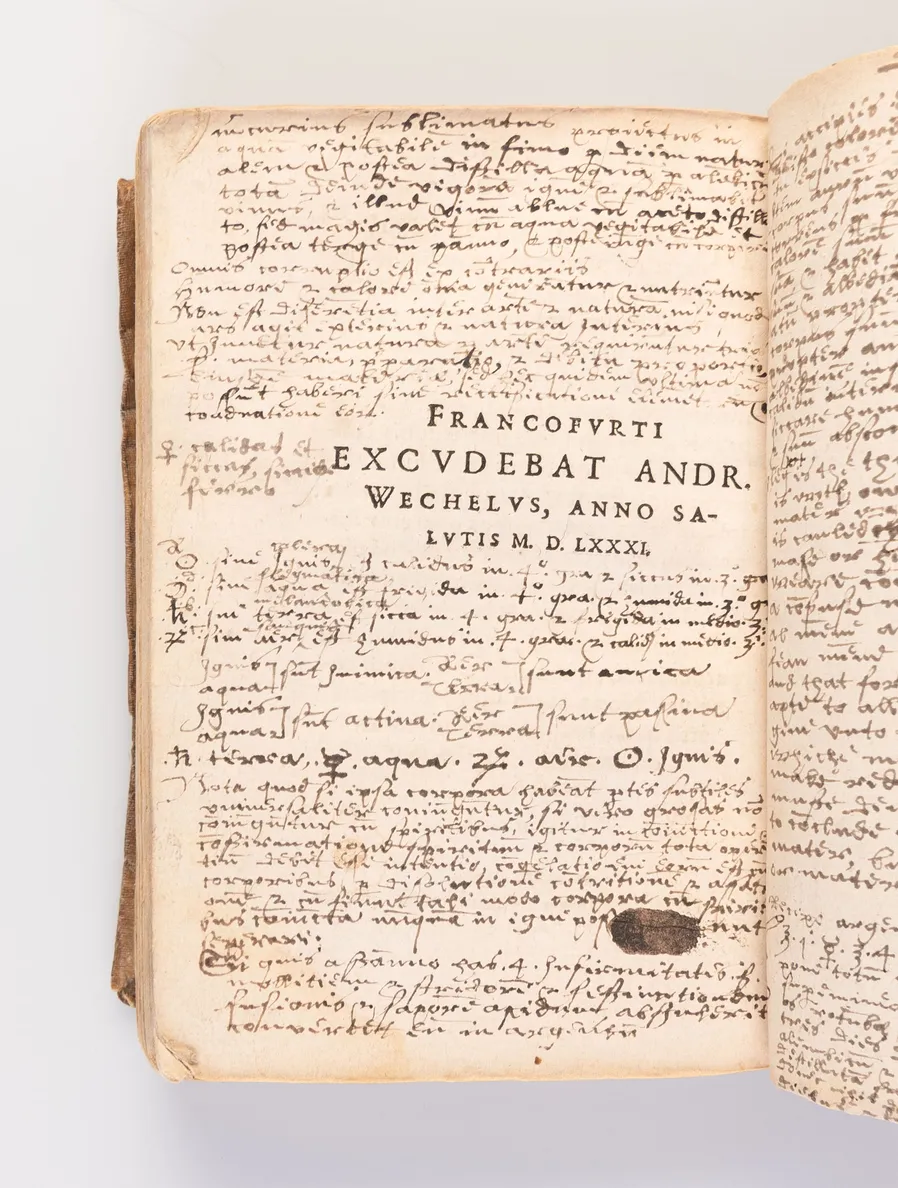
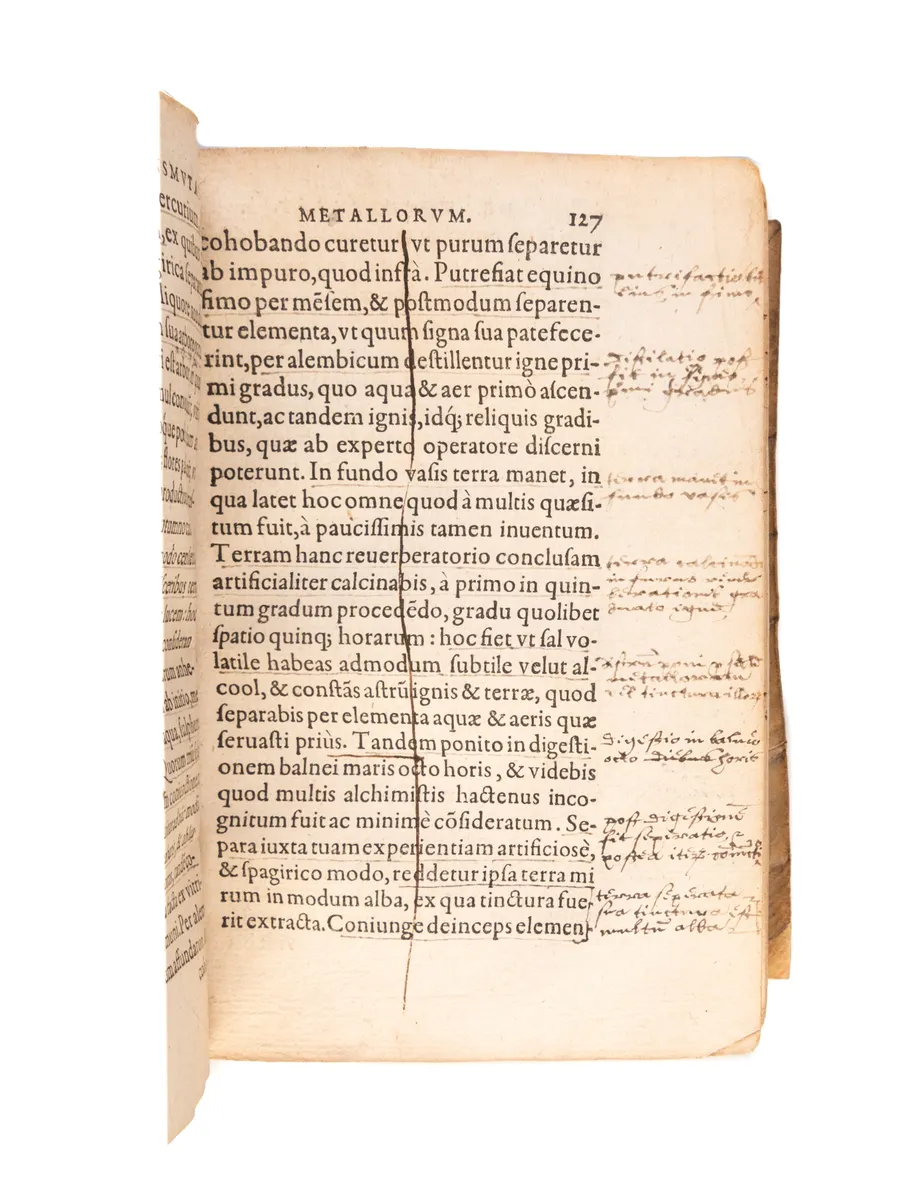
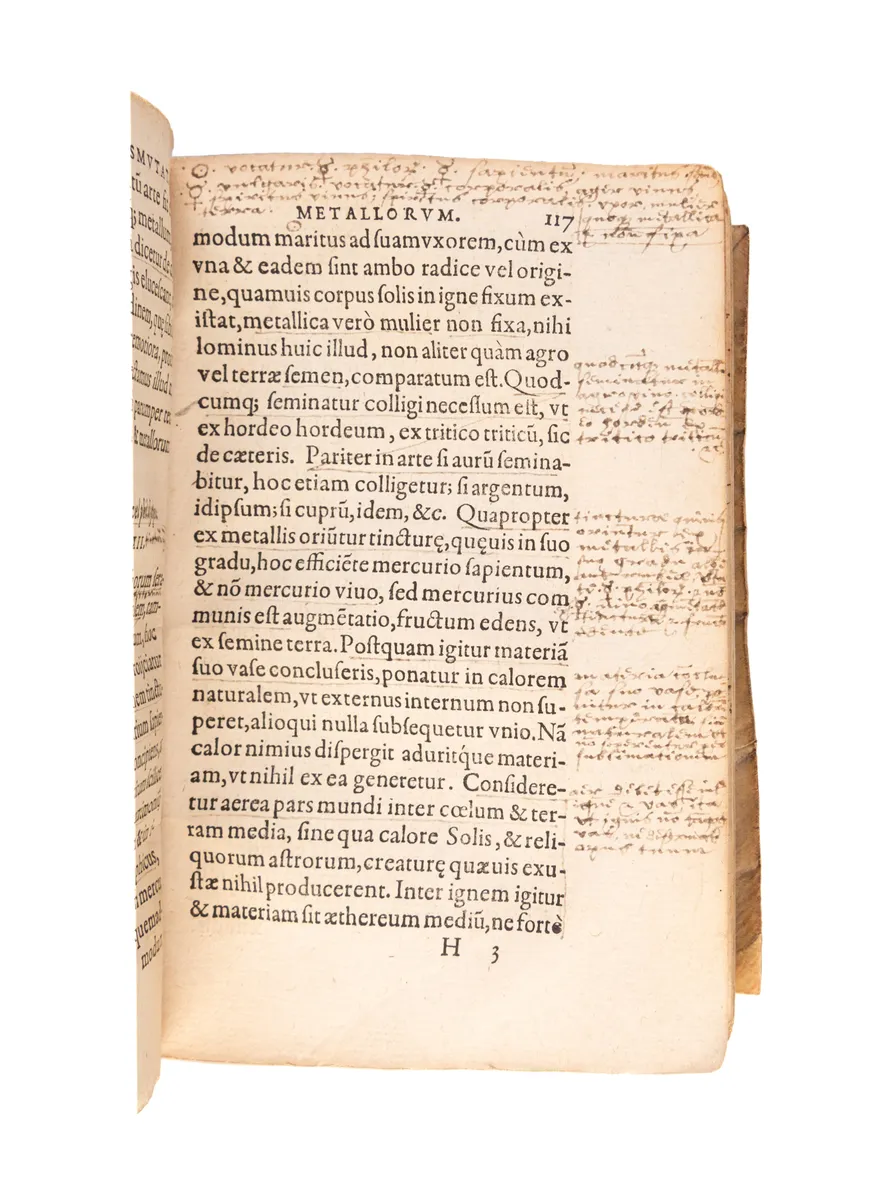
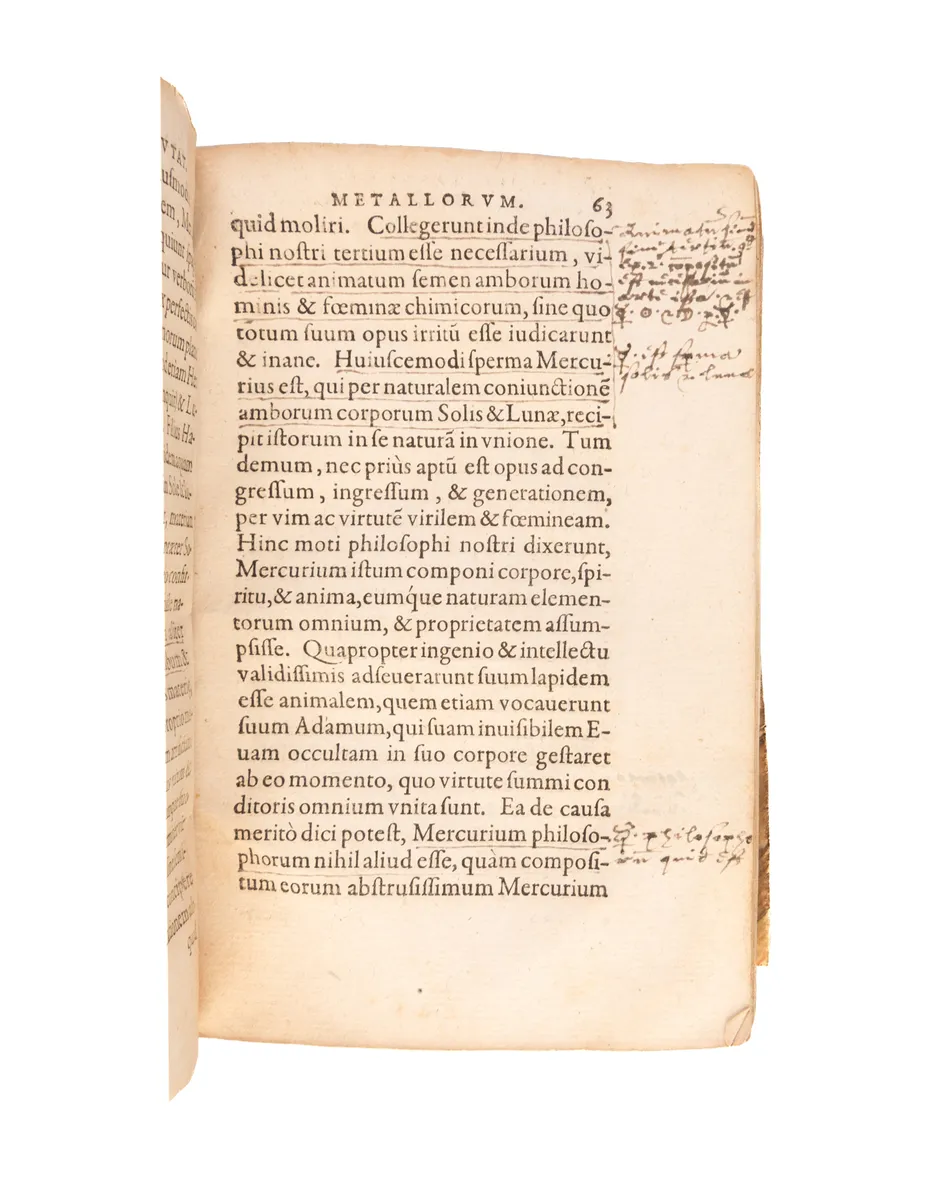
A fascinating copy of the first edition of Gerard Dorn’s selections of Paracelsus’ On the transmutation of metals; extensively annotated by an amateur alchemist in Latin and English in the margins, filling the flyleaves and even the vellum folds of the binding, and with an annotated drawing of metallurgical/(al)chemical apparatus to the inside of the upper cover.
The two front fly-leaves, the title-page (and its blank verso) and four and a half pages at the end and the inside of the vellum binding (including folds), are covered in closely-written notes in a small, cramped hand in both Latin and English - in places, switching between the two in the same sentence. Of particular note is the diagram drawn on the inside of the upper vellum cover of equipment for what looks like fire assaying, a metallurgical process used during the Renaissance - and still - to determine the purity and presence of particular metals in a given substance, most frequently used to check for noble metals like gold and silver (Martinon-Thores, Rehren). Accordingly here are drawn the square furnace, at the bottom, with bellows; a cup-like vessel, likely an assaying cupel on top of it; what look like aludels, subliming pots that are open at top and bottom to be fitted together and stacked; and at the top a retort, used for the distillation of substances. Each element of the diagram is annotated with its function - 'for ye...' - including 'for ye gol.', possibly gold, in the cupel above the furnace.
'During the Renaissance, what we nowadays call alchemy and chemistry constituted a single, all-inclusive sphere of activity that involved the routine conduct of fire assays ... it is often impossible - and inappropriate - to separate one sphere of activity [alchemy/chemistry] from the other [metallurgy] given their strong intertwining in this period' (Martinon-Thores, Rehren). The notes that fill the blank leaves and margins following this diagram are further evidence of this intertwining, combining interest in (al)chemical processes and metallurgical ones, and even astronomy and astrology: 'the eclypse of the sonne comethe --- in the newe monne, and the eclypse of the monne in the fll monne'. In the margins of the text, repeated use is made of the planetary symbol for Mercury (e.g. p. 63-65), and occasional use of other symbols for the sun and moon, Jupiter and Saturn (e.g. below colophon).
To the verso of the front flyleaf is a detailed recipe for the 'transformation' of copper: "...arsenico sublimato et sex de mercurio, et septem vel octo de argento puro, et sex de cupro nudo/mudo redactibus in limaturam, et solvatur quodlibet illorum in phiala per se et separata sect a metallibus coniungante simul cum aqua in cucubita, et distilletur aqua quatuor vel quinque per omnia clandendo vas, ut fumino. Custodiatur; et infra sexdecem septimanabus perficietur bona medisima ad transmutandum cuprum utum purum': '...of sublimed arsenic and six of mercury, and seven or eight of pure silver, and six of bare/dull copper reduced to filings, and each of them is dissolved in a phial by itself and separated from the metals, combined together with water in a cucubita, and the water is distilled four or five times through all the vessels, closing them as with a fume hood. It is kept, and within sixteen weeks the best medium for transforming pure copper will be completed.' On the rear flyleaves are, among other things, a recipe for aquafortis - nitric acid - and a tantalising reference to the making of gold; 'A ring of gould was made...'.
The annotator appears to be enthusiastic and knowledgeable. There are frequent underlinings and occasional crossing through of text (e.g. pp. 127 & 130), and notes in the text itself abound, in: the preface to the reader (pp.1-29); chapters 1 (De scala transmutationis), 2 (De simplici chimicorum igne), 6 (De subiecto vel materia philosophica in genere), 7 (De variis in inquisitione materiae balsami perpetui), 8 (De praeparatione materiae spagiricae in genere), 9 (De proportione materiae & formae spagirici lapidis), 10 (De tincturis & spiritibus metallorum, & primo de tinctura solis) 11 (De specialibus praeparationibus materiae lapidis) 12 (De matrimonio spagirici vel philosophici lapidis), 13 (De alio ad lapidem processu per Paracelsum; heavily annotated), 14 (De quarto ad lapidem Paracelsico processu) and 15 (De quinto lapidis processu brevissimo).
Who the annotator is is unclear, though 'Henry Marshall' is inscribed in a contemporary (c.1600) hand to the title page. There was a Henry Marshall in the later sixteenth century who wrote to William Cecil, Lord Burghley in 1595 advertising his military inventions: ‘an engine whereby the walls of annye town or castle may be defended from the force of anye canon; an engine which shall breake the araye of anye battell being ready to joyne’ (Ms. Lands. 101, Art. 16. Orig., from Halliwell-Phillipps). The experimental nature of the annotations here might point to this Henry Marshall and Cecil's correspondent being one and the same.
Although it was as a medical man and pharmacist making clever use of natural remedies that Paracelsus had been active and successful, it was for his chemical or alchemical activities that his reputation blossomed. The editor of this collection, Gerard Dorn (1530-84) is said to have been born in Mechelen, and was one of the most industrious Paracelsists through his Latin translations - published from the 1560s onwards - and his own works such as his Clavis totius philosophiae chymisticae (Lyon, Giunta heirs, 1566). Some of his writing was also included by Zetzner in his Theatrum chemicum.
Provenance**:** contemporary (c. 1600) inscription of Henry Marshall on title-page. Early 19th century stamp of M. Ch Duchanoy (fly-leaf and title); possibly [Claude François] Duchanoy (1742-1827), French doctor and surgeon (M[aître? Magister]] CH[irurgie?; Chirurgiae?]] and possessor of property in Puteaux, which included a substantial library of 700 volumes (inventoried after his death).
Front free endpaper with old paper repair and small loss, also strengthened at inner edge.
VD16 P435. Duveen, 178. Ferguson 1. 221. Sudhoff, K. Bibliographia Paracelsica I, No. 186.
Marcos Martinon-Torres, Thilo Rehren, ‘Alchemy, chemistry and metallurgy in Renaissance Europe: a wider context for fire-assay remains’, Historical Metallurgy 39(1) (2005), pp.14–28. J.O. Halliwell-Phillipps, A Collection of Letters Illustrative of the Progress of Science in England 1841*,* p. 37. See also H. Dircks, The Life, Times and Scientific Labours of the second Marquis of Worcester… (Quaritch, 1865), p.362. Text of letter cited in K. Maynard, 'Science in Early English Literature 1550-1650', Isis 17.1 (1932), pp.94-126.