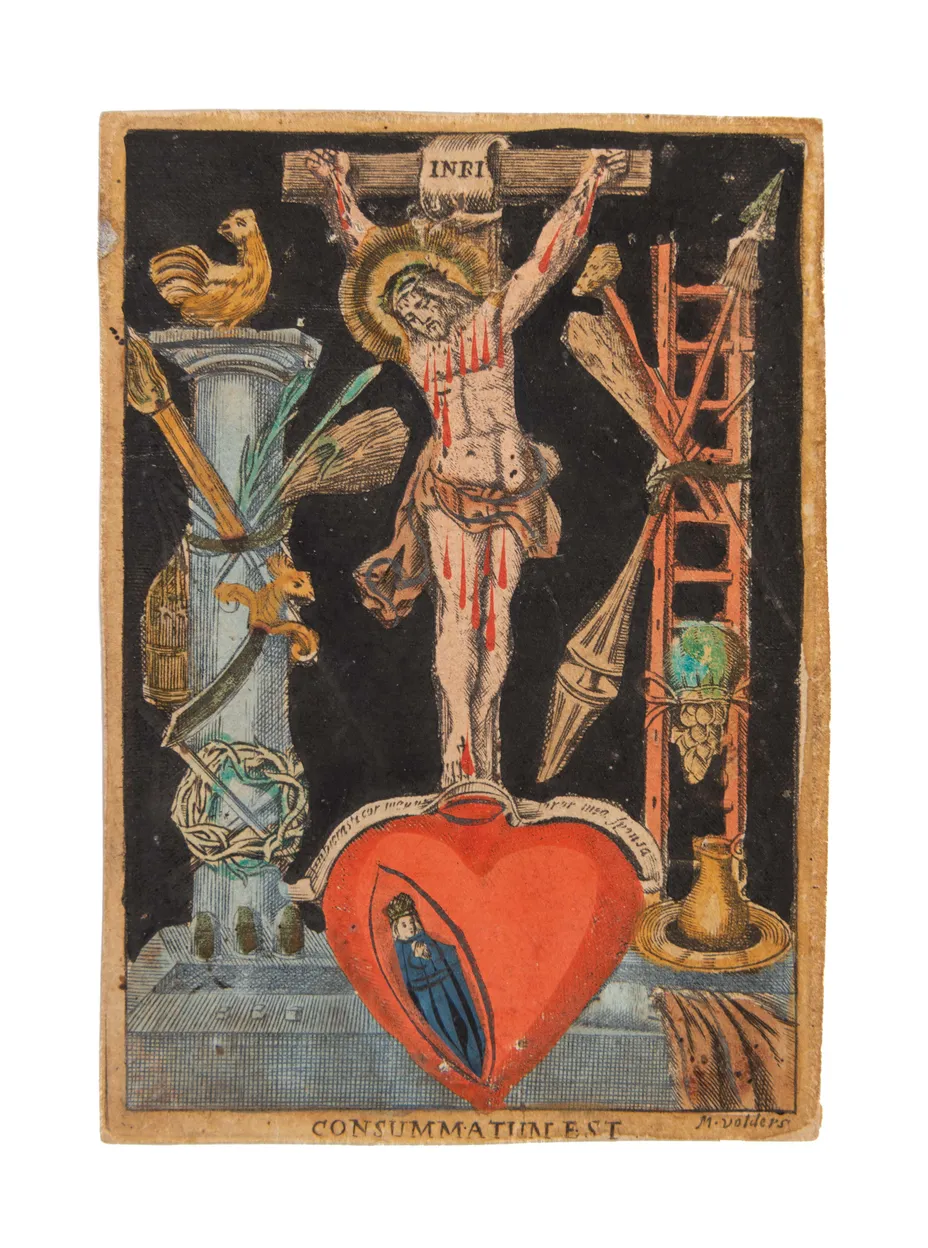
A striking devotional print in vibrant, if clumsy early hand colour by the little-known female engraver, Maria Volders (1669-99) whose signature, 'M. Volders' is visible at the foot of the plate.
The central figure of Christ crucified is surrounded by the Instruments of the Passion, above the Sacred Heart in vibrant red, the lance wound inhabited by a female figure, likely the Virgin Mary from her crown and blue mantle. The text around the heart is 'vulnerasti cor meum, soror mea, sponsa' from the Song of Songs (4:9), 'you have wounded my heart, my sister, my spouse'; beneath, 'Consummatum est', Christ's last words on the Cross (John, 19:30), 'it is finished', 'it is fulfilled'. It appears to be a copy of print produced by 'celebrity' Antwerp engraver Michel Cabbaey (1660-1722).
Little is known of Dutch engraver Maria Volders, though she is frequently named alongside other, better-known women engravers of the Low Countries like Isabella Herstens and Susanna Verbruggen, and there are examples of her work recorded elsewhere: of St Theresa of Avila, St Francis, and, at the Ruusbroec Institute in Antwerp, Jesus in the Olive garden, among others. Emile van Heurck adds further engravings of saints Eugenie, Bernard, Benoit, Robert and St Catherine; the seven joyful mysteries of the Virgin; Notre Dame de Bon Succes, and Notre Dame de Montaigu; and the present crucifixion scene, though this is the only record of it that we have been able to find.
Volders was admitted as master of the Guild of St Luke in Antwerp, which regulated the trade in and production of arts in the city, in 1688, at the age of just 19. The participation of women in the print trade in the Low Countries in the seventeenth century - as engravers, printers and colorists - is well-documented. It was formalised in Antwerp; Volders' membership of the Guild of St Luke is representative of a system in which women, both young and old, and widows, were contracted to colour and sell images like this one (van Heurck).
Prints such as this one functioned as talismans for private devotion, to be either held or displayed; holes at the head and foot of this print suggest that it was once pinned up. Between the seventeenth and nineteenth centuries they had many other functions: given as souvenirs of first communion, and as prizes at school; pasted to doors in plague years as a ward against infection (specifically St Rosalia); and rather poignantly, in Mons, cut in half and used to identify children given up by their parents to orphanages and religious institutions, with half kept with the child, and half taken by the parent, which would create a whole image when they were reunited (van Heurck).
Remnants of paper pasted to verso, pin pricks at head and foot, but excellent condition.
E H. van Heurck, 'Les Images de dévotion Anversoises' du XVIe au XIX siecle', De Gulden Passer, Jaargang 8 [1930], p.67.