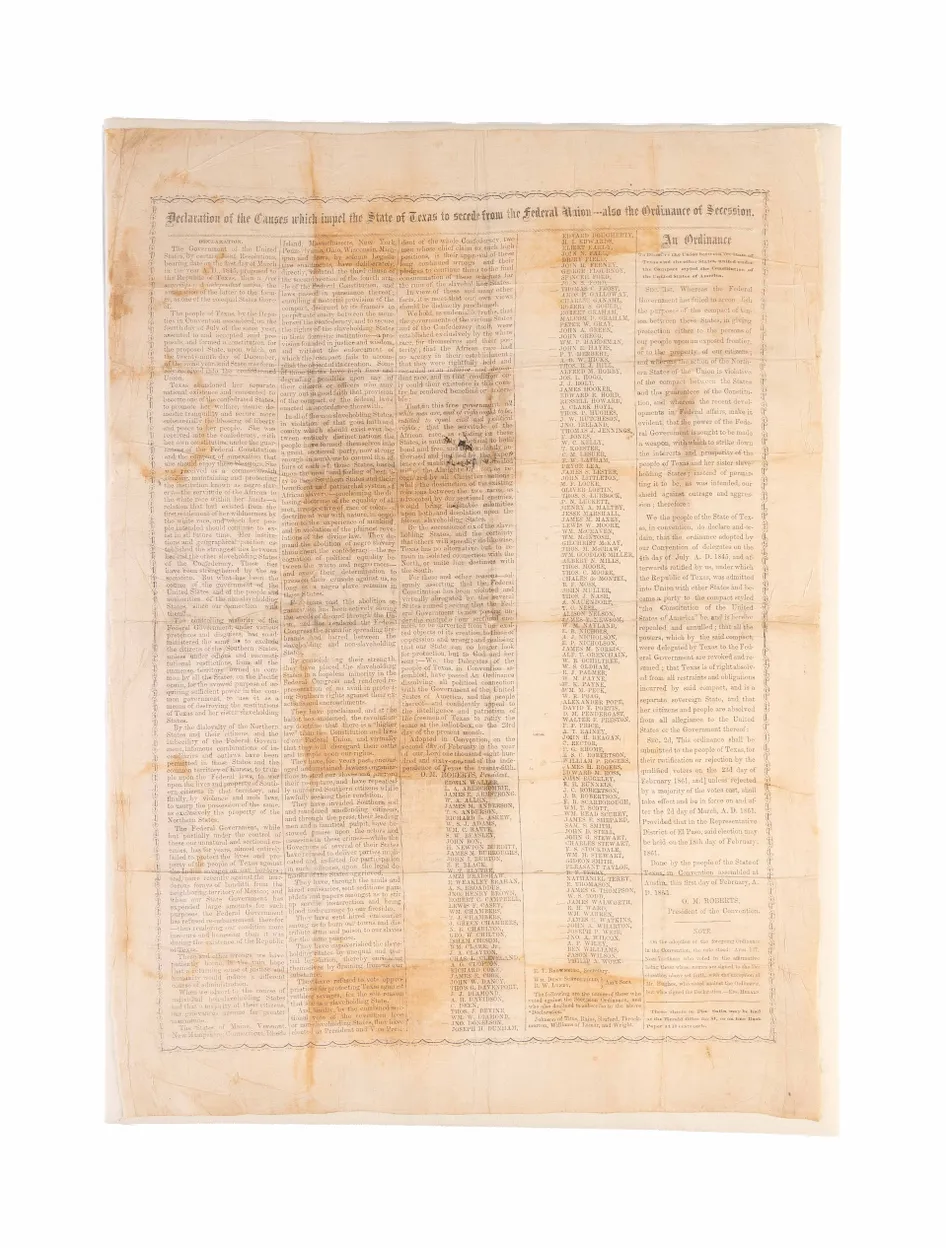
An exceptionally rare Texas secession broadside – one of three known copies and the only one in private hands – it features both the Ordinance of Secession and the Declaration of Causes, two of the three principal documents drafted by the Texas Secession Convention, along with a list of delegates. It is further distinguished by having belonged to Cyrus Halbert Randolph (1817-1889), who was the Texas State Treasurer at the time of secession.
Printed on silk in San Antonio in 1861, this is the more desirable of the two issues (the other being on paper). Typeset in five columns with an ornamental border, the colophon reads “These sheets on Fine Satin may be had at the Herald Office for $1, or on fine Book Paper at 10 cents each.” It’s entirely possible that satin copies were given as gifts to prominent Texas politicians, such as Randolph.
Just twenty-five years before this printing, Texas was still a part of Mexico. While it seceded in 1836, becoming The Republic of Texas (with its Lone Star) "Texans had continually asked to become part of the Union from 1836 to 1845. Their precarious position on the southwestern frontier reminded them daily of the value of belonging to a large and powerful nation" (Buenger). Its wish was granted. The United States annexed Texas in 1845 (it became the 28th State), and the Mexican-American War, 1846-1848, followed directly thereafter.
Sixteen years later, the experience of the Texas revolution directly informed its attitudes towards leaving the Union. "Shortly after Texas seceded, one of the convention delegates [Charles A. Russell] notified his daughter that while enthusiastic cheers erupted in Austin and cannon fire shook the convention hall, ‘the Lone Star Flag was run up the pinnacle of the Capitol’" (Lang, 25).
For this document, and Texas secession itself, there is the wider context of federal versus states' rights – the tension between which provided the spark for the Civil War. One need only look to the nullification of the Fugitive Slave Act by thirteen states or indeed Lincoln’s election. Across the South, the likes of Alabama, and South Carolina argued “that the Union’s founding purposes had been thwarted not by federal usurpation but ‘by the action of the non-slaveholding States.’ Texas secessionists concurred …, calling ‘the action of the Northern States’ unconstitutional. Certainly, secessionists shuddered at the Republican capture of the White House, which they described as a wholesale seizure of federal authority. But what made it distressing was Republicans’ track record as foes of proslavery federal action. Republicans had used states’ rights to advance their antislavery agenda, and secessionists knew it" (Woods). The broadside provides clear evidence of the anger and betrayal felt in slaveholding states.
South Carolina was the first state to secede in December 1860, followed by Mississippi, Florida and Georgia, in January 1861 and Texas the following month. The Constitutional Convention was organized on February 1, 1861, and voted overwhelmingly in favor of secession. The ordinance was ratified by popular vote on February 23rd.
Beginning with the Declaration of Causes, this aggressive assertion of Texas’s rights highlights her unique history as an independent country and leaves no doubt as to the core issue at stake:
"Texas abandoned her separate national existence and consented to become one of the Confederated States to promote her welfare, insure domestic tranquility and secure more substantially the blessings of peace and liberty to her people. … She was received as a commonwealth holding, maintaining and protecting the institution known as negro slavery -- the servitude of the African to the white race within her limits -- a relation that had existed from the first settlement of her wilderness by the white race, and which her people intended should exist in all future time. Her institutions and geographical position established the strongest ties between her and other slave-holding States of the confederacy. Those ties have been strengthened by association. But what has been the course of the government of the United States, and of the people and authorities of the non-slave-holding States, since our connection with them?"
The language is bullish throughout: the authors accuse the North of interfering directly as they “encouraged and sustained lawless organizations to steal our slaves;” “invaded Southern soil and murdered reoffending citizens;” “sent seditious pamphlets and papers among us to stir up servile insurrection and bring blood and carnage to our fireside;” “sent hired emissaries among us to burn our towns and distribute arms and poison to our slaves;” and, “finally, by the combined sectional vote of the seventeen free or non-slave-holding States, they have elected as President and Vice President of the whole Confederacy, two men whose chief claims to such high positions, is their approval of these long continued wrongs, and their pledges to continue them to the final consummation of these schemes for the ruin of the slaveholding States.”
This is followed by a list of the 168 delegates ending with Philip A. Work, distinguishing this copy as a first edition. Importantly, it is also the only edition to include the names of the delegates who voted against secession.
Noted bibliographer and Texas historian Everett C. Wilkie, Jr. made a detailed study of the Texas secession documents in The 1861 Printings of the Ordinance of Secession (Dallas, 2011), and identifies three separate editions of the broadside, essentially distinguished by the list of delegates. The first edition (Wilkie 23) was almost certainly printed in February 1861 and ends the delegate list with Philip A. Work. The later editions (Wilkie 24 & 25) were printed in early and mid-March, respectively, with additional delegates added to the list. This edition also includes six lines naming the delegates who voted against secession.
Cyrus Halbert Randolph arrived in Texas in March 1838 and quickly became established as an attorney and politician. A member of the Snively Expedition in 1843, he served in several political roles in Houston County, including justice of the peace (1840), chief justice of the county (circa 1843), and sheriff (1847). He also represented the county in the Texas Legislature in two terms between November 1851 and November 1857. Randolph was elected state treasurer 1859, and won re-election in 1860. Notably, small pencil notations are next to the names of several delegates in the list, perhaps associates of Randolph.
A rare copy in private hands, this is one of the most significant broadsides in Texas history – here in the first edition and on silk.
Parrish & Willingham note three institutional copies: University of North Carolina, University of Texas, and Baylor University. The Baylor, copy, however, is actually the 7-page Austin edition (Parrish & Willingham 4150). The UNC and Texas are the only other known copies of the first edition.
Provenance: Cyrus Halbert Randolph (1817-1889), Texas State Treasurer (1858-1865), thus by descent.
Crandall, 2153; Parrish & Willingham, 4151; Wilkie, 23; Winkler & Friend, 171; Buenger, W.L., “Texas and the Riddle of Secession” in The Southwestern Historical Quarterly, Vol. 87, No. 2 (Oct., 1983), pp.151-182; Lang, A.F., “Memory, the Texas Revolution, and Secession: The Birth of Confederate Nationalism in the Lone Star State” in The Southwestern Historical Quarterly, Vol. 114, No. 1 (July, 2010), pp.20-35; Woods, M.E., “‘Tell Us Something about State Rights’: Northern Republicans, States’ Rights, and the Coming of the Civil War” in Journal of the Civil War Era, Vol. 7, No. 2, (June, 2017), p.261.