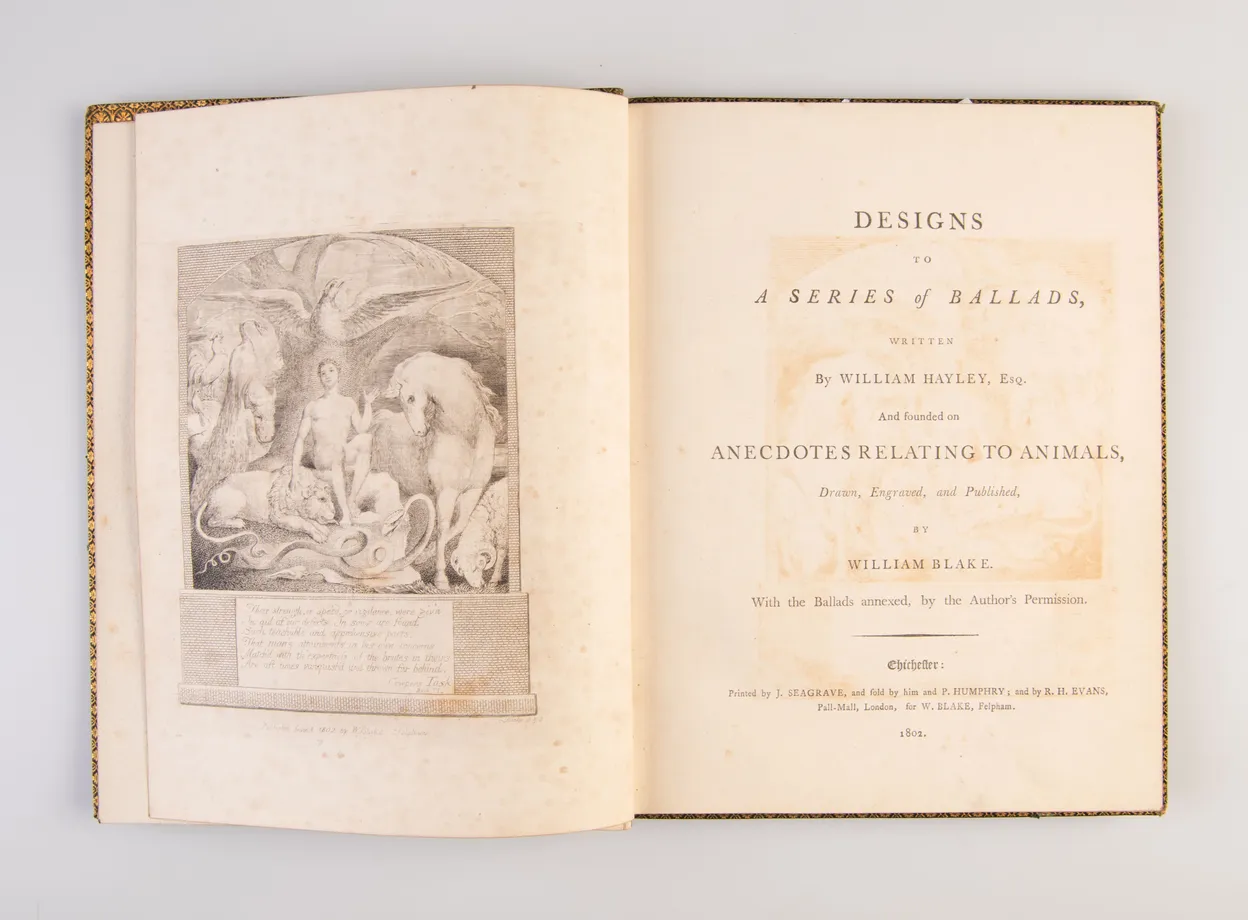
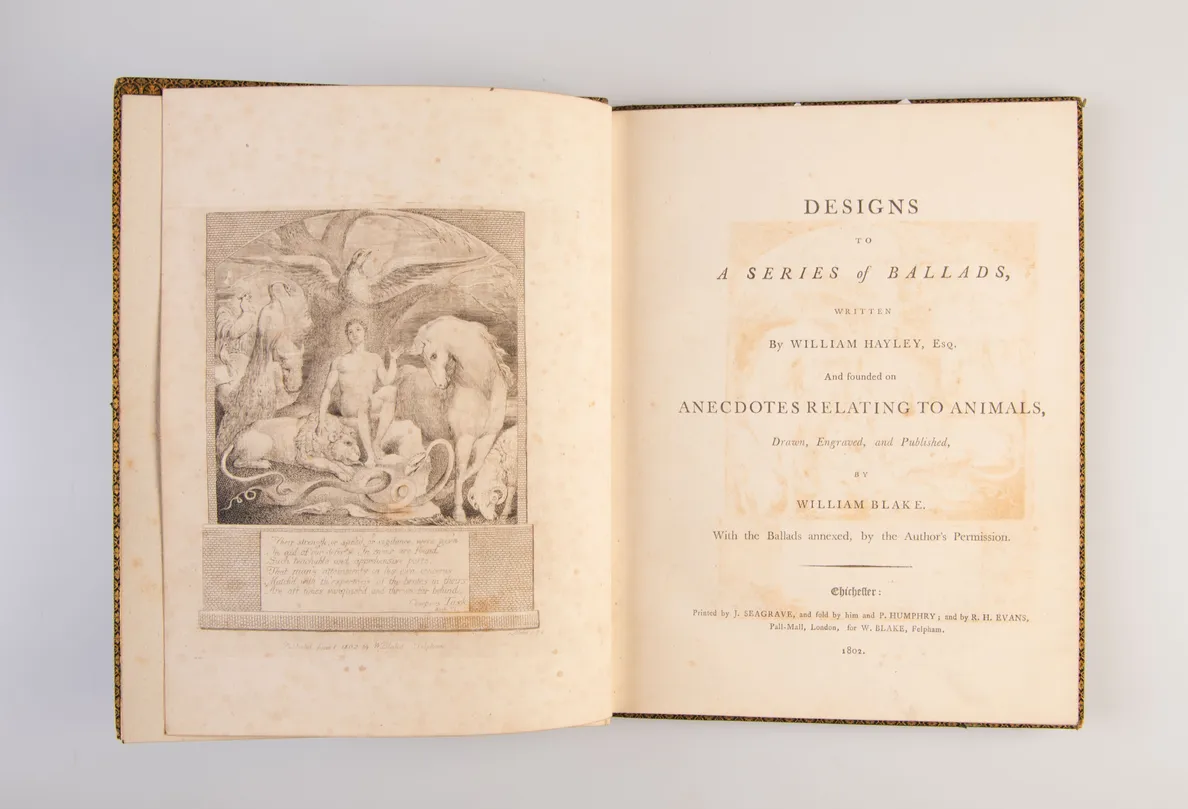
Very Rare. Described by Essick as "One of the rarest letterpress books containing plates designed and engraved by Blake" and by Keynes as, "now extremely rare." Essick compiled a census of complete copies in Blake/An Illustrated Quarterly in 2000 (p.125) in which he located seven copies (one of which is now lost): Cambridge (Keynes collection), Huntington (x2, one of which is supposed to be A. C. Swinburne's copy), Library of Congress (Rosenwald collection, lacking the general title-page), Princeton (Herschel V. Jones and A. Edward Newton copy) and Watkinson Library (in Hartford CT) as well as Essick's own copy (ex Locker-Lampson copy) which he acquired from Ursus Books in New York in 1999. Essick also mentions an untraced copy in original blue paper wrappers that was bought by Maggs at Sotheby's in London in 1937 (for £410).
A very rare and complex letterpress volume of poetry with fine engraved plates by William Blake. The book was produced through the conjunction of Blake's own domestic cottage press at Felpham in West Sussex and and that of the provincial printer Joseph Seagrave of nearby Chichester which resulted in a highly unusual book issued in four (fifteen had originally been intended) parts through the summer of 1802 in a project which was soon discontinued and proved a financial disaster but today remains as a typical piece of uniquely Blakean eccentric book design and engraving style.
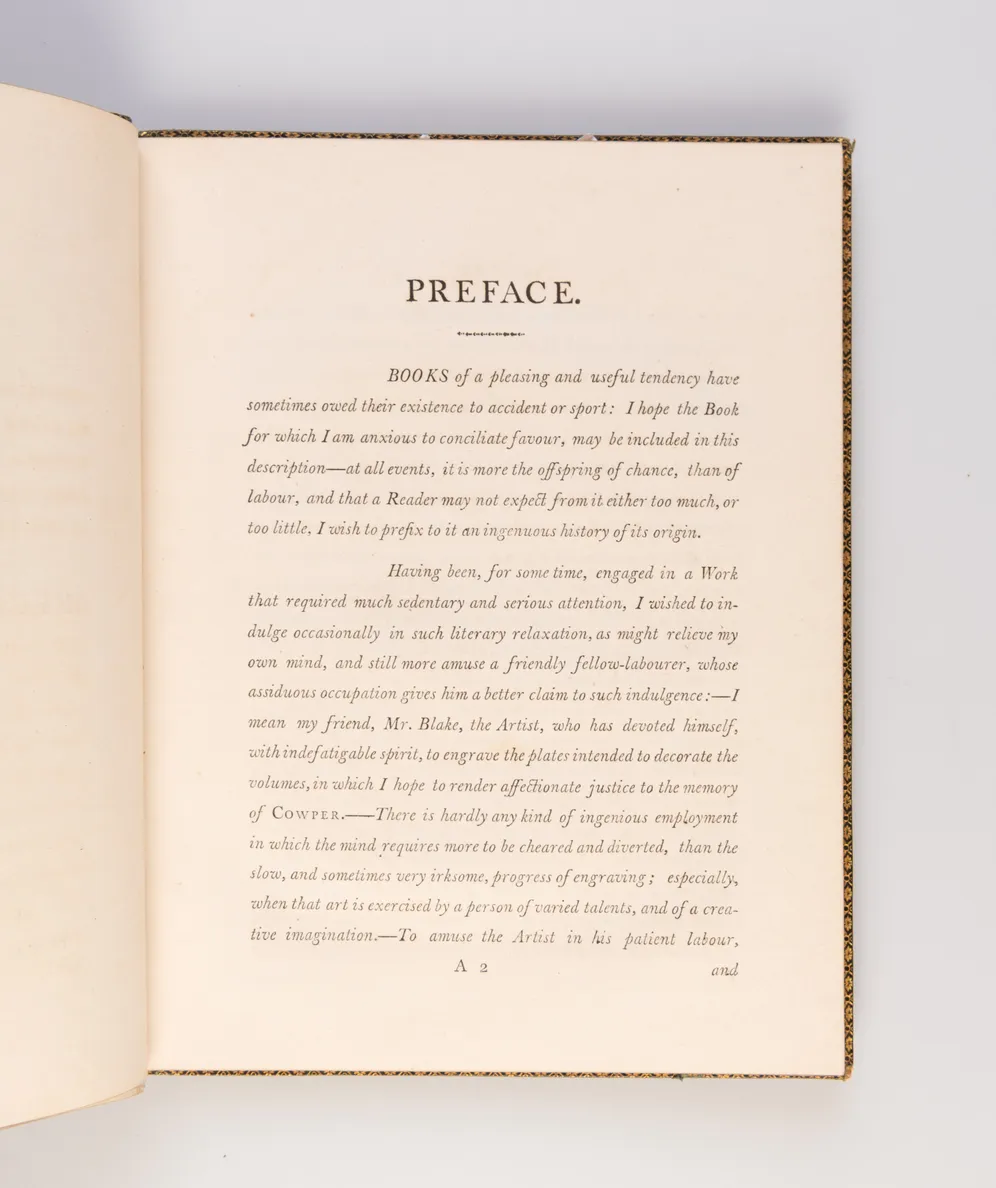
William Hayley's preface to this book outlines the still hopeful wish that the project might indulge the product of his "literary relaxation" with plates by "my friend, Mr. Blake the Artist." (A2r):
"Books of a pleasing and useful tendency have sometimes owed their existence to accident or sport: I hope the Book for which I am anxious to conciliate favour, may be included in this description - at all events, it is more the offspring of chance, than of labour, and that a Reader may not expect from it either too much, or too little, I wish to preface to it an ingenuous history of its origin"
Hayley continues by acknowledging his debt to William Cowper in these poems and continuing:
"I chanced to compose in hours of exercise and leisure, a few Ballads, upon anecdotes relating to animals, that happened to interest my fancy. They succeeded perfectly as an amusement to my Friend [Blake]; and led him to execute a few rapid sketches, that several judges of his talent are desirous of converting to his honour and emolument. The favour that two of three Ballads obtained, in a private circle, induced us to enlarge the number; and to try this success in the world as a periodical publication.- It is proposed to publish every month, a Number, containing three Engravings, with one Ballad, at the price of Half-a-crown; and to complete the whole series in fifteen Numbers, so that the purchaser will ultimately obtain a quarto Volume, containing forty-five Engravings, not to mention the Ballads which indeed I wish to be considered as vehicles contrived to exhibit the diversified talents of my Friend for original design, and delicate engraving.- Since friendship induced this meritorious Artist to leave London (the great lucrative theatre of talents!) for the sake of settling near me, it seems to be a duty incumbent on me to use every liberal method, in my power, to obtain for his industrious ingenuity the notice and favour of my Countrymen." (A2r).
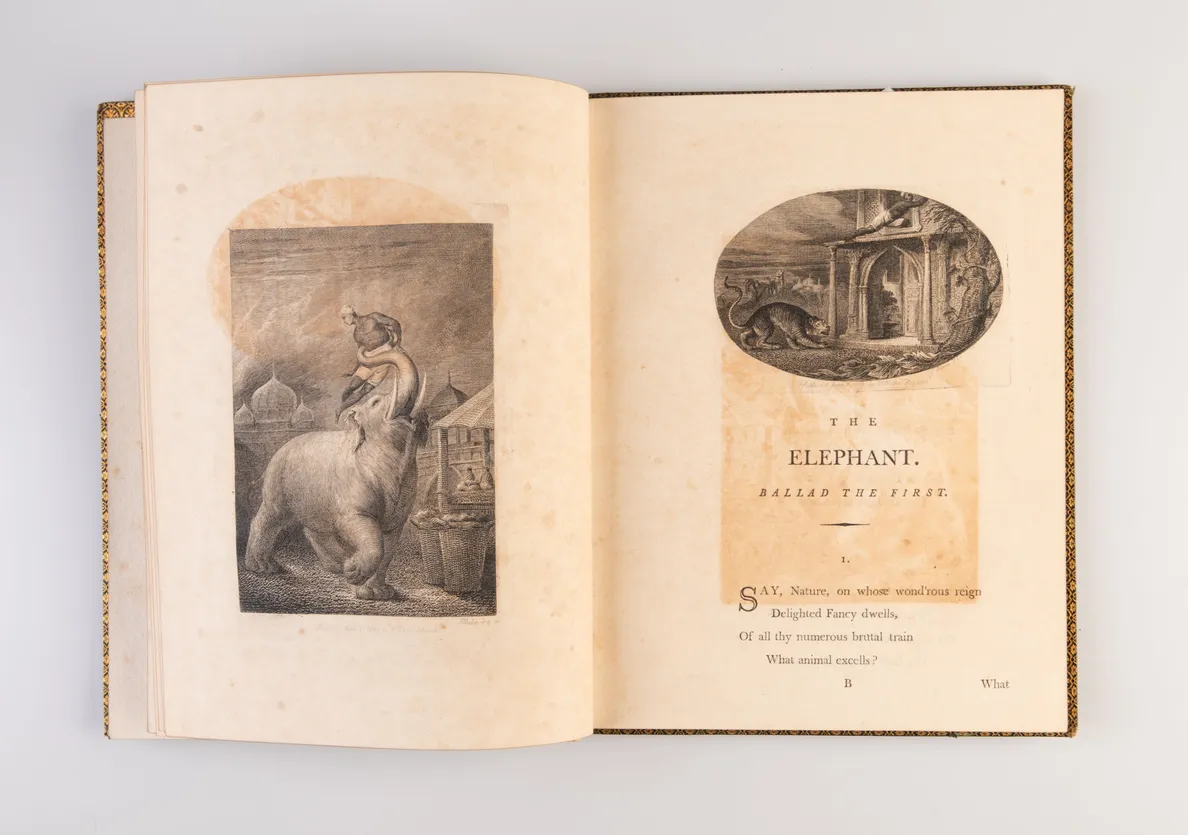
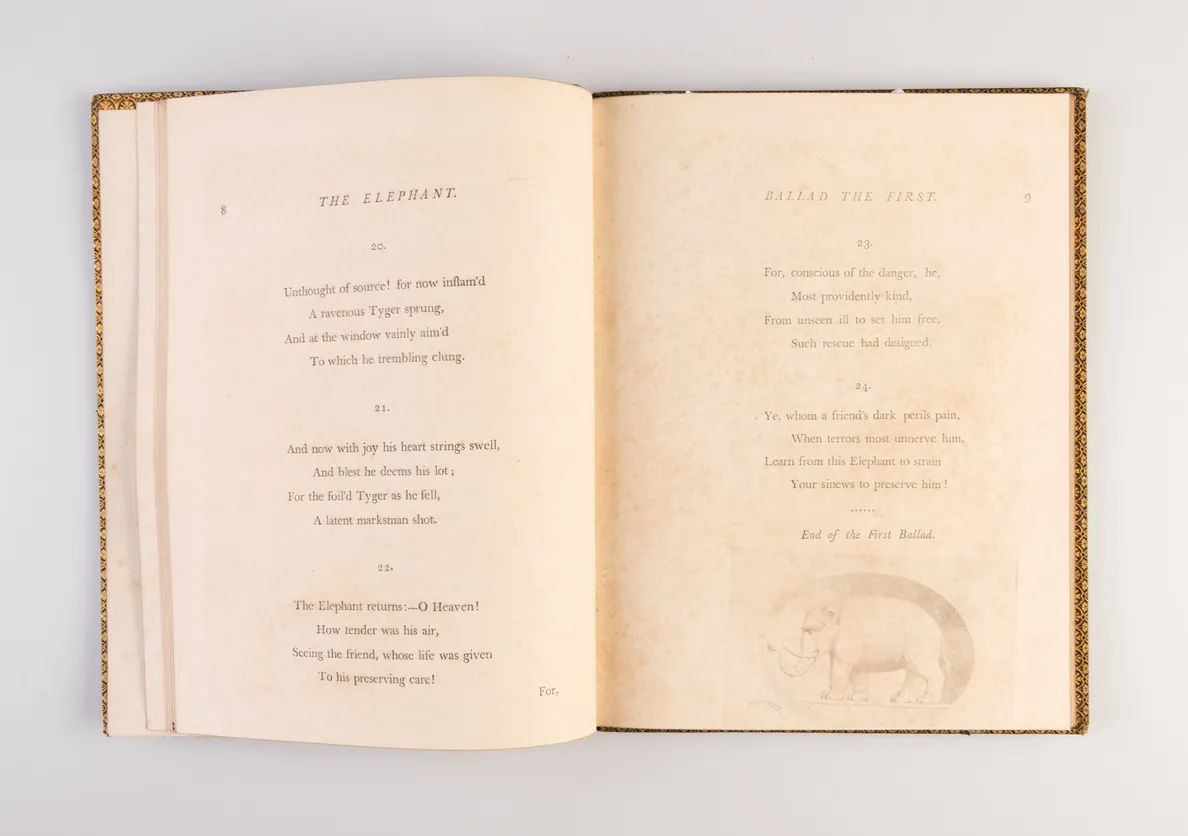
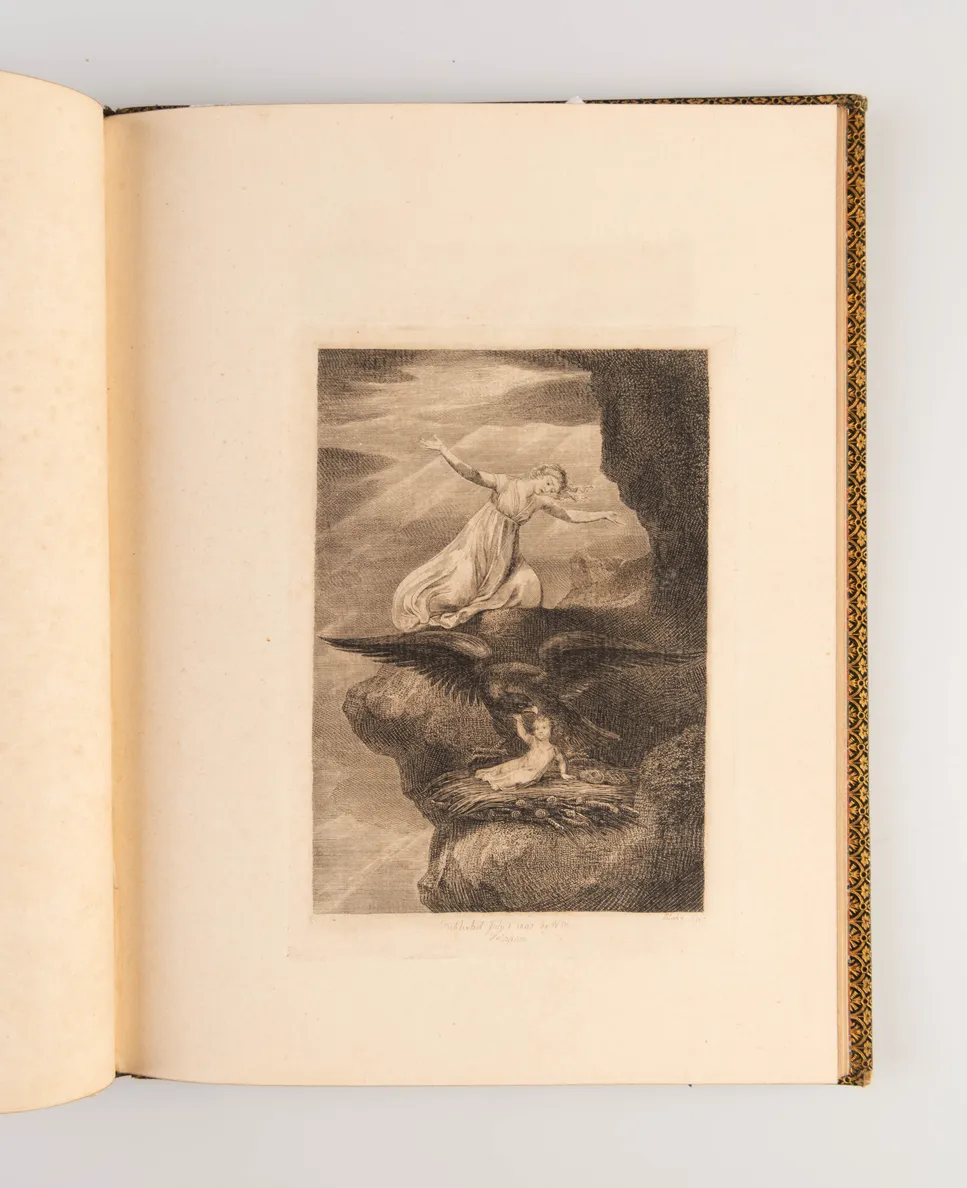
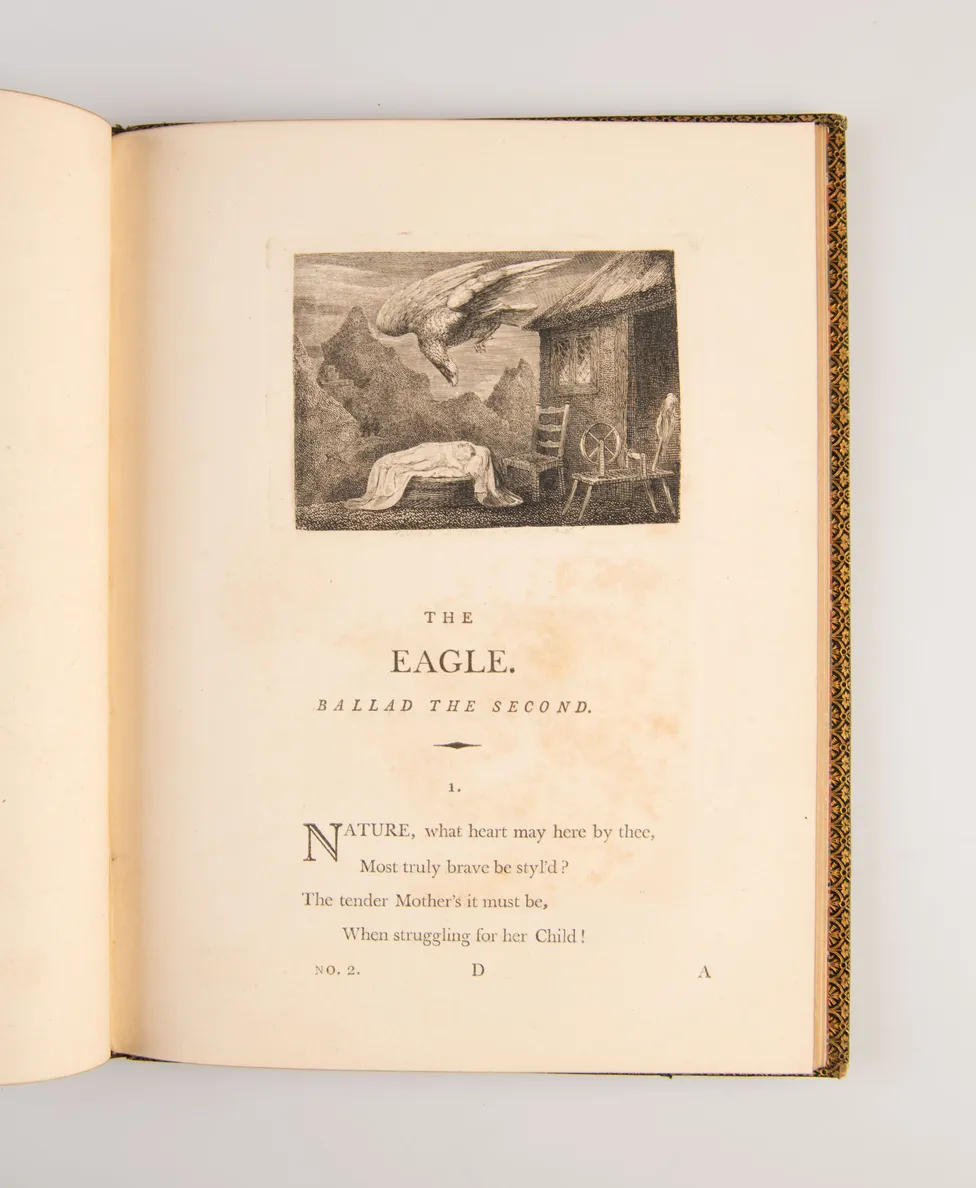
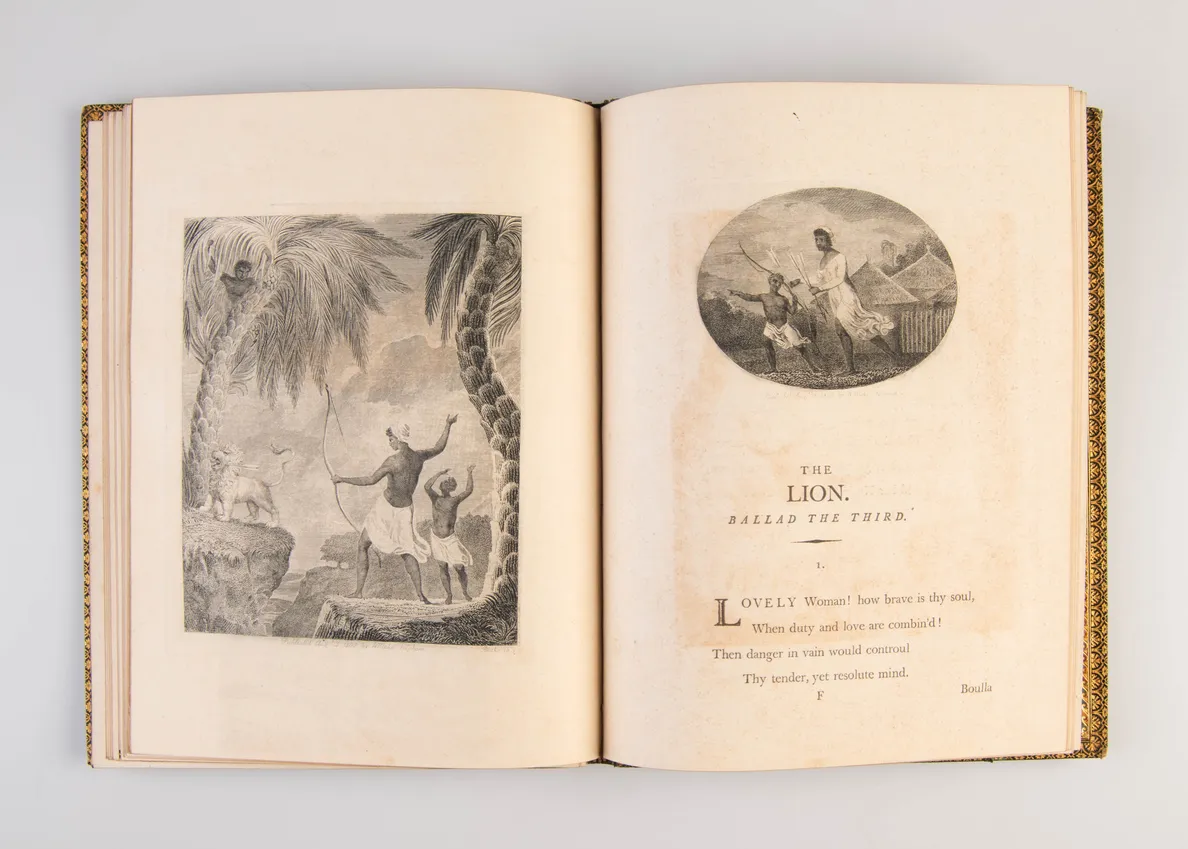
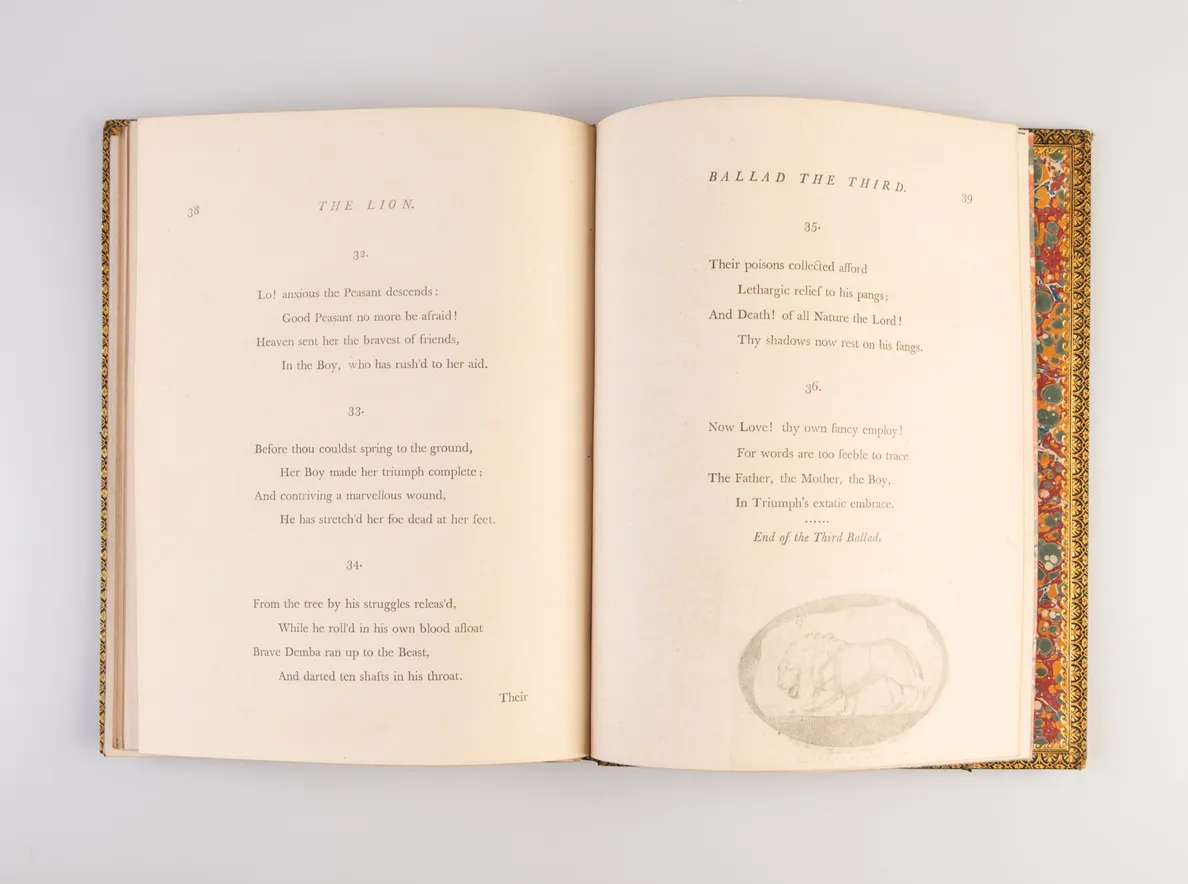
The letterpress text of the book was printed by the local Chichester printer Joseph Seagrave with the plates printed by Blake and his wife on their own rolling press at their nearby home. This collaboration gives the book a very unusual look as the text and images often don't quite align on the page. The project proved to be a disaster and the few copies that were sold were purchased by Hayley's friends and Blake himself was reduced to using some of the leftover sheets as drawing paper. Blake designed the full-page frontispiece (dated 1st June 1802) showing Adam amongst various animals. At the end of the Preface there is a landscape vignette of Chichester Cathedral. The first poem "The Elephant" has a large full-page frontispiece showing an elephant lifting a man into the air (this has heavily off-set onto the facing page) which also has a vignette of a man escaping from a snarling tiger by climbing to the upper parts of a building. The ballad ends with an oval vignette of an elephant (after a drawing by Thomas Hayley) which has been very lightly inked and does not quite fit at the end of the text and so the lower edge has been trimmed with the loss of the title "From an antique Gem" and the imprint. The second ballad "The Eagle" has a full-page frontispiece showing a woman attempting to rescue a child from the clutches of a large eagle, the initial vignette before the text shows the eagle swooping down to take the child. The final vignette shows the child standing triumphantly on the dead body of the eagle (again this has been trimmed slightly within the platemark at the foot). The third ballad has a full-page frontispiece showing a man and a woman hunting a lion with a bow and arrow. The oval vignette before the text shows the woman setting out to hunt with her bow and arrows. The final oval vignette is a lightly-inked impression of an illustration of a lion (after a design by Thomas Hayley) which again is trimmed just within the platemark at the foot but preserves the title and imprint.
The London bookseller Richard Phillips published an octavo edition of fifteen ballads by Hayley in 1805. For this volume, Blake engraved new plates of his designs for three of the ballads first published in 1802 and both designed and engraved new illustrations for two of the additional ballads.
Provenance: Union Presbyterian Seminary Library in Richmond, Virginia. Part of a Blake collection donated to the Seminary in the 1950s but deaccessioned in the last few years as the collection was uncatalogued and outside the institution's scope.