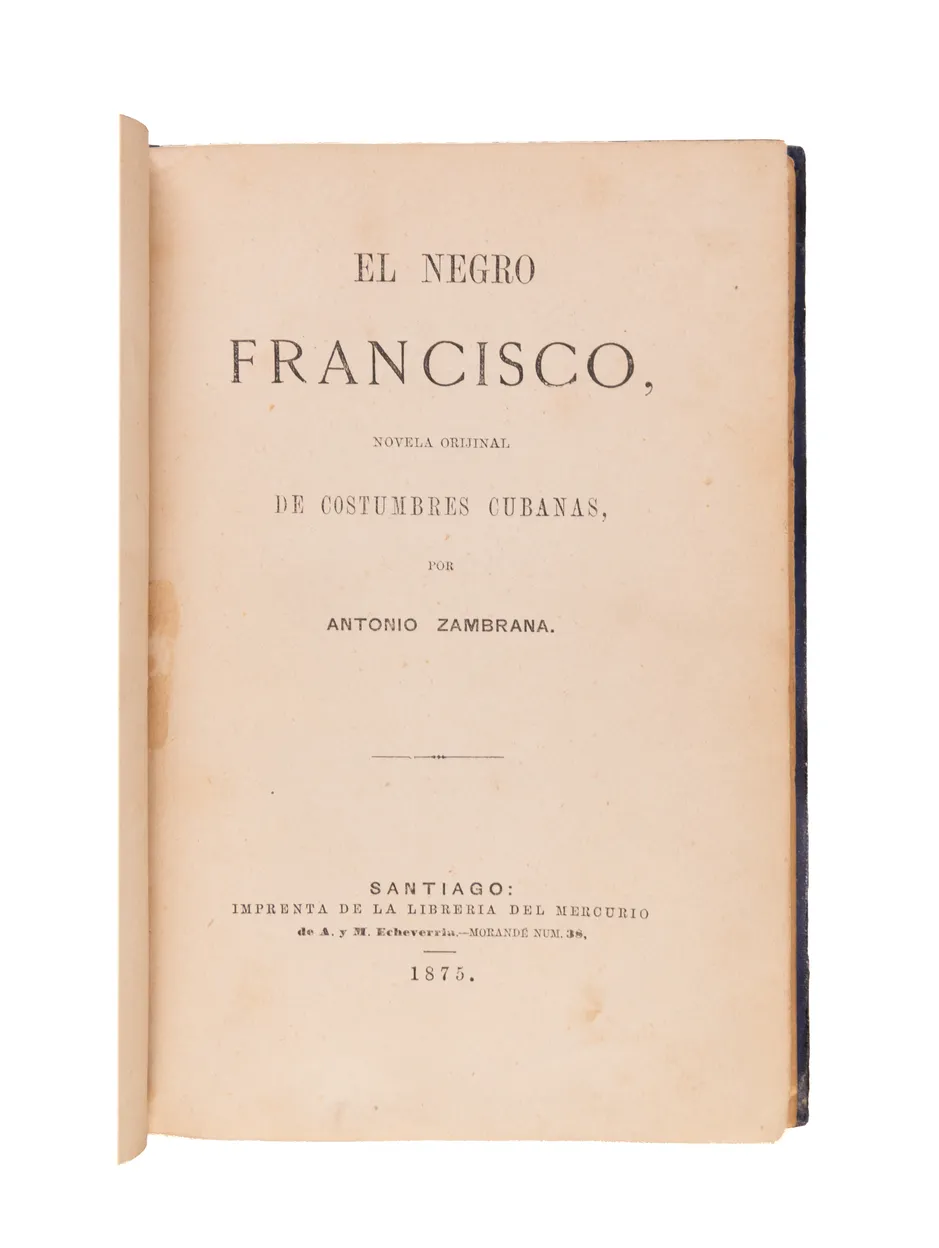
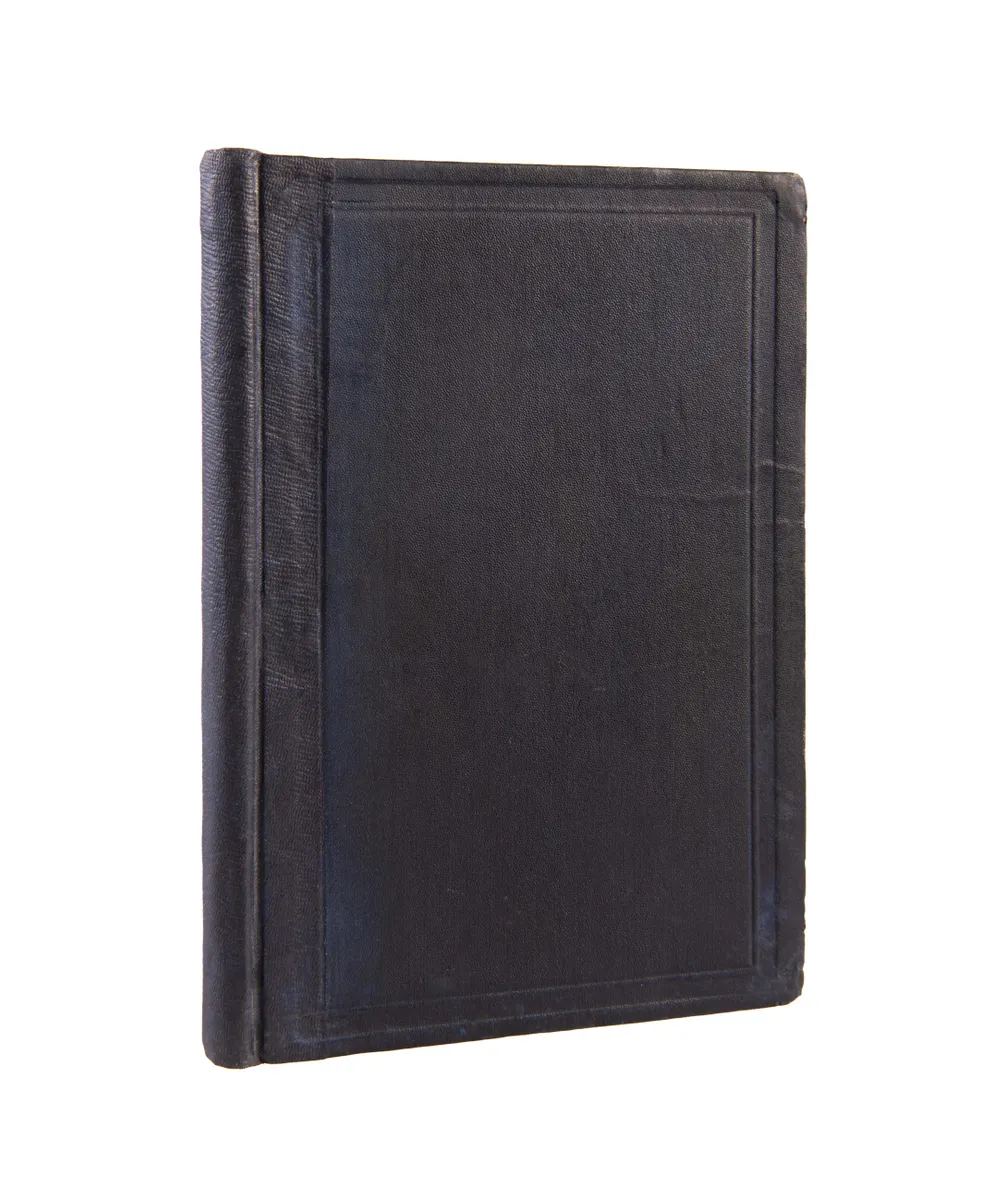
Rare and important: a canonical work of Cuban abolitionist literature, written by the prominent Cuban jurist, journalist and freedom fighter Antonio Zambrana (1846-1922). This powerful tale of love and redemption is set amidst the violence and moral corruption of late plantation era Cuba. El negro Francisco is one of the most thoughtful and effective critiques of slavery of its era.
We learn from the author's preface that Zambrana came to abolition early in life. At fifteen he attended a literary salon in Havana where Anselmo Suárez y Romero personally read passages from his unpublished manuscript Francisco, El Ingenio o las Delicias del Campo. It left the teenager in tears and he immediately declared himself an abolitionist. That stance informs the basis of this novel, published in Santiago, Chile, while the author was travelling in exile.
El negro Francisco is the story of an enslaved Black man who falls in love with Camila, a mulatto who is also enslaved. Their idealised relationship takes place on a plantation characterised by hard labour and sexual violence. Matters become complicated when Francisco's owner, the brutal Carlos, also falls for Camila. Francisco and Camila decide to elope, though are surprised by Carlos who has returned from a trip to Havana. Despite Francisco having saved his master from being gored to death by a bull, Carlos, shows no leniency and threatens to whip Francisco to death unless he gives up his love. Francisco commits suicide, while it is simply said that "Camila died insane." The horror of the situation is transformative for Carlos who renounces slavery and plantation life. He travels to the United States, then in the midst of the Civil War, to join the Union Army, and hasten the end of slavery in that country. Like many of the great Romantic dramas of the 19th century, El negro Francisco ends in both tragedy and redemption.
The novel is heavily influenced by the characters and storyline of Suárez’s Francisco but is a much sharper and more brutal social commentary. Specifically emphasizing the hierachy of both Francisco and Camila's races throughout the work, it draws on current events, as well as the author’s own observations. Despite the narrator’s (and author's) abhorrence of slavery, his tone is calm rather than emotional or sensational.
It must be seen in the wider context of Cuban abolitionist literature such as Cirilo Villaverde’s Cecilia Valdés (Havana, 1839; expanded and reissued, 1882); Juan Francisco Manzano’s Autobiografía (completed in manuscript in 1835 and published in an English translation as the Autobiography of a Slave (London, 1840); Gertrudis Gomez de Avellaneda’s Sab (Madrid, 1841) which is both an abolitionist and feminist novel; and Anselmo Suárez y Romero’s Francisco, El Ingenio o las Delicias del Campo (completed in 1839 but not published until 1880).
Zambrana was educated at the Colegio El Salvador and later earned a doctorate in law. He fought with the rebels during the Ten Years' War (1868-1878) and became a member of the insurgency's governing body. Indeed, he was later a signatory to the 1869 Abolition of slavery decree and a co-author of the rebel regimes Guaimaro Constitution. Zambrana was sentenced to death in absentia by a Spanish court in Havana in 1870, whereupon he fled Cuba for the United States. He published the newspaper La República de Cuba in New York before undertaking a tour of Latin America in the capacity of the rebel's Special Envoy of the Cuban Republic. It was during this time that he completed this manuscript. He spent the next decade in Costa Rica before returning to Cuba in 1886.
El negro Francisco is an important and heartfelt contribution to Cuban literature - a wartime publication a decade prior to Cuban abolition on 7 October, 1886.
OCLC locates copies at Harvard, UCLA, Notre Dame, Henderson State, and two in Chile. No copies recorded at auction.
Altamiranda, D. & David William Foster, D.W. (eds.), From Romanticism to Modernismo in Latin America, vol. 3 (1997), p. 102; Barreda, P., The Black Protagonist in the Cuban Novel (1979), p 175; CASTELLANOS, J. & CASTELLANOS, I., Cultura Afrocubana 2: El negro en Cuba 1845-1959 (Miami, Ediciones Universal, 1990), pp.198-206; Duke, D., Literary Passion, Ideological Commitment: Toward a Legacy of Afro-Cuban and Afro-Brazilian Women Writers (2008), pp.33-6; FOUNTAIN, A., José Martí, the United States, and Race (2017), p.1853; Lohse, R., Africans Into Creoles: Slavery, Ethnicity, and Identity in Colonial Costa Rica (2014), p. 293; Luis, W., Literary Bondage: Slavery in Cuban Narrative (2014), p.49; McKnight, K.J. & Garofalo, L.J., (eds,), Afro-Latino Voices: Narratives from the Early Modern Ibero-Atlantic World, 1550-1812 (2009), p.76.