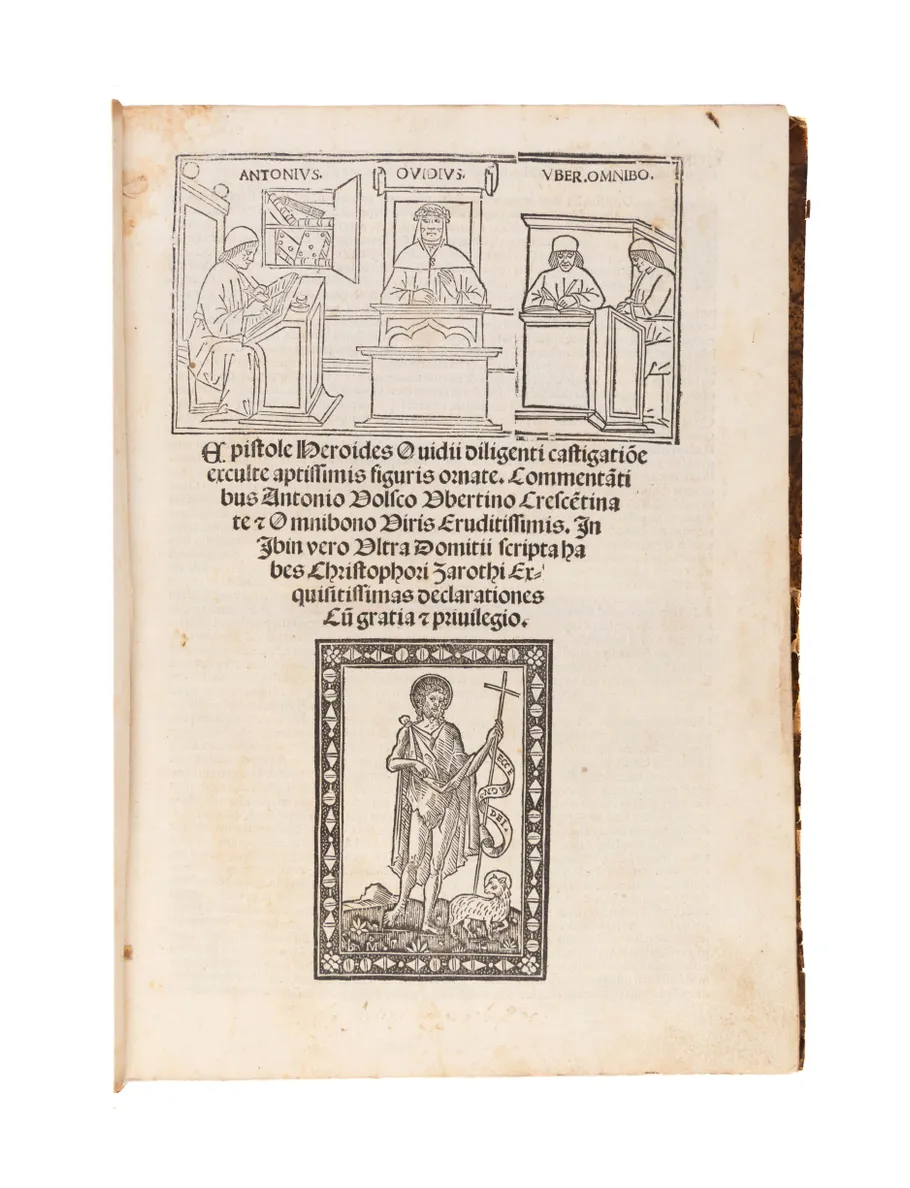
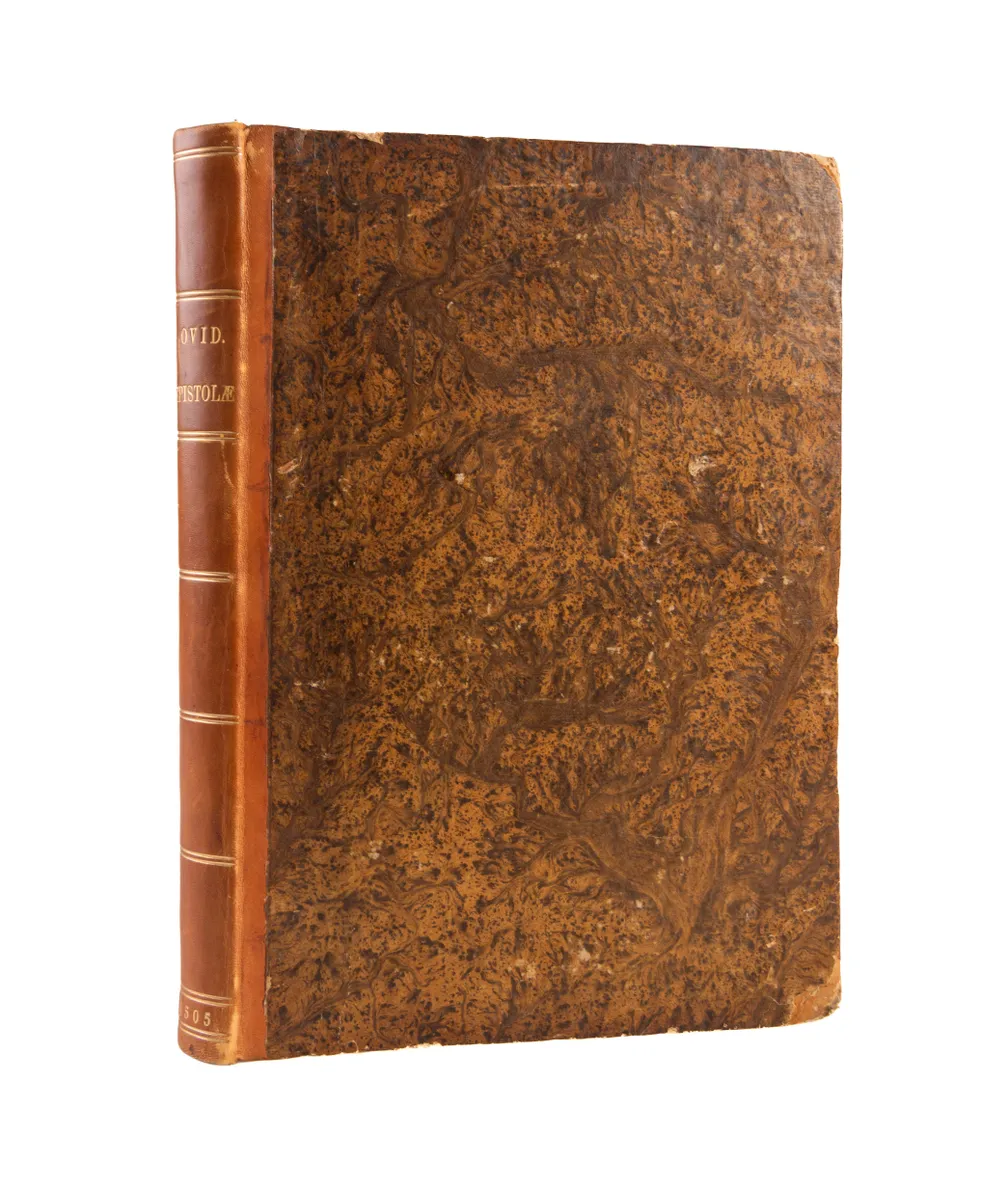
The handsomely printed second, illustrated Tacuino edition of Ovid's Heroides, letters from classical heroines to their husbands and lovers; illustrated throughout with more than twenty episodic woodcuts of key events in the lives of the heroines and their counterparts. It is exceptionally rare: though several editions of the Heroides issued from Tacuino's press in the first quarter of the sixteenth century, all are rare, and early editions like this one even more so. We have found just four copies of this edition listed in institutional holdings worldwide, none in America.
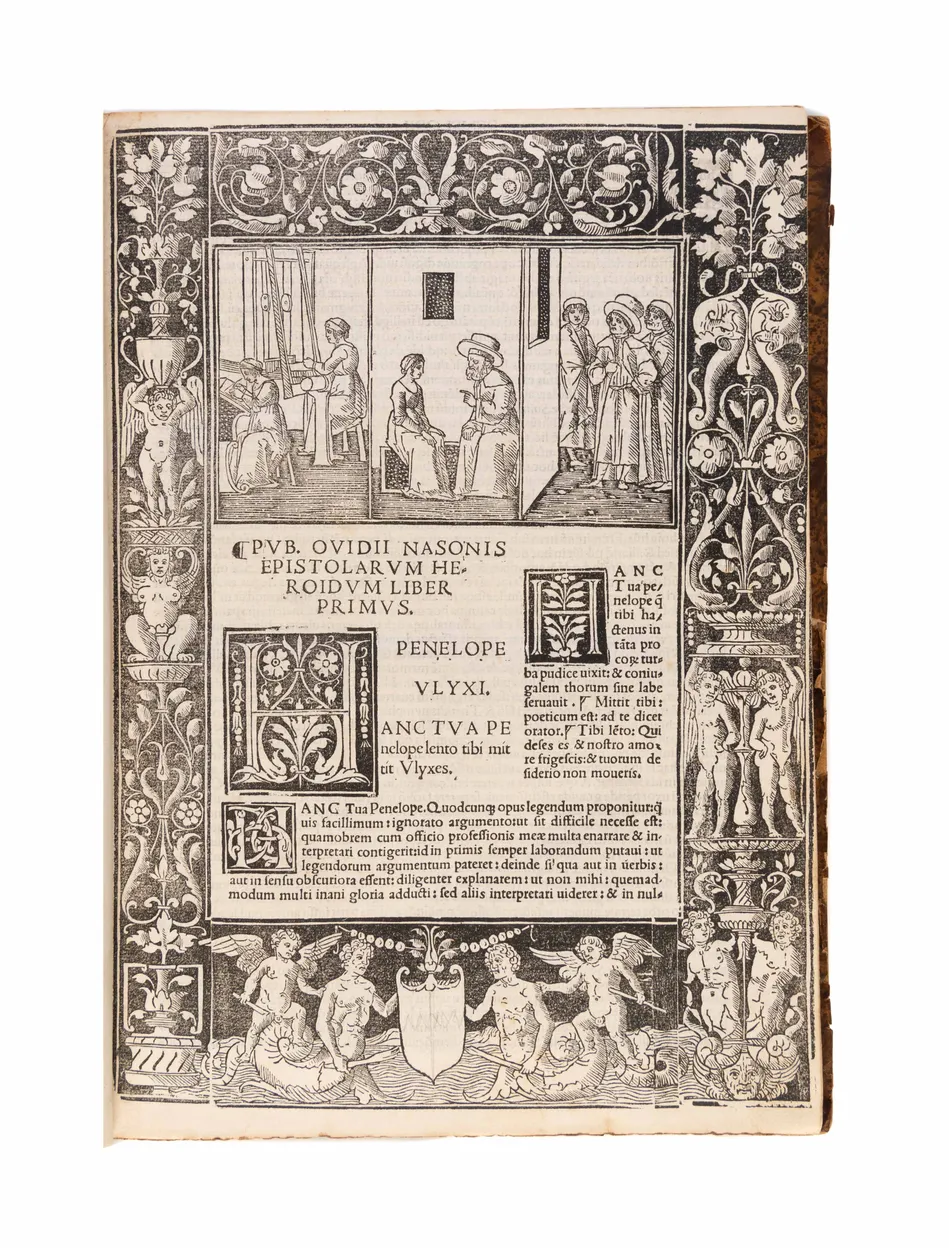
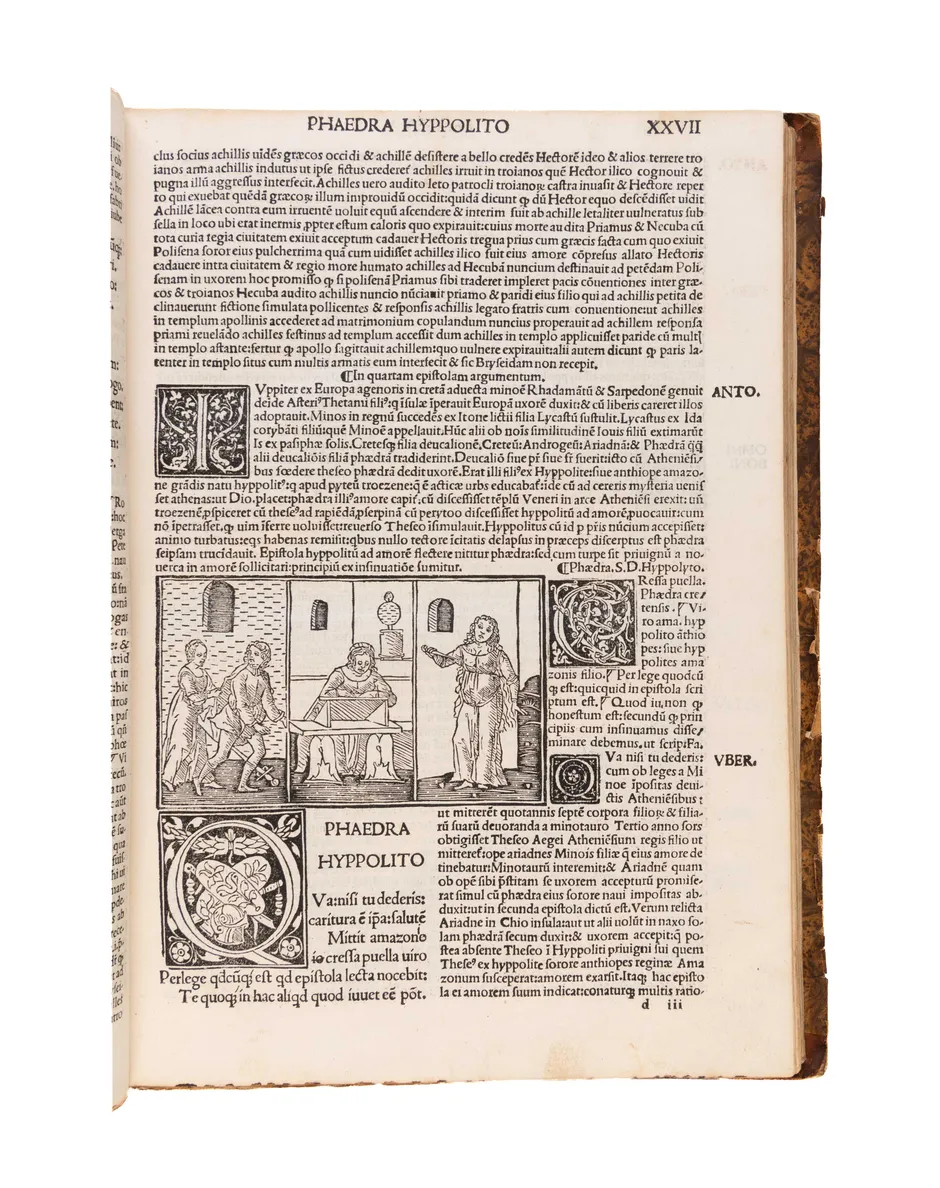
Tacuino's programme of woodcuts here, first used in his first illustrated edition of 1501 and emphasised in the title - 'aptissimis figure' -would become the basis for subsequent editions of the Heroides printed in France and Italy (Mortimer, p.487; for an example of free copies of Tacuino's woodcuts see Bernardino Stagnino's Venice printing of the work in 1516). The blocks 'are divided into three compartments showing successive scenes and usually the writing or receipt of the letter'; thus, for example, the first illustration shows Penelope writing her letter to the absent Ulysses, working her loom, weaving the endless tapestry that kept her suitors at bay; rebuke by her father, Iscarius, finger censoriously pointed, for waiting; and the insistent swarm of suitors themselves, waiting beneath her window. It is unusual, and notable, to see early depictions in print of women, specifically, writing; care has been taken here to make each such scene slightly different from the last, even down to the ornamentation on each woman's desk.
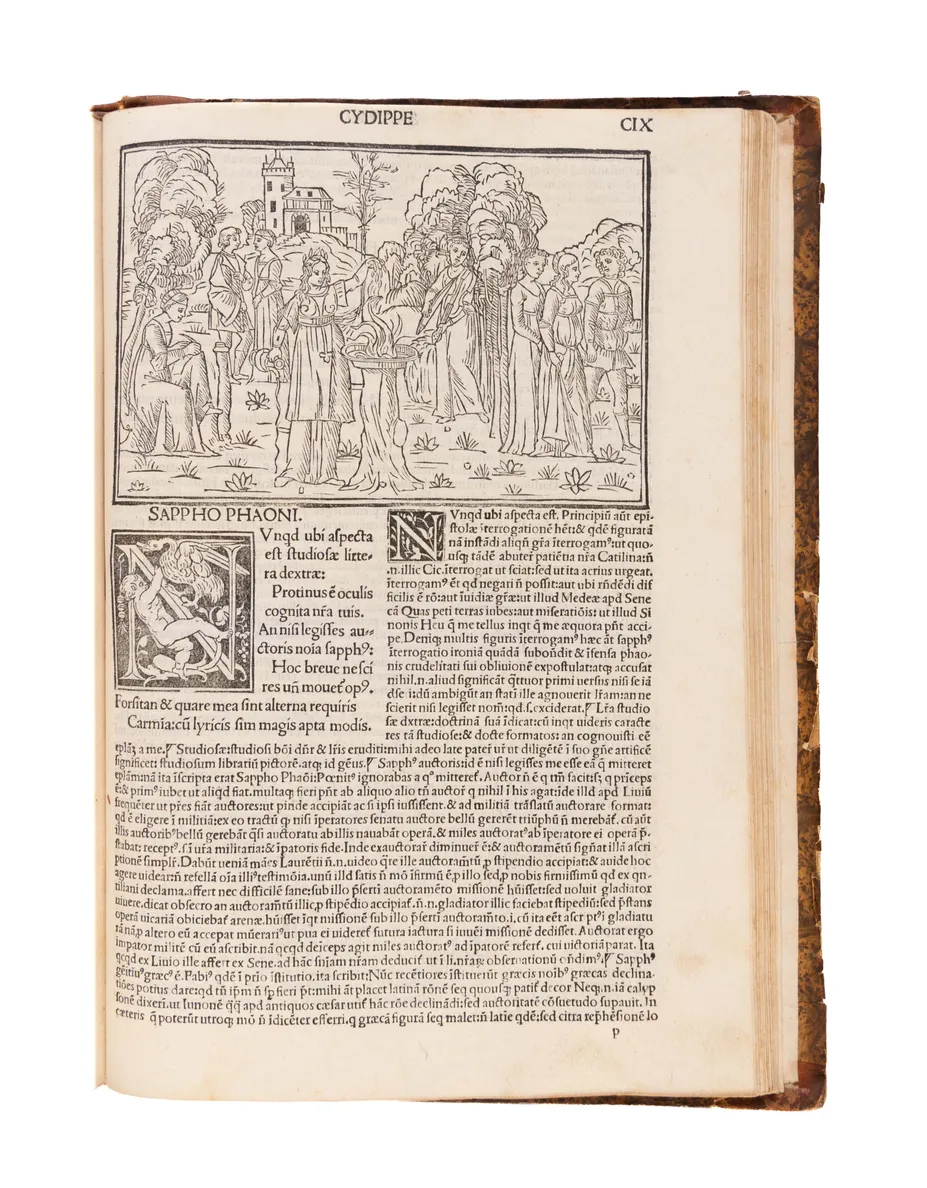
The final two woodcuts are compositionally different, being larger, single-panel scenes, though both feel distinctly Venetian in style. The first accompanies Sappho's letter to Phaon, and depicts her as poet, musician and priestess. The second accompanies Ovid's vengeful poem addressed to the anonymous 'Ibis' and depicts a laurel-crowned Ovid himself, writing at his desk; multiple ibises in flight, feeding on serpents and so on; and the wizened embodiment of Invidia, envy.
The senders of the elegaic epistles that follow Penelope's letter to Odysseus are a who's who of the heroines of classical mythology and tragedy: Briseis writes to Achilles, Phaedra to Hippolytus, Dido to Aeneas, Hermione to Orestes, Medea to Jason, Helen to Paris, among others. The letters are insertions into known stories, written predominantly 'about being left behind, abandoned, deserted' and 'are set at a very particular moment in each narrative': Medea writes to Jason about his abandonment of her, in favour of Creusa, but aside from a brief mention of something preying on her mind, she does not yet show murderous intent towards her children (McAuley, 'Introduction'). Accompanying three of the letters are replies from three of the recipients, Paris, Leander and Acontius to Helen, Hero and Cydippe respectively, written in Ovidian style but of potentially unknown authorship.
Sparse annotations throughout, the lengthiest on f.V(r), slightly trimmed, correcting the text in its description of Hector defeating Antilochus - see interlinear correcting note 'Memnone' in contemporary hand - and describing the episode as recounted by Homer in the marginal annotations. At the head of the verso of the final leaf are manuscript notes in a contemporary hand only partly visible; ?glue residue suggests that something had been pasted over it and subsequently removed. Legible to us here are miscellaneous references to 'la barba', beards, la garza (gauze, or textile), dogs, wild figs, oil, basil, which might point to a natural historical or medical source.
Closely trimmed at head, sporadic foxing to endpapers, light waterstain to upper margin of final few leaves, wear to final leaf with small hole, presumably from removal of paper to verso, but not affecting legibility.
Censimento finds just two copies in Italian libraries at Modena and Rome. OCLC: Two copies in Switzerland, none in the US.
Edit16: CNCE 34391. Mairéad McAuley, 'Introduction to Ovid's Heroides', Greek and Latin at UCL [short lecture, open access]. Mortimer, Italian, p.487 (entry for Bartolomeo de Zanni's 1507 edition). Sander, 5266.