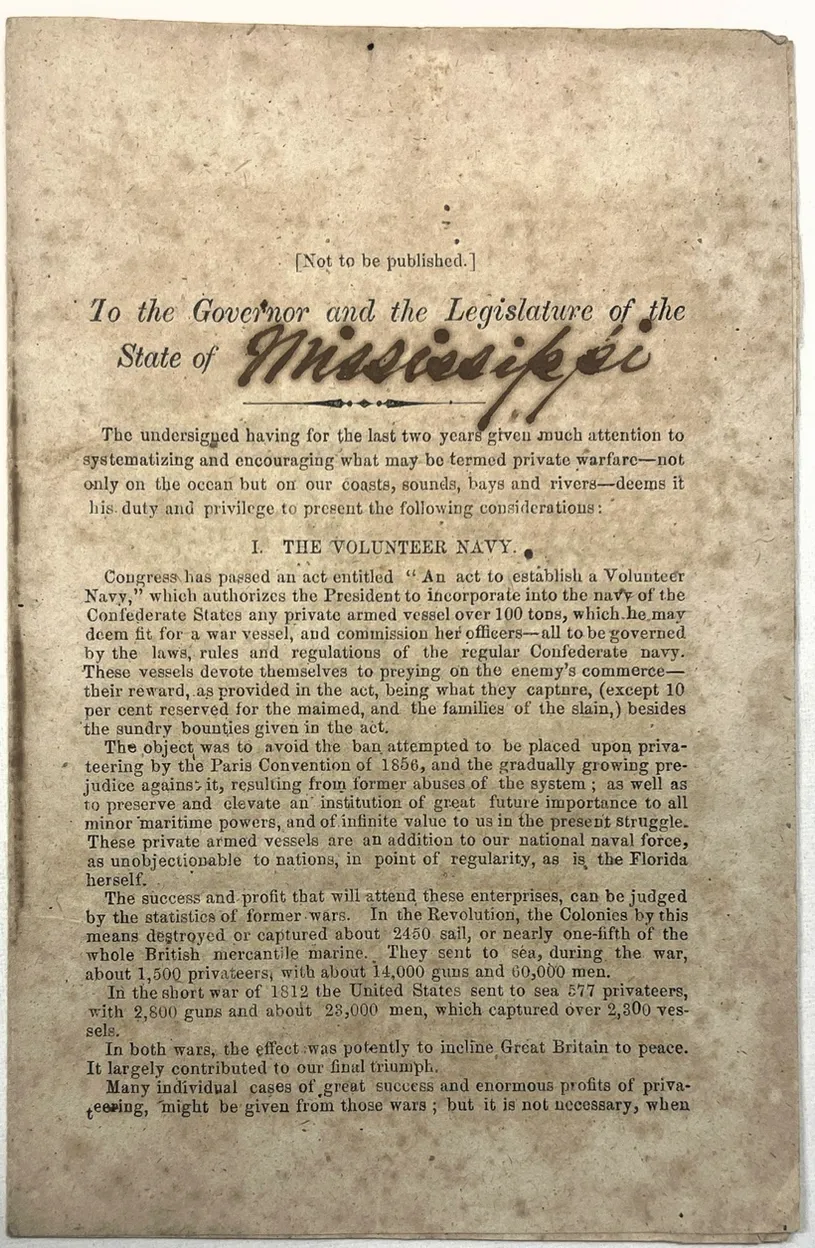
A very rare pamphlet, surely printed in low numbers, for circulation among high-ranking Confederate politicians only.
At the outset of the Civil War, the Confederate Navy had thirty ships of which only fourteen were seaworthy. Under the leadership of Stephen Mallory (1812-1873), that number grew to one hundred over the course of the war with many built in Liverpool. However there was an ongoing need for additional ships which proved difficult to fulfil as privateering had been outlawed under the 1856 Paris Convention. A way of circumventing the ban was sought via the passing of "An act to establish a Volunteer Navy" in May 1863 which permitted ships of 100 tons or more to be admitted into service.
Born in Connecticut, Bernard Sage studied and practiced law in New Orleans. Sage served in the Confederate navy and acted as a sort of spy for Jefferson Davis who sent him abroad on several secret missions. In this pamphlet, Sage acknowledges that a volunteer navy would be of great advantage, especially as a means to seize Union ships for Confederate use and otherwise sabotage and disrupt their shipping. However, he suggests the Volunteer Navy Act was altogether too timid and that advocates for privateering outright.
He quotes articles in the New York Herald and the New York Times confirming the efficacy of privateers Sumter, Alabama, Florida, and Tacony. And continues, "[b]eside the vast damage done to the enemy, and good to our supplicating cause, that can be done this way, let us not forget the importance of preserving the practice privateering for our future wars and not letting it fall into desuetude, so as to allow the world to settle on the idea that it is done away with."
Sage argues the Confederacy "cannot stand the taxation to keep up a large navy, besides paying our enormous national and state debts", and adds the capture of Union ships redeployed for Confederate use, and the men trained upon them, will be ideal for a future Confederate mercantile marine and a "future belligerent naval force." He suggests that papers might be fudged to allowing for better, captured ships to sail under the guise of extant inferior vessels, and that "as every well-informed nautical man knows," there are many ways to profitably dispose of prizes away from ports of major powers which would otherwise be closed to them.
In addition to the Volunteer navy, Sage encourages active privateers to operate along the coasts and rivers, and outlines the rewards. "If war vessels are destroyed by new contrivances the destroyer gets half the value." Congress would hopefully give "20 to 40 per cent for such destruction by any mode" and "5 to 10 per cent" will be given for mercantile vessels. While captured munitions and arms would remain the property of the privateers, all vessels and property would be owned by the government.
Instead of criticising the Volunteer navy, Sage ambitiously advocates a whole system of privateering. He sent his pamphlet to the several Confederate States (this copy was addressed in manuscript to Mississippi), and The Journal of Virginia's House of Delegates for 15 September 1863 records the receipt of this document, and its referral to the committee on military affairs. Ever active, Sage lobbied investors in Richmond to help form the Virginia Volunteer Naval Company. In 1865, he was one of several lawyers appointed counsel to Jefferson Davis, then being tried for treason.
Not in OCLC, we locate a single copy at Georgia University, which is also annotated with "Mississippi" on the first page.
Parrish & Willingham, 5035 (incorrectly dated 1864); Bennett, J.D., The London Confederates. The Officials, Clergy, Businessmen and Journalists who Backed the American South During the Civil War, (McFarland, 2008) p.75.