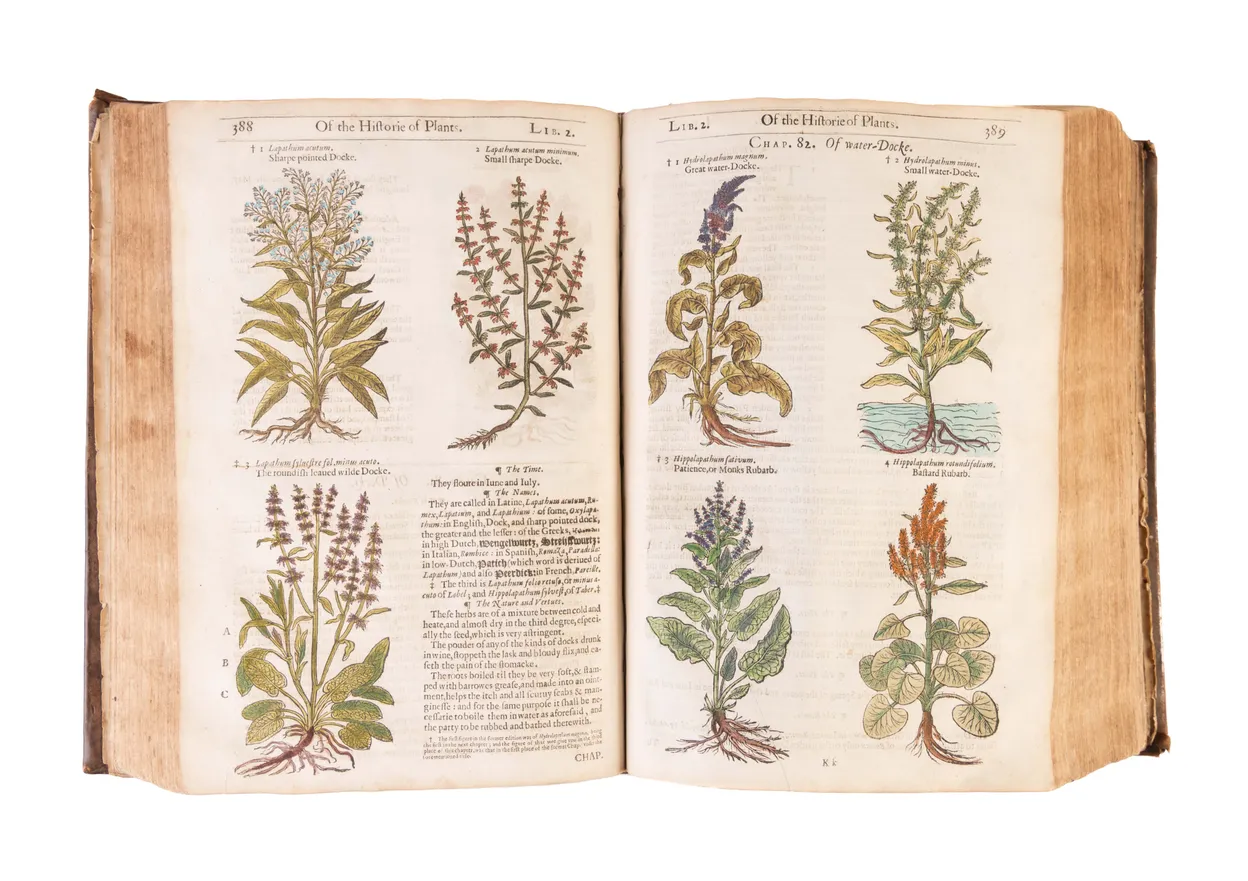
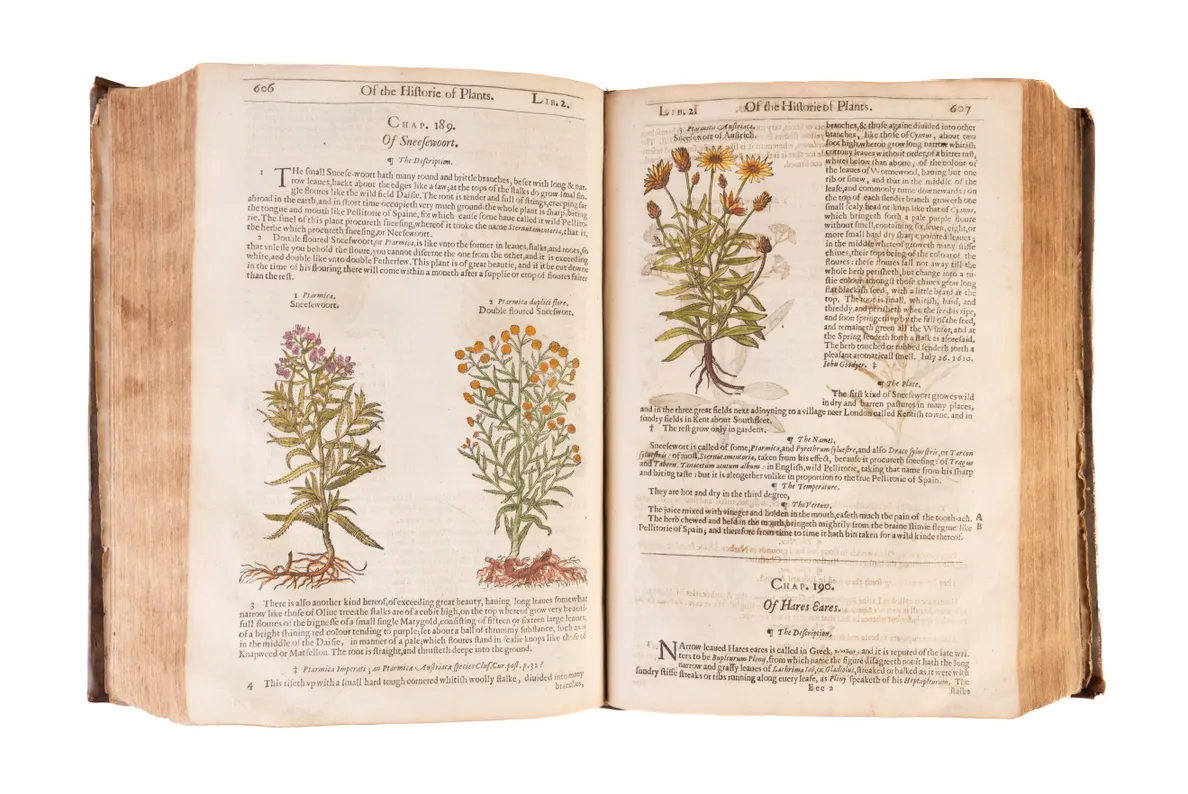
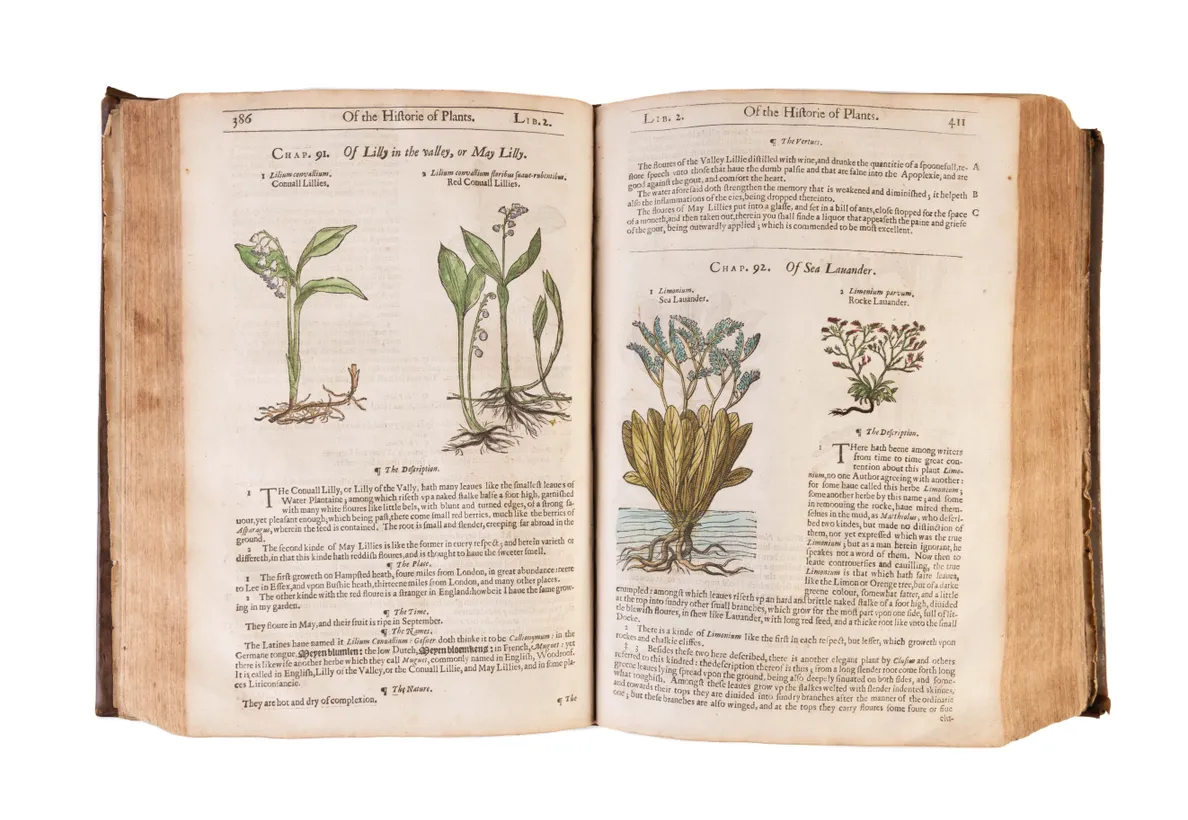
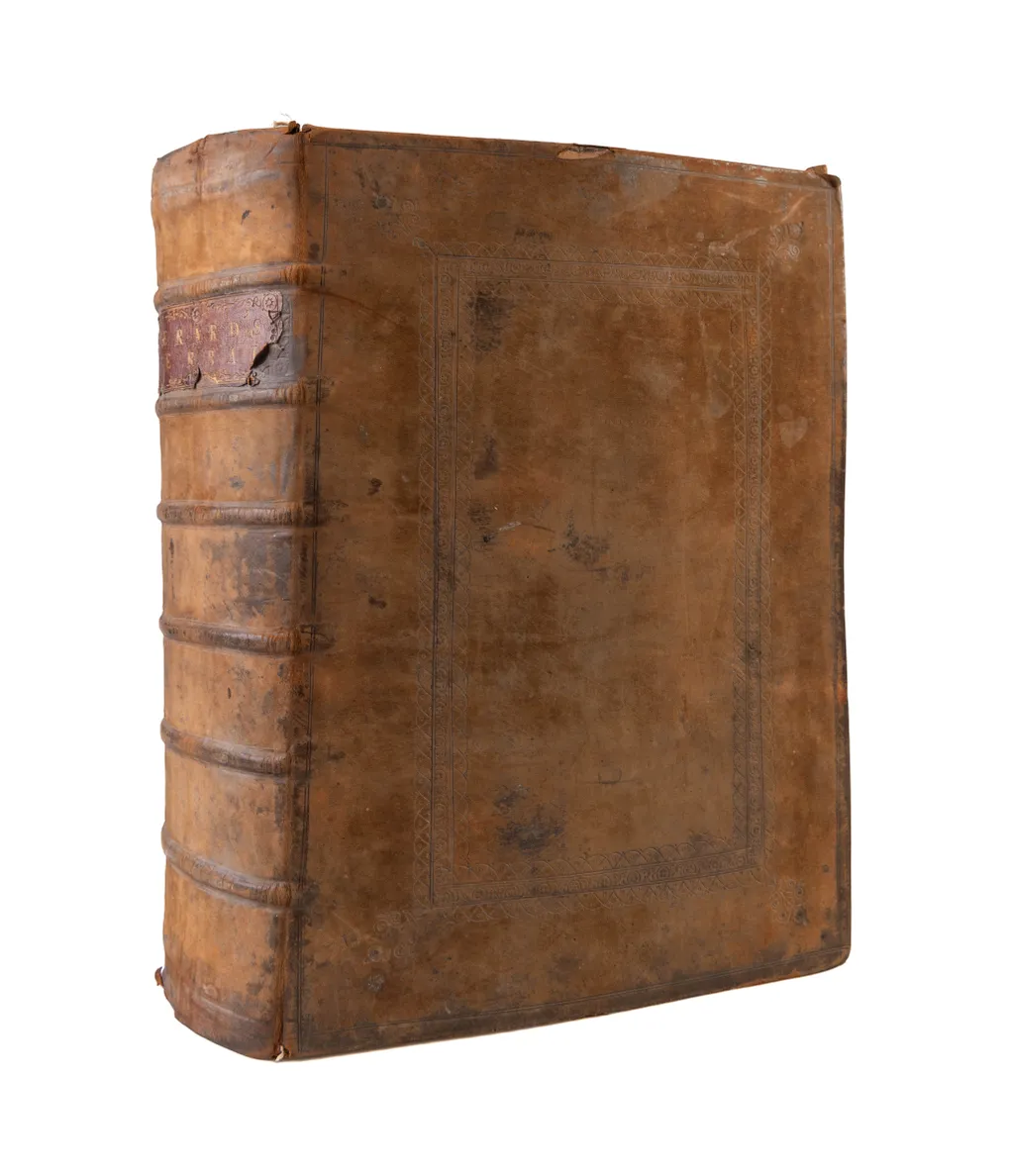
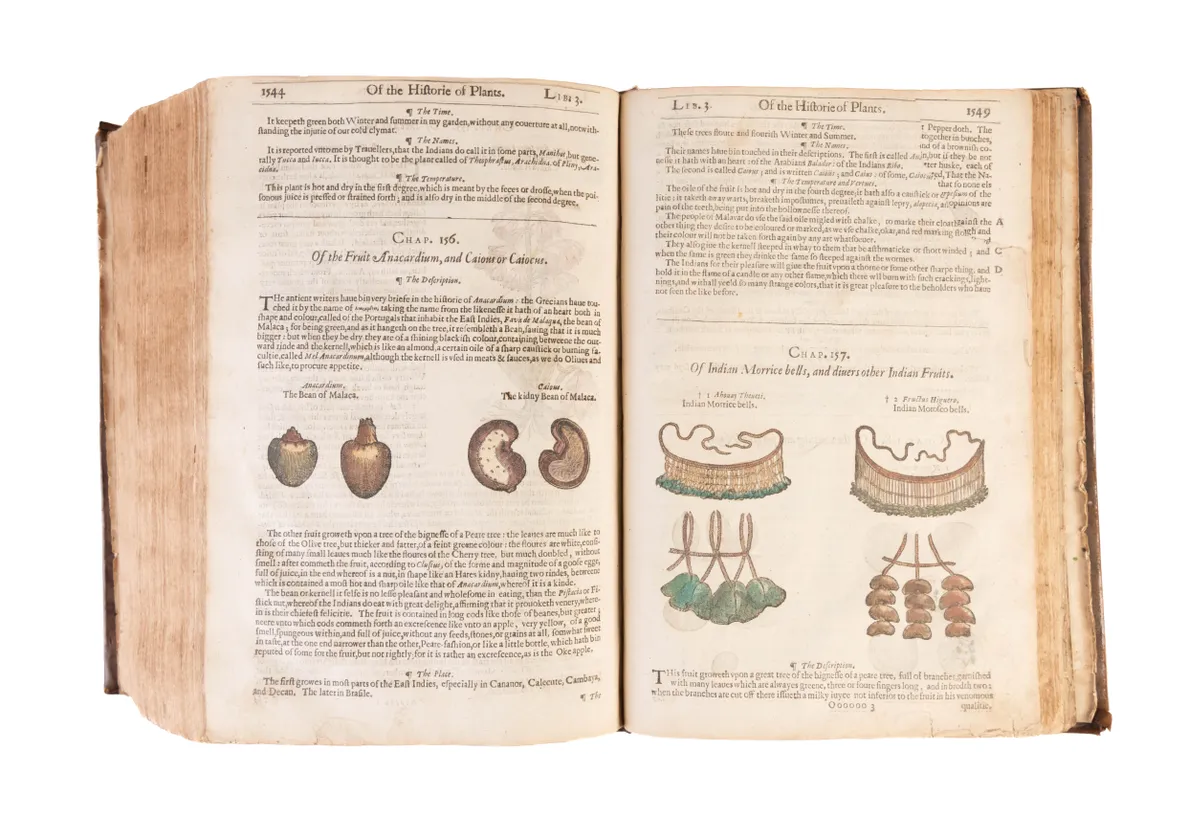
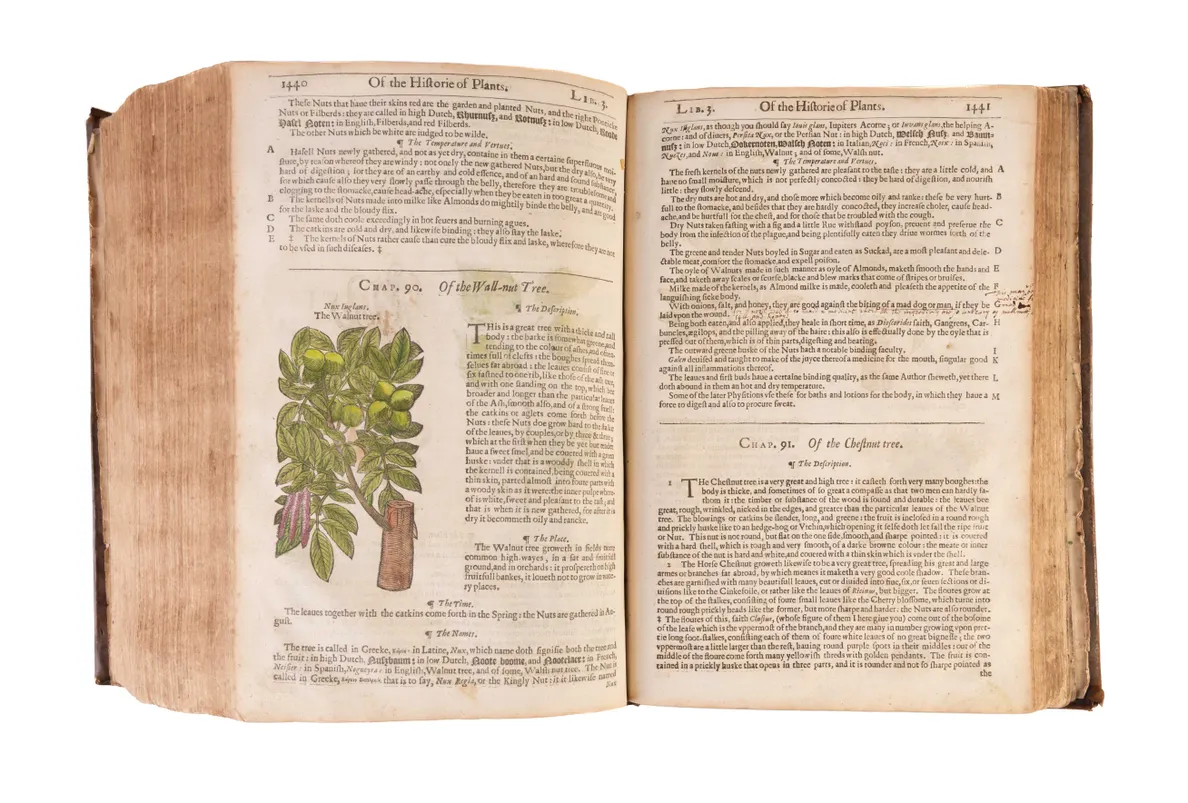
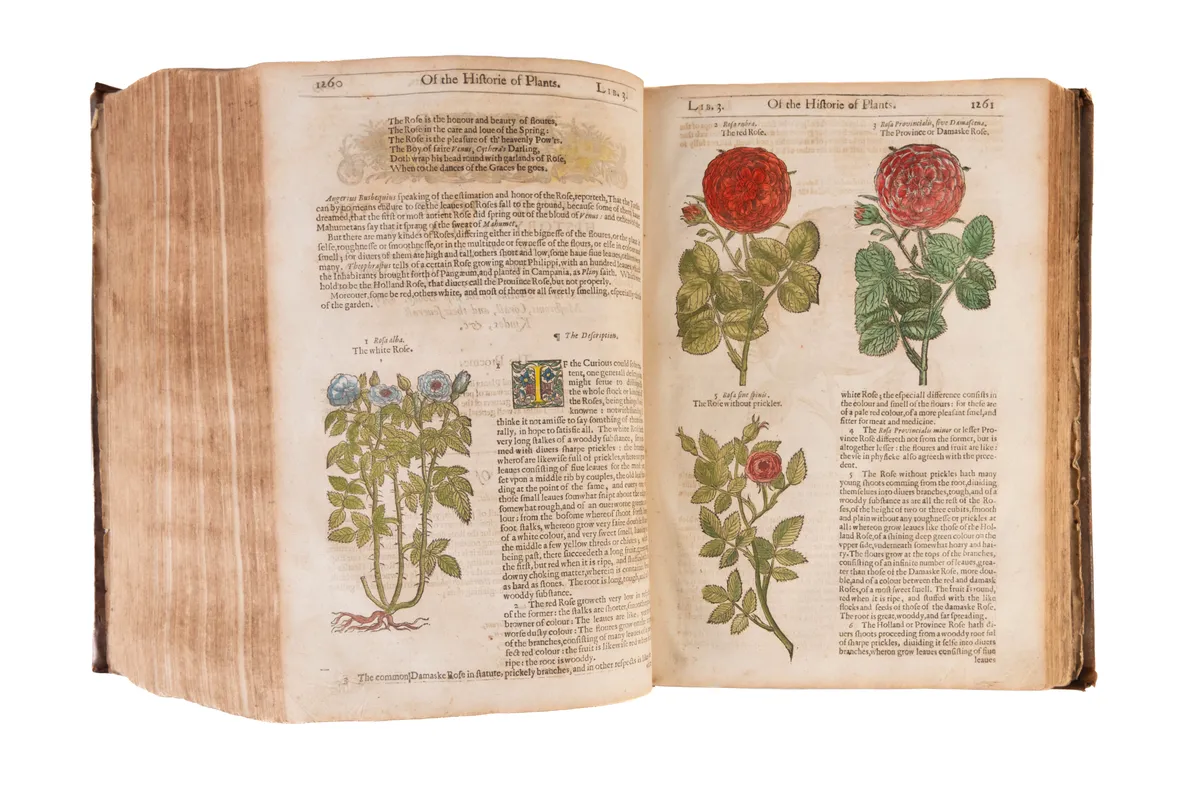
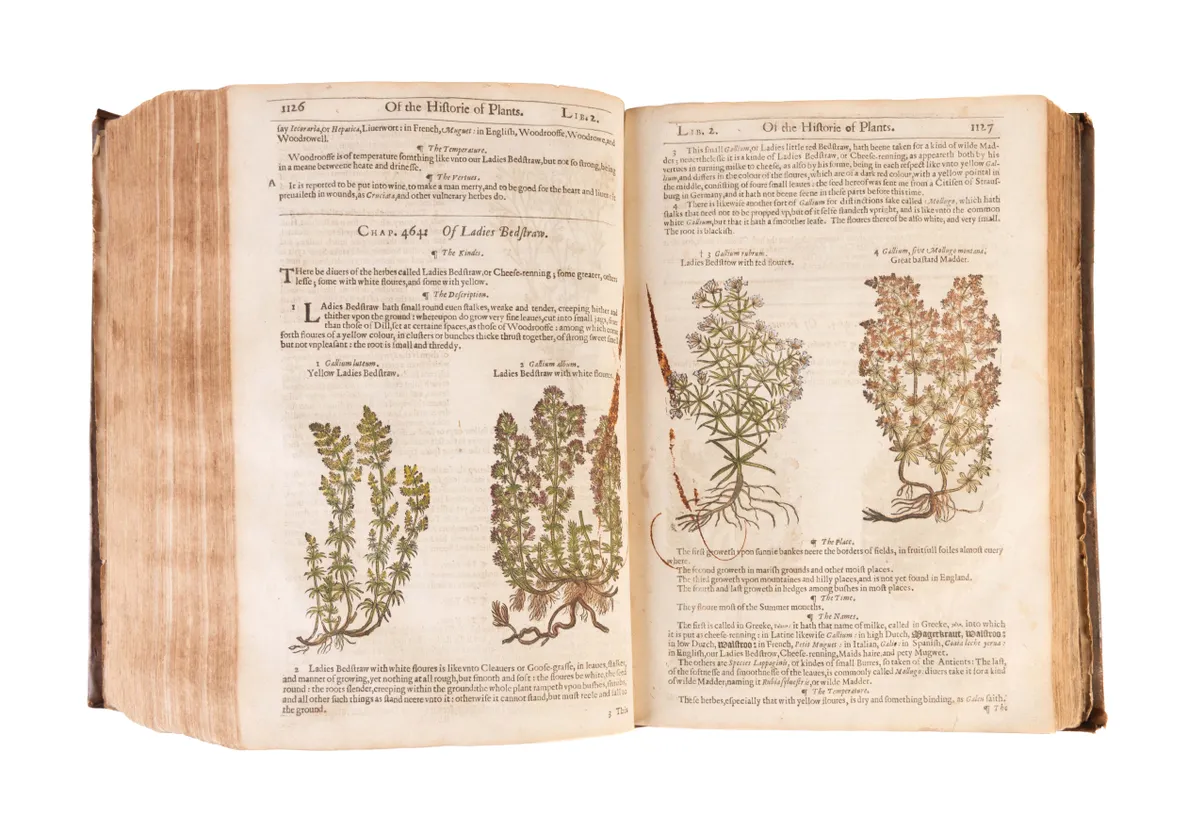
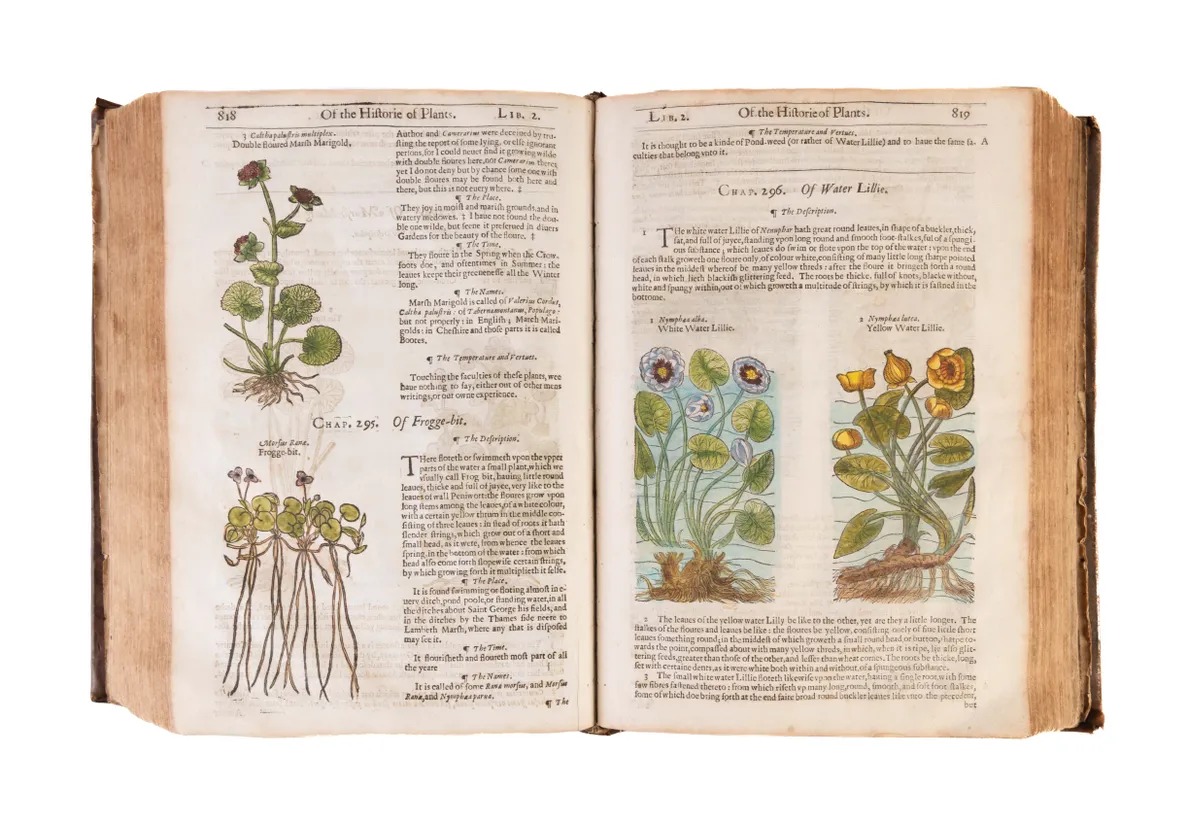
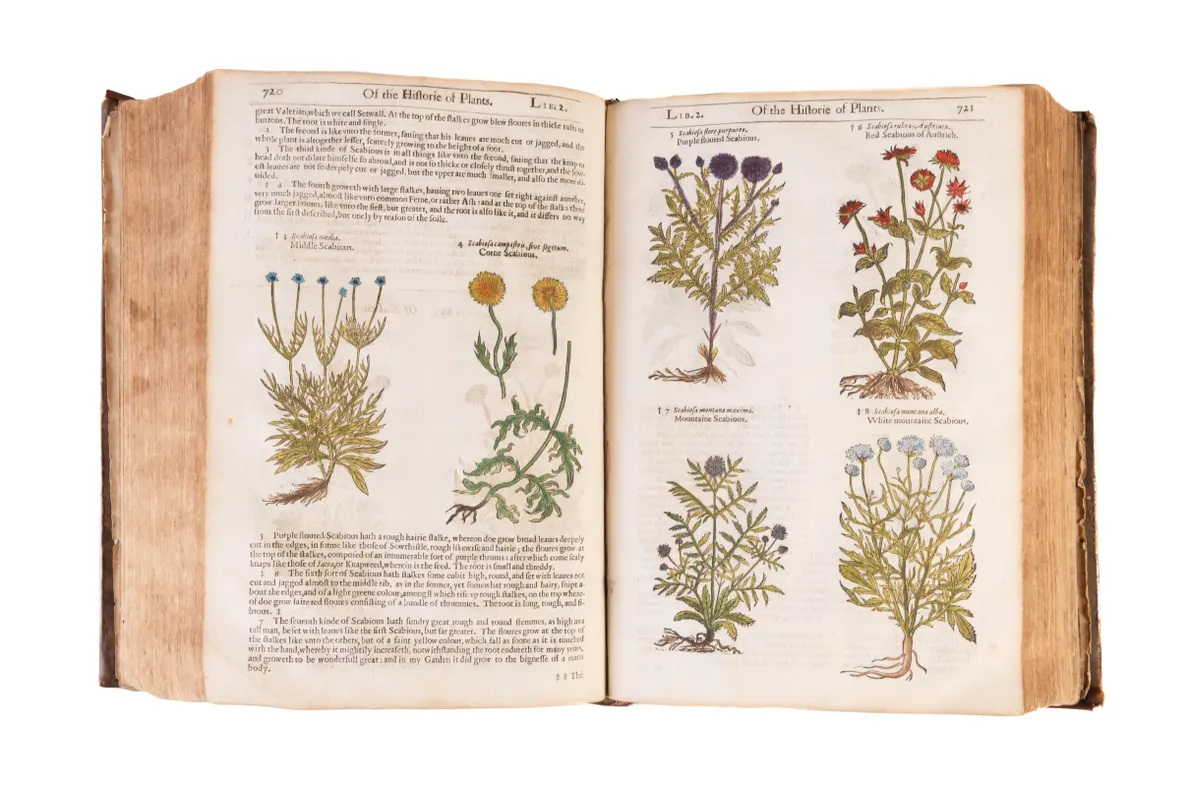
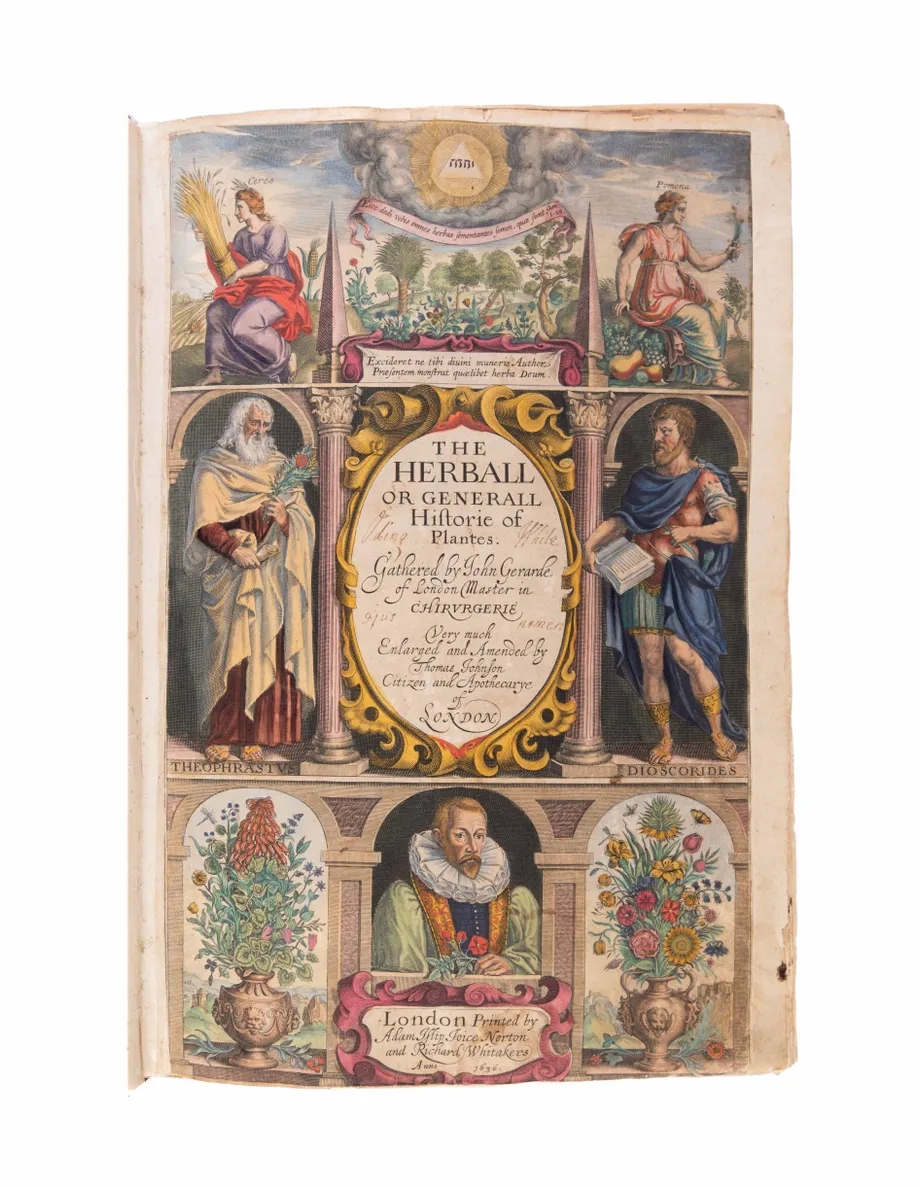
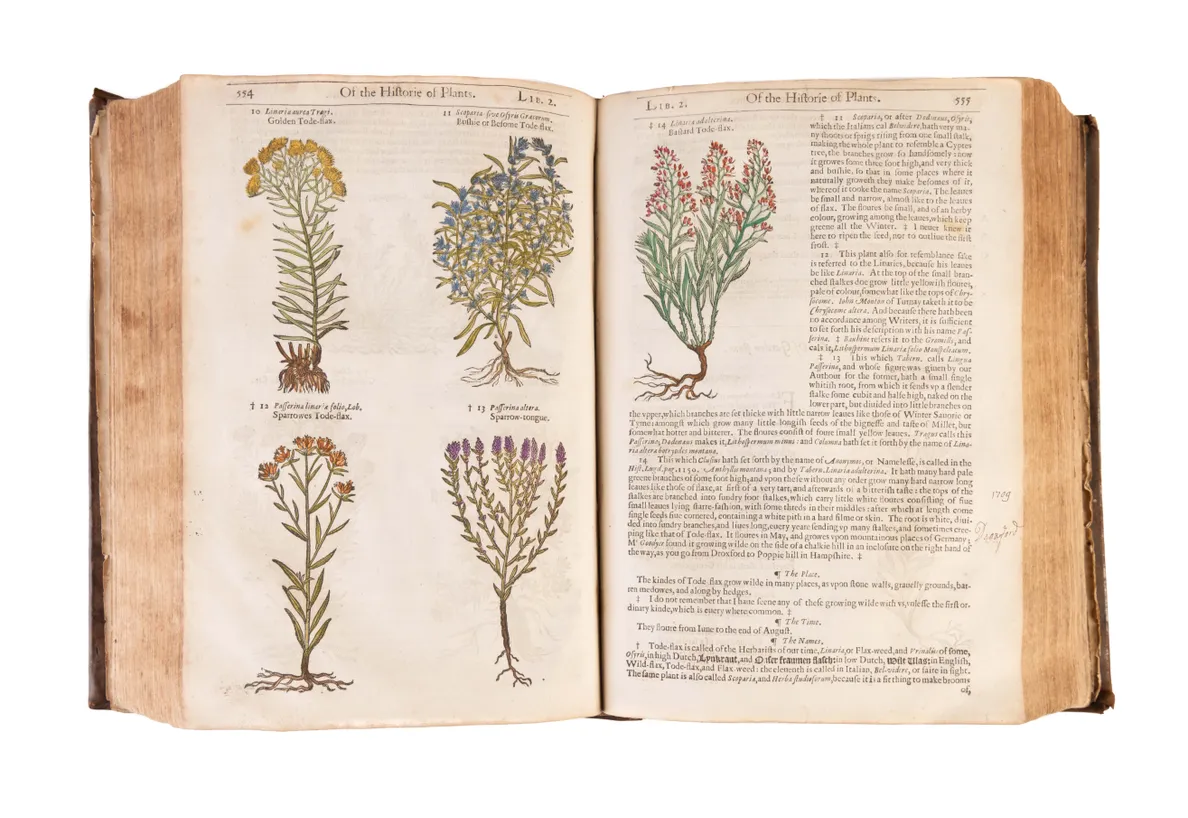
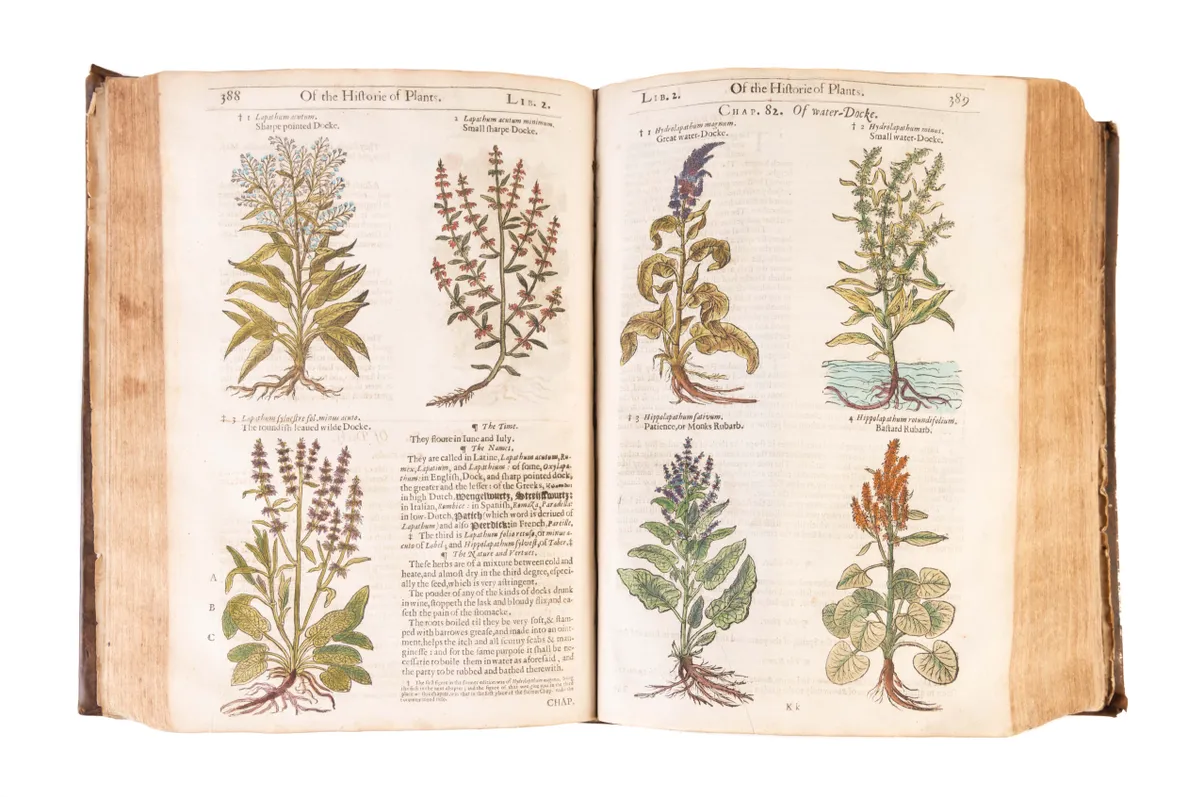
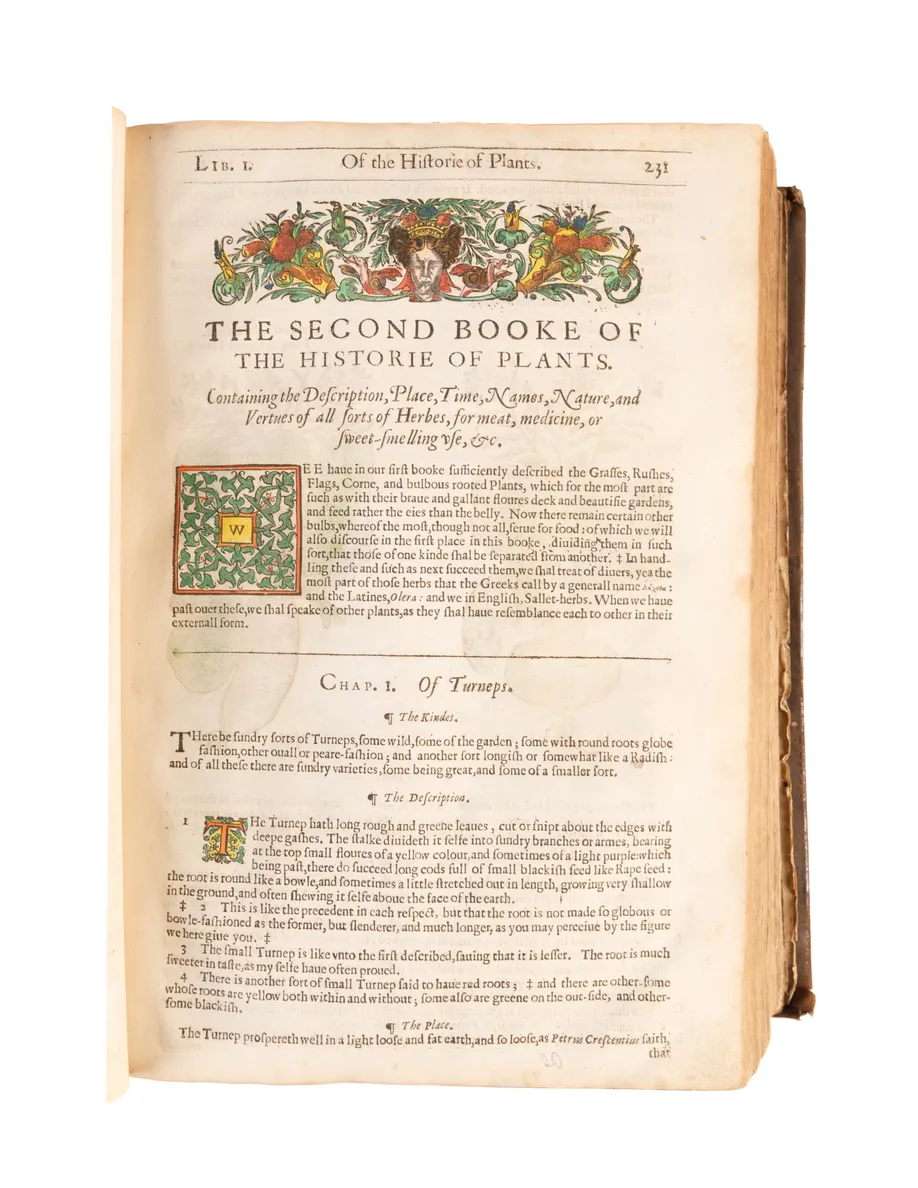
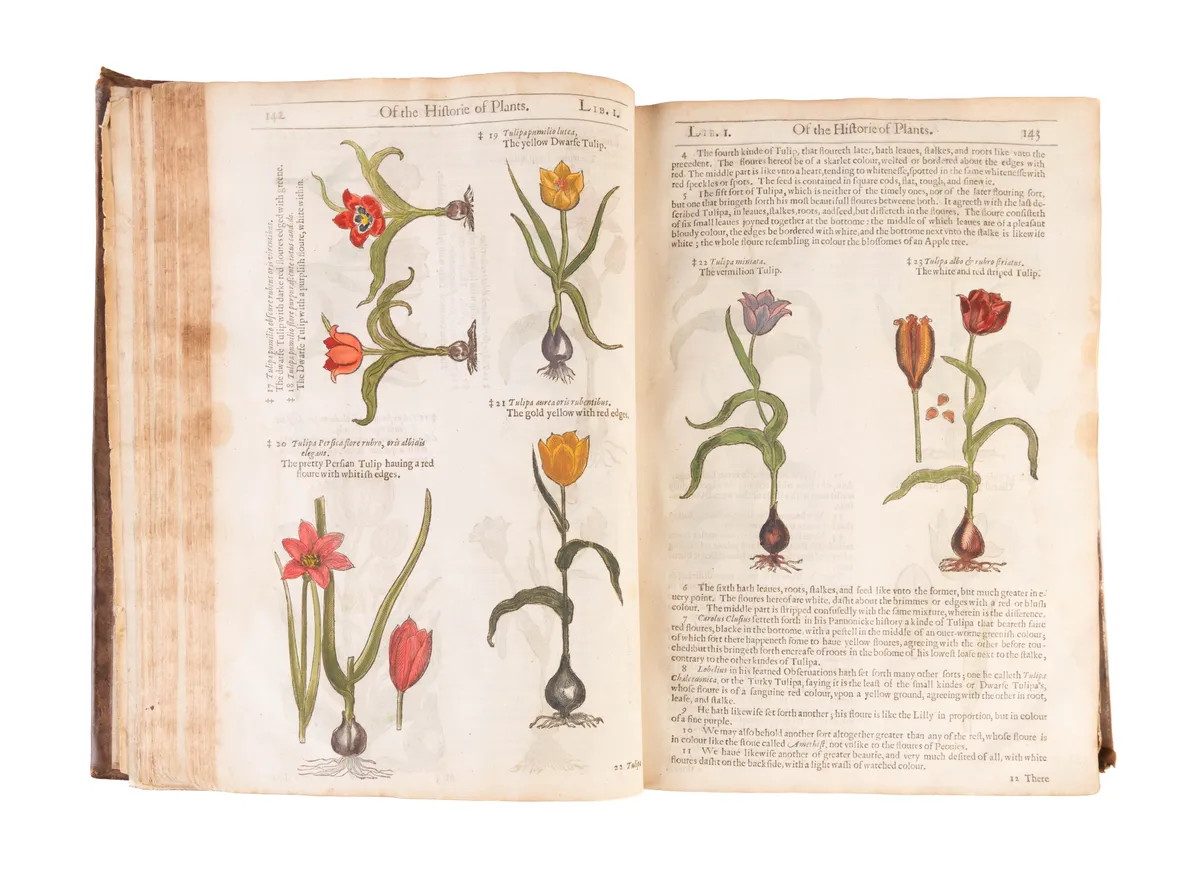
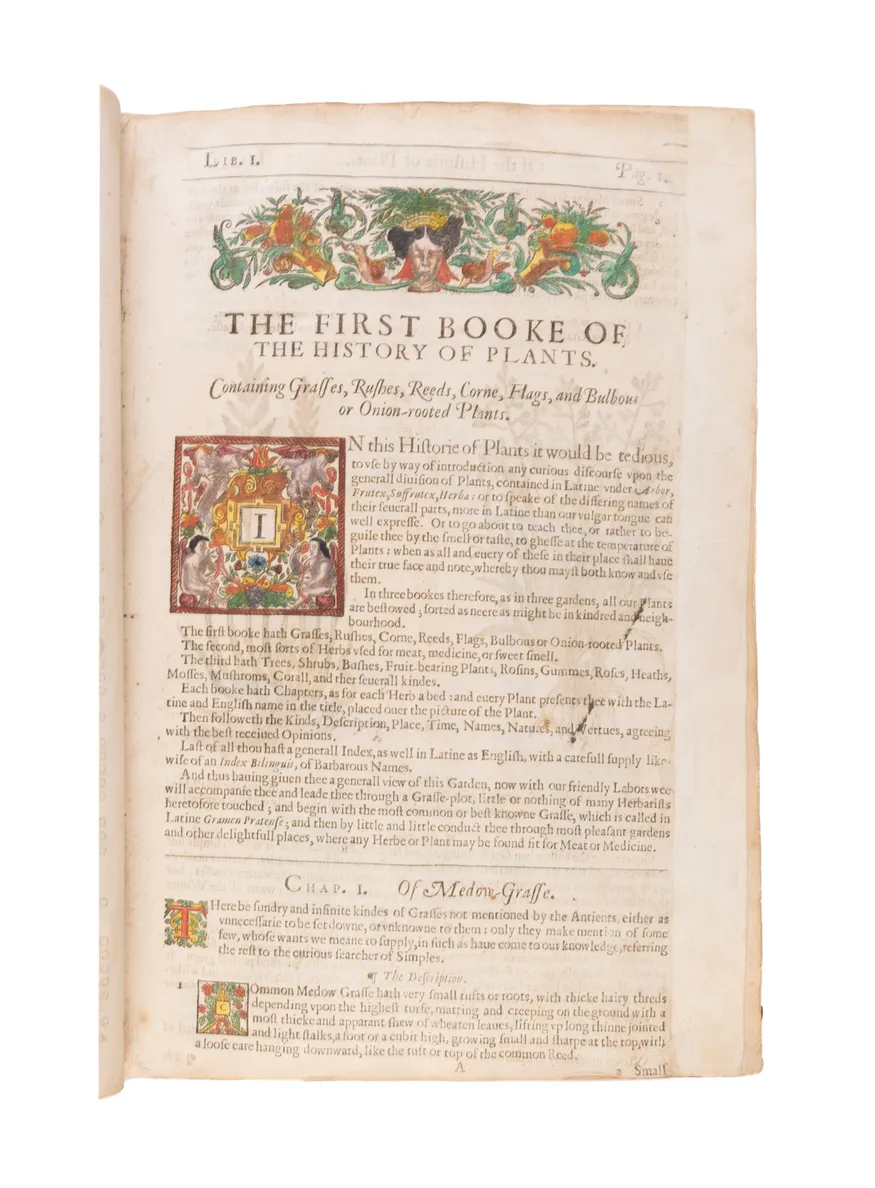
STC 11751. First published in 1597. This is the first edition with the extensive additions by Thomas Johnson and many additional new woodcuts. This edition was re-printed in 1636.
The first revised edition of the most famous English herbal: copiously illustrated with woodcuts and including extensive notes on the use of plants for medicinal purposes based on both first-hand research by Gerard and Johnson. With an overview of plants from across the world, including the first reference in any herbal to the potato.
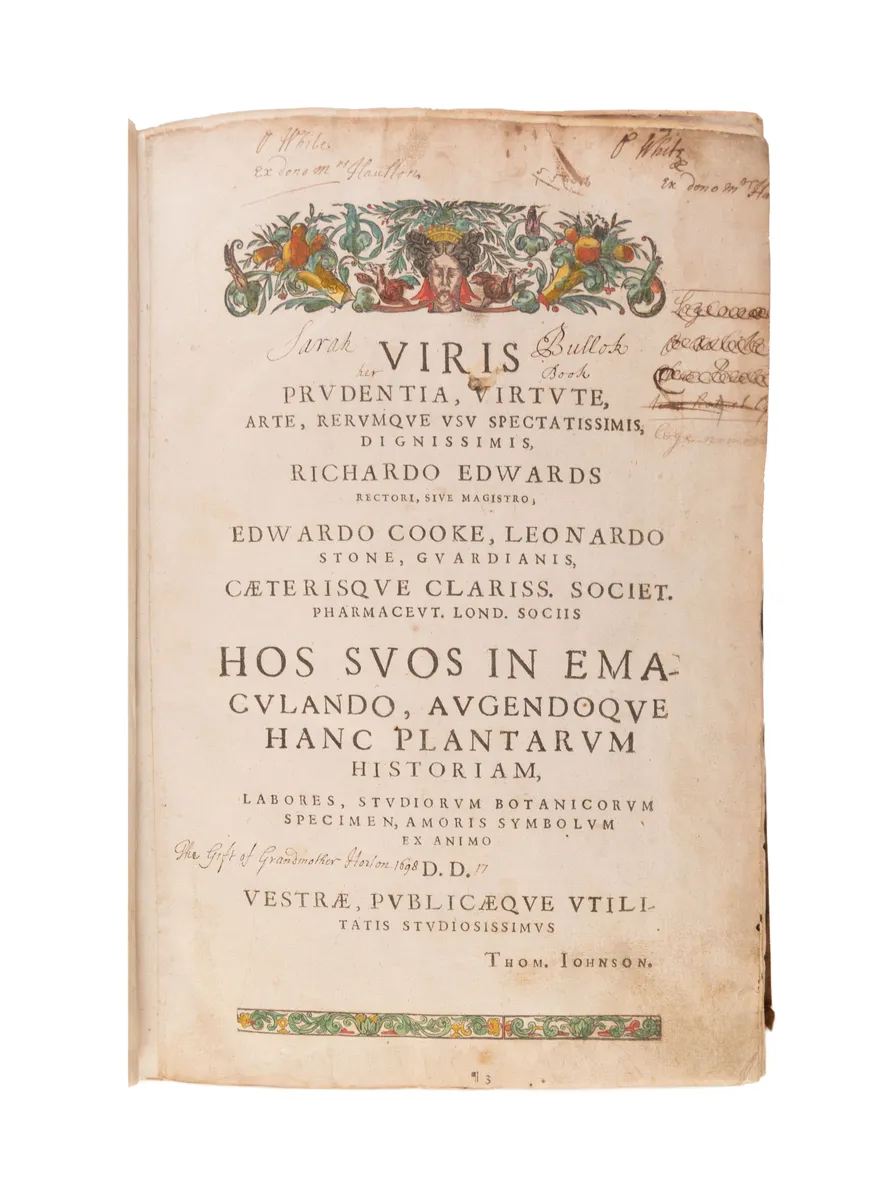
A striking copy - unfortunately lacking some of the index leaves - but otherwise with handsome contemporary hand-colouring and with marks of early ownership by various individuals including a woman, Sarah Bullok, and an apothecary, Odingsells White.
John Gerard's Herball was first published in 1597 and quickly became the standard English reference work on the subject despite being criticised for being based on earlier Continental herbals. The apothecary and botanist, Thomas Johnson (c.1595-1644) edited and updated Gerard's work. He was commissioned by Joyce Norton, widow of John Norton, the publisher of the first edition, and her two partners Richard Whitaker, concerned by the threat to their rights by the projected Theatrum Botanicum of John Parkinson which appeared in 1640. This new edition included many more woodcuts (the woodcuts "from beyond the Seas" were taken from books printed at the Plantin press and are not the same as the cuts in 1597 edition) and the extensive extra material by Johnson are clearly marked with a series of symbols to show his work. Although it is as "Gerard's Herbal" that it became universally known Thomas Johnson's role in correcting and supplementing Gerard's original book cannot be underestimated; it made into the work which generations have known since.
Each entry has an illustration and description followed by details of where the plants can be found (often based on Johnson's own plant-hunting tours of England), the time of year that it usually grows, an explanation of the names given to it and its "vertues" or medicinal uses. Much of the information shows Gerard and Johnson's own personal research and includes much anecdotal evidence about the plants. John Gerard was William Cecil, Lord Burghley's gardener and tended the garden of the College of Physicians in Chelsea as well as maintaining his own personal garden at his "House in Holborn within the Suburbs of London". Johnson also had his own garden at his home at Snow Hill in the City of London, so both were able to experiment with growing plants and received many unusual specimens from correspondents both around Britain and abroad.
The first-hand accounts by Gerard and Johnson figuratively 'root' the book firmly in London (and, in Johnson's case, Kent where he made several journeys) and provide much detail about gardening, medicine and food and drink preparation.
This edition reprints all the "para-material" from Gerard's first edition of 1597: his dedication to Sir William Cecil, Lord Burghley, the Latin addresses to Gerard by Lancelot Browne, physician to Queen Elizabeth, and Mathias de L'Obel, the Flemish physician and botanist living in London, five Latin liminary verses, and English addresses to the Reader by Stephen Bredwell [Bradwell], physician, by George Baker, "one of her Majesties chiefe Chirurgions in ordinarie", and by Gerard himself. There is a new dedication by Johnson to Richard Edwards, Edward Cooke, Leonard Stone and the rest of the members of the Society of Apothecaries, and a new 11-page address "To the Reader" in which Johnson rehearses the history of botanical writing from ancient to modern times concluding with John Gerard himself who, it must be said, he damned with faint praise:
"His chiefe commendation is, that he out of a propense good will to the publique advancement of this knowledge, endeavoured to performe therein more than he could well accomplish; which was partly through want of sufficient learning, ... He was also very little conversant in the writings of the Antients, neither, as it may seeme by divers passages, could hee well distinguish betweene the antient and modern writer; ... But let none blame him for these defects, seeing he was neither wanting in pains nor good will, to performe what he intended; and there are none so simple but know, that heavy burthens are with most paines undergone by the weakest men: and although there were many faults in the worke, yet iudge well of the Author; ..." Johnson then explains the many improvements and additions to his new edition which are identified in the text by a series of initials and listed in a 7-page "Catalogue of additions".
Johnson's revision of Gerard's text ends on (pp. 1588-9) with the Barnacle Goose - Gerard believed the medieval myth that they were hatched from barnacles generated at sea from drift-wood but Johnson quotes reports that they "were found by some Hollanders to have another originall, and that by eggs as other birds have: for they in their third voiage to find out the North-East passage to China & the Molucco's, about 80 degree and eleven minutes of Northerly latitude, found two little Islands, in one of which they tooke away sixty eggs, &c." Barnacles, on the other hand, he explains "are a kind of Balanus marinus" shell. This is followed by, "An Appendix or Addition of certaine Plants omitted in the former Historie" (pp. 1591-1630, [2]), forgotten or omitted in their proper place due to the "troublesomenesse, and above all, the great expectation and hast of the Worke, whereby I was forced to performe this task within the compasse of a yeare."
This section opens with the "Maracoc or Passion-floure" which "growes wilde in most of the hot countries of America, from whence it hath been brought into our English gardens, where it growes very well, but floures only in some few places, and in hot and seasonable yeares: it is good plenty growing with Mistresse Tuggy at Westminster, where I have some yeares seene it beare a great many floures." It ends with a leaf with four woodcuts (verso blank) omitted from their proper places as this "worke was begun to be printed before such time as we received all the figures from beyond the Seas."
Among the many new entries by Johnson are the Sugar Cane:
"The Sugar Cane groweth in many parts of Europe at this day, as in Spaine, Portugal, Olbia, and in Provence. It groweth also in Barbarie, generally almost every where in the Canarie Islands, and in those of Madera, in the East and West Indies, and many other places. My selfe did plant some shoots thereof in my garden, and some in Flanders did the like: but the coldnesse of our clymate made and end of mine, and I thinke the Flemings will have the like profit of their labour." (p. 38).
And the Potato:
"It groweth naturally in America, where it was first discovered ... since which time I have received roots hereof from Viriginia, otherwise called Norembega, which grow and prosper in my garden as in their owne native country ... the temperature and vertues be referred unto the common Potatoes, being likewise a food, as also a meate for pleasure, equall in goodnesse and wholesomeness unto the same, being either roasted in the embers, or boyled and eaten with oyle, vinegar, and pepper, or dressed any other way by the hand of some cunning in cookerie." (p. 927-8).
The Gerad-Johnson Herball was an important guide to botanical life for earl-modern settlers in new England:
“There were three great herbal authorities upon which the seventeenth-century settlers of New England mainly depended. Noted in inventories, listed by booksellers, mentioned in libraries and referred to in text, these are: Gerard’s Herball, 1633 edition, done over by Thomas Johnson, Parkinson’s Paradisi in Sole, Paradisus Terrestris, published in 1629, and Culpeper’s Herbal. … Gerard’s Herball sets out to be encyclopaedic and achieves such vigour, charm and style as place it in the forefront of quotable books in English literature. It has both spark and salt. Neither of the others has either” (Early American Gardens: For Meate or Medicine by Ann Leighton, 1987, p. 140).
Raymond Stearns neatly summarizes Johnson's updating of Gerard: "Johnson’s 'Gerardus Immaculatus' was a vast improvement over Gerard’s Herball and it became the guide-book of American colonial botanical collectors for many years.” (Science in the British Colonies of America, 1970, p. 63-4).
There is also a long section on tending fruit grown on vines and making wine from grapes: "The kindes of wine are not of one nature, nor of one facultie or power, but of many differing one from another: for there is one difference thereof in taste, another in colour; the third is refered to the consistence or substance of the wine; the fourth consisteth in the vertue and strength thereof ... by age wines become hotter and sharper, and doe withall change oftentimes the colour, the substance, the smell: for some wines are sweet of taste, others austere or something harsh. ...The stronger and fuller wine groweth in hot countries and places that lie to the sun" p.878-9).
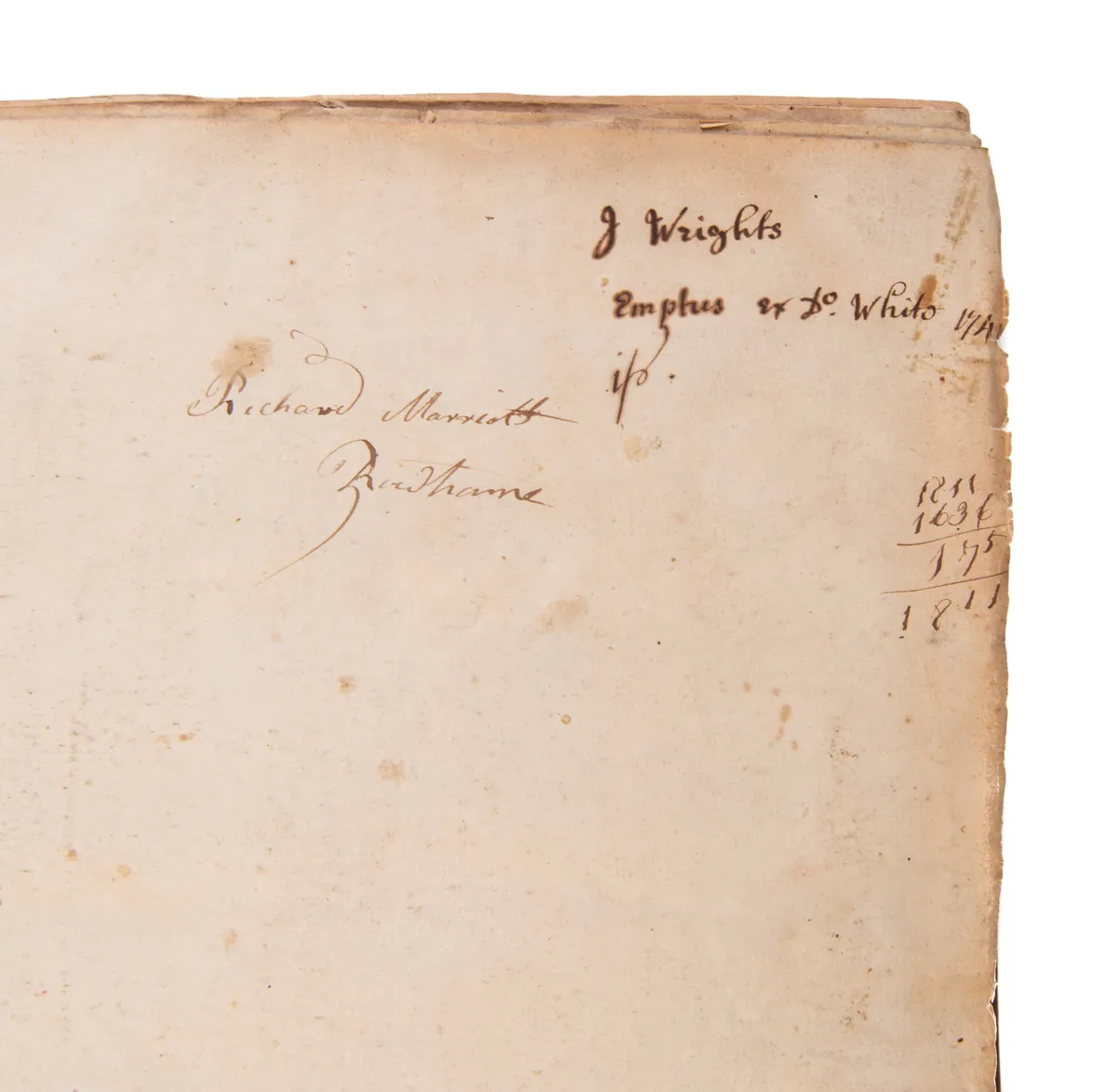
Provenance: 1.: "Sarah Bullok Her Book", inscription on the dedication leaf (perhaps the earliest inscription here as it has the prime central position). 2: Odingsells White, an apothecary, of Mansfield, county Nottingham, with his signature "Odingsells White 1709" opposite p. 1 and inscriptions on the dedication page: "O White ex dono Mrs Hautton" (repeated) and "The Gift of Grandmother Horton 1698". Records are elusive, but he was described as a 'pharmacopala' [sic for pharmcopola] on a bond for the marriage of his daughter Ann White to John Thompson "bibliopala" [sic] of Mansfield (Nottinghamshire Marriage Licences, Vol. II, Part 1, p. 28 He was buried at St Peter's, Mansfield, on 28 March 1715. The (De) Odingsells family had owned part of the manor of Epperstone in Nottinghamshire since the Middle Ages. 3: "J. Wrights Emptus ex D.o White 1741" (inscription on the front flyleaf). 4: Charles Burbidge, wit signature "Ch. Burbidge" opposite p. 231. 4: Richard Marriot [?Rowhame]", later 18th/early19th-century signature on the front flyleaf.