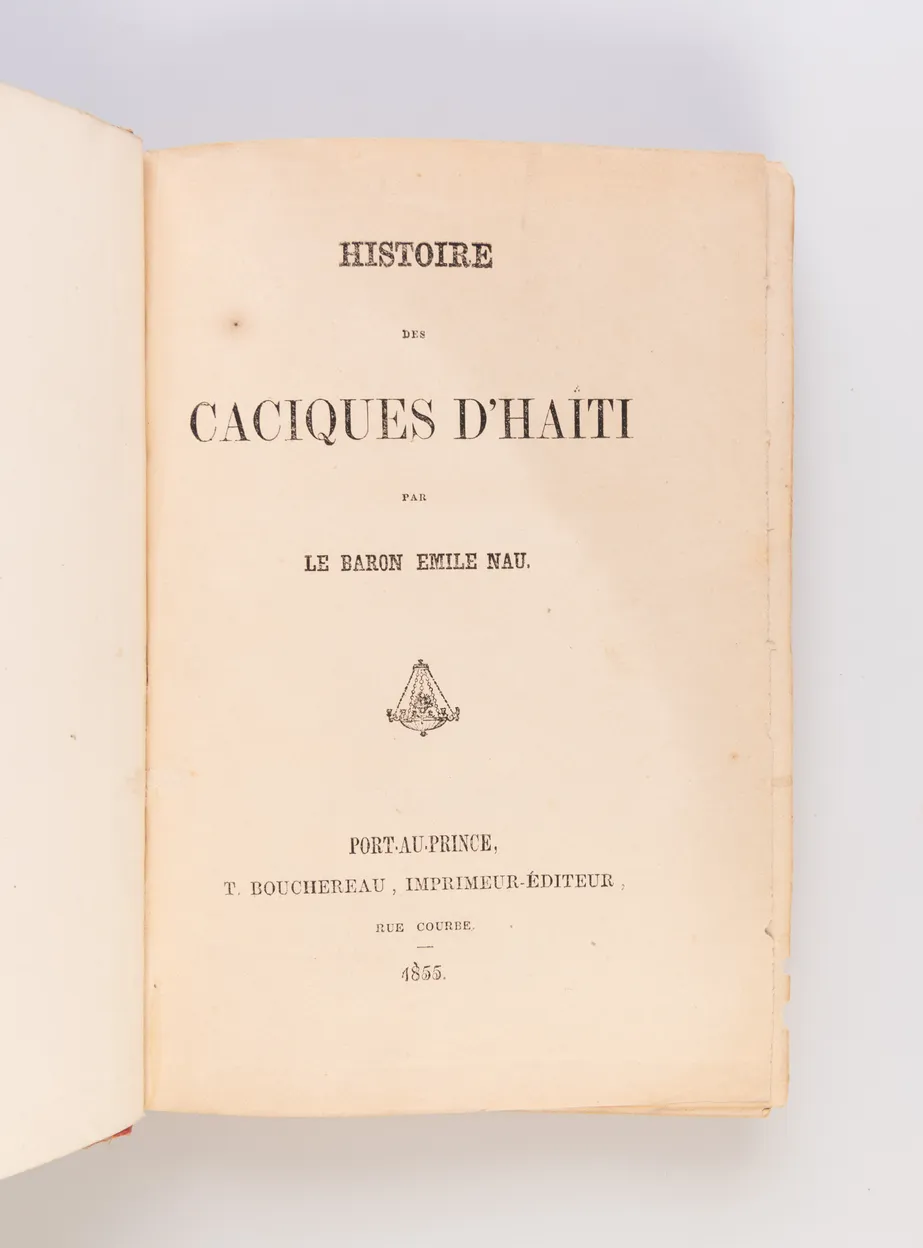
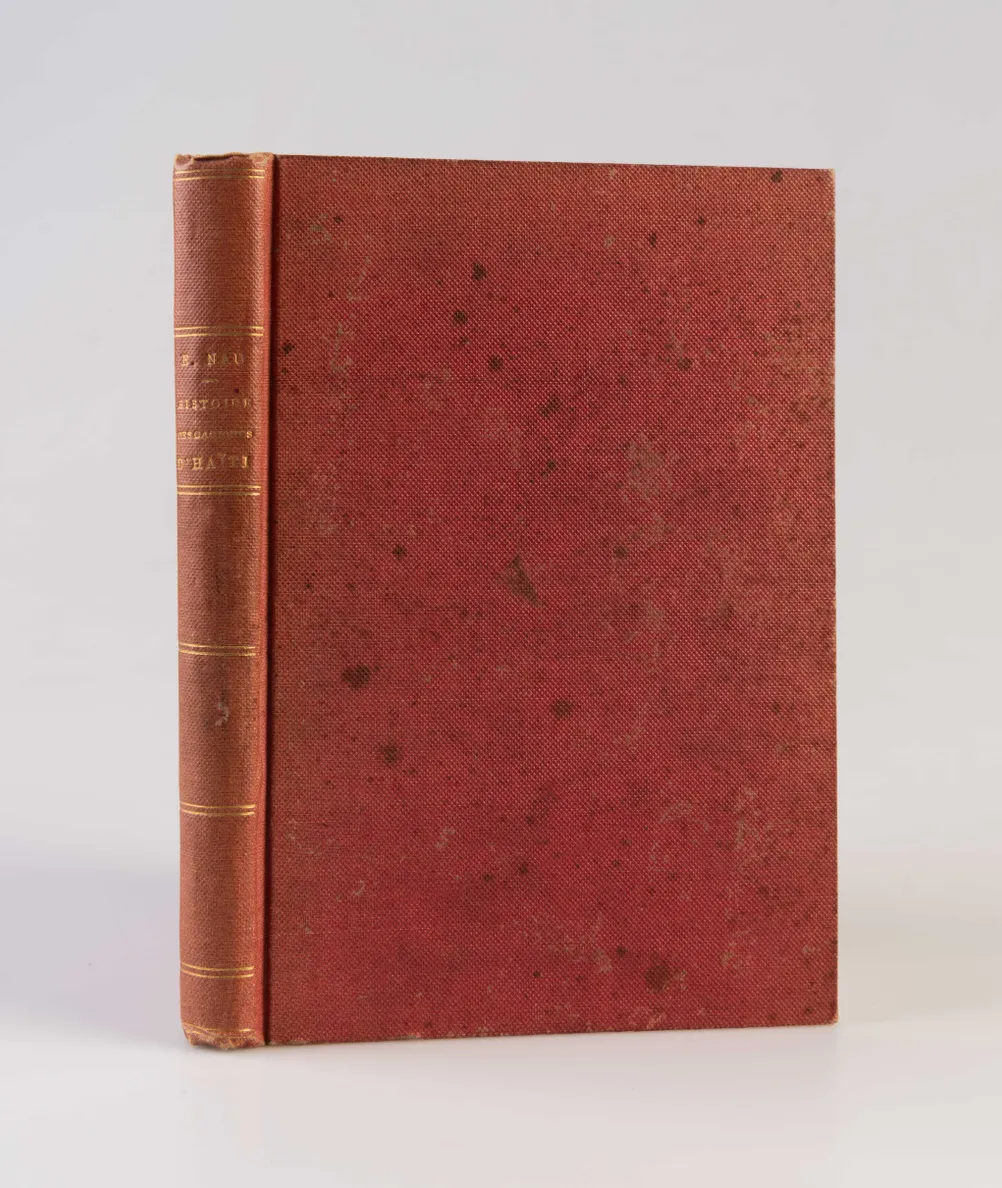
A very good copy of an exceedingly rare and substantial work by the Haitian politician, journalist and historian, Émile Nau (1812-1860).
Nau states in the preface that the history of Haiti divides neatly into four periods: European discovery; colonisation and the introduction of chattel slavery; the era of conflict between owner and enslaved, the class of free coloured people, emancipation and the Haitian Revolution; followed by the establishment of the Republic of Haiti.
The focus of this work is a history of the indigenous chiefs of Haiti and commences with the arrival of Christopher Colombus in 1492 and finishes with the rebellion led by the Taíno (Arawak) cacique, Enrique (1498-1535) in 1519. Across fourteen chapters that document the earliest years of contact, Nau draws a thematic line from that period through the Haitian Revolution to the founding of the Republic of Haiti.
Nau's work is a detailed account of the European colonisation of Haiti (which is to say America) through Haitian eyes. From this historical perspective, he "depicted the Arawaks as a regal line that was derived from neither Europe nor Africa. Later generations of Haitian historians and artists were able to imbue the Arawak people with nationalistic characteristics that combined the best qualities of elite culture. Arawaks were thought of as the original defenders of Haitian soil who carried themselves with a cultured comportment that attested to their ruling competence" (Largey). Indeed, "Nau presents the indigenous Taínos as the forbears of his country's Afro-descended population and positions Enrique's 1519 rebellion against Spanish colonialism as a precursor to the 1791 Rebellion of Saint-Domingue" (Genova, 14). Furthermore, "the Taínos are not simply the predecessors of the nineteenth-century Haitians; rather through a process of race mixture, they have become the literal ancestors of that population" (ibid, 15).
An important contribution to Haitian history as well as Haitian publishing, the book concludes with an appendix divided into sections on geography, indigenous language, and Haitian flora.
OCLC locates copies at NYPL, Newberry, State Lib Mass, BL, and Zurich. Just two copies at auction in 1955 and 1972. A second edition was published in Paris in 1894.
Sabin, 52057; Genova, T., "Haitian Entanglements: Emile Nau's Histoire des caciques d'Haïti in Manuel de Jesús Galván's Enriquillo" in Afro-Hispanic Review, Vol. 35, No. 2 (Fall, 2016), pp.10-25; Largey M., "Composing a Haitian Cultural Identity: Haitian Elites, African Ancestry, and Musical Discourse" in Black Music Research Journal, Vol. 14, No. 2 (Autumn, 1994), p.112.