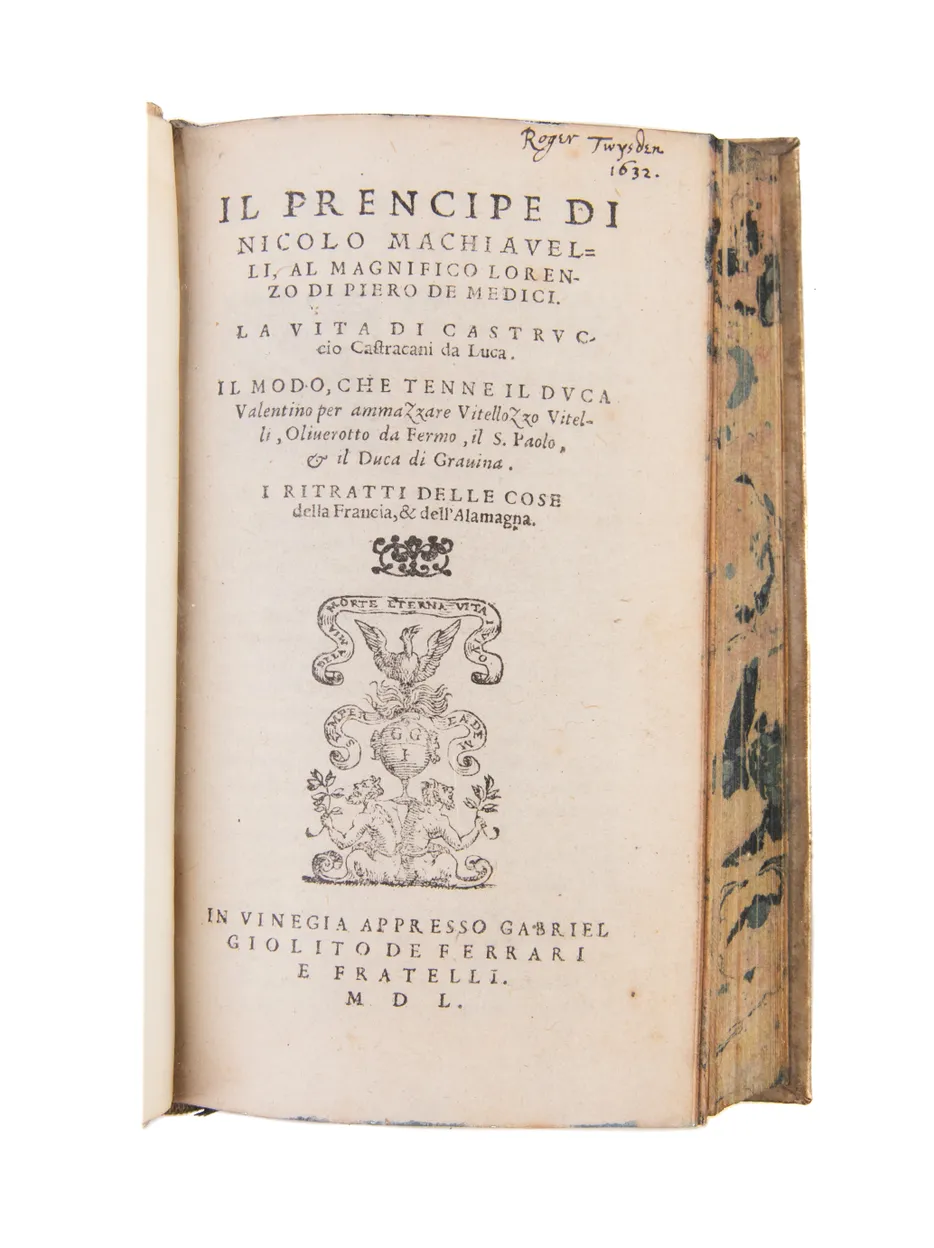
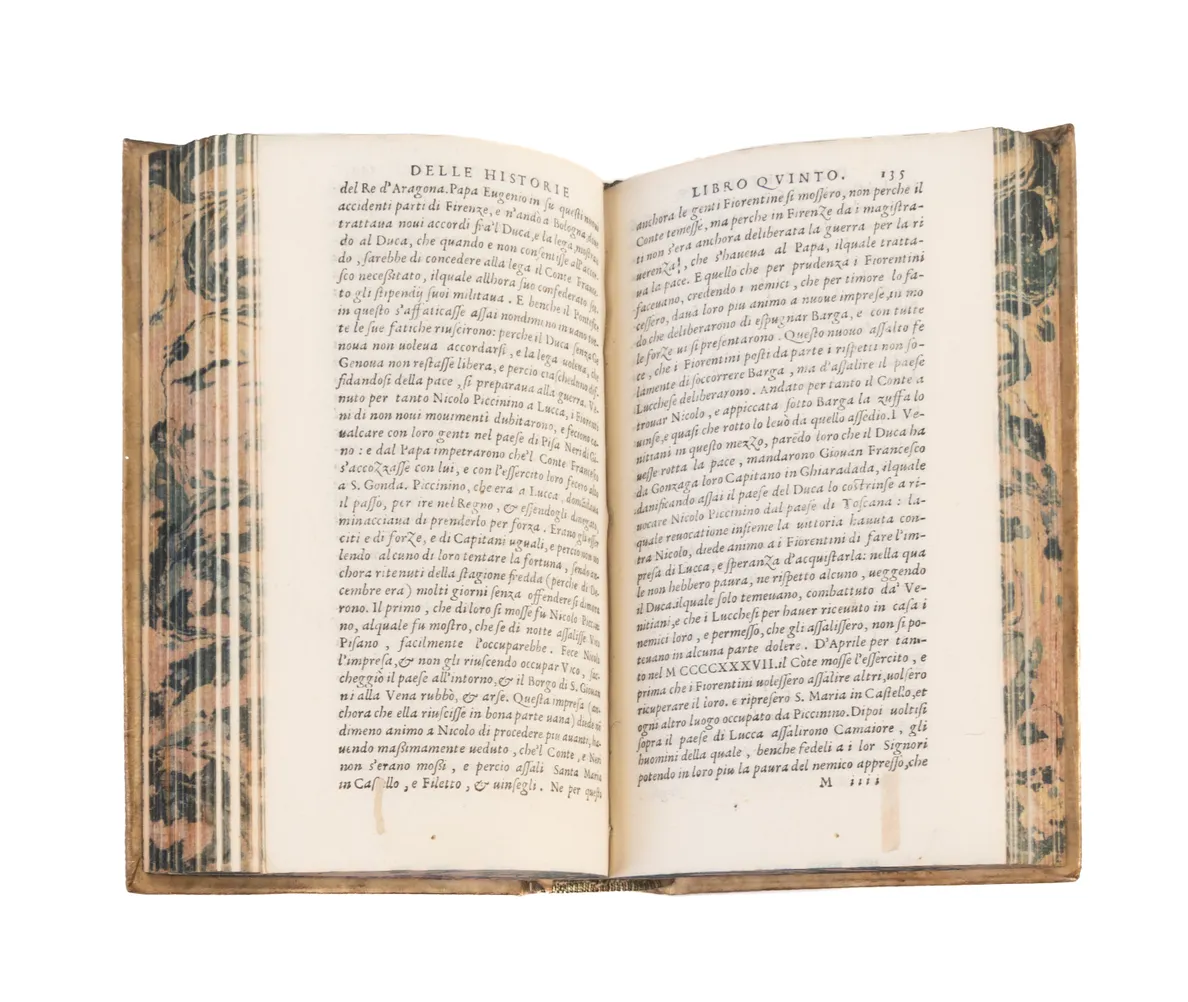
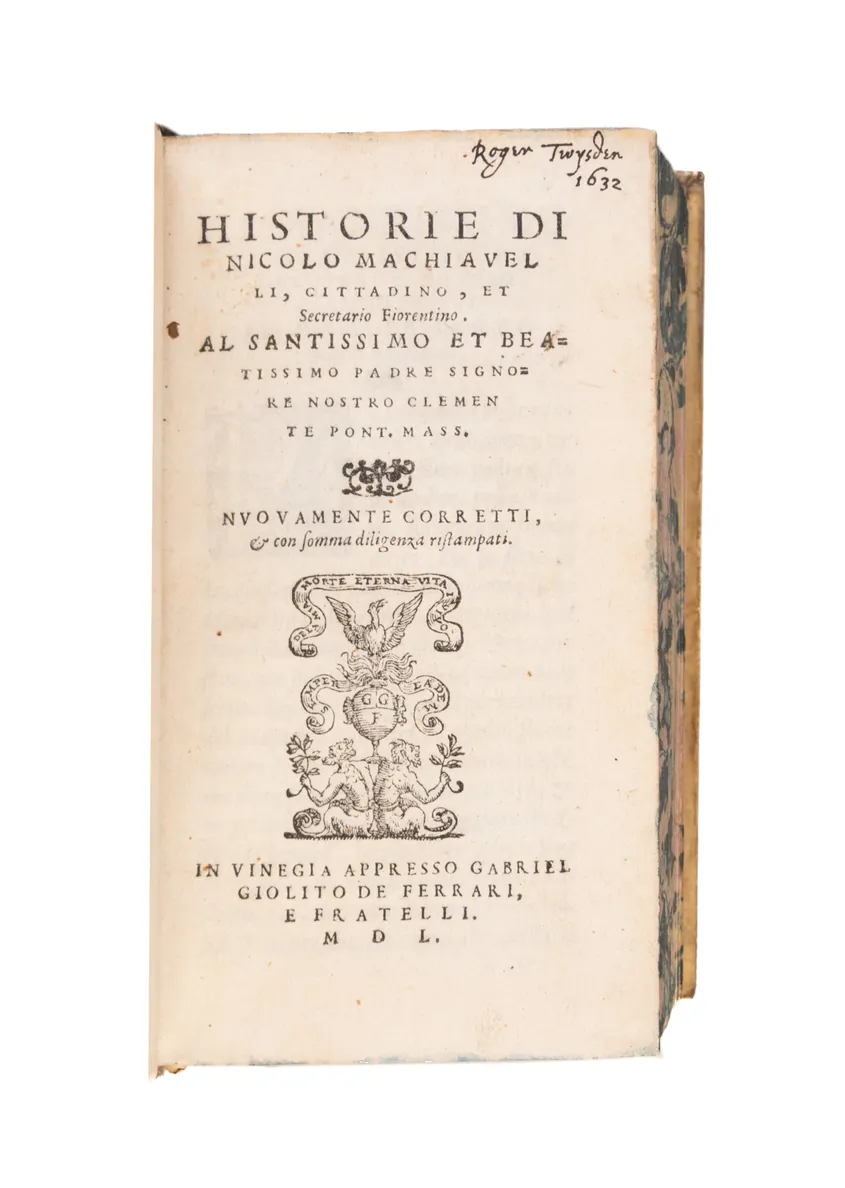
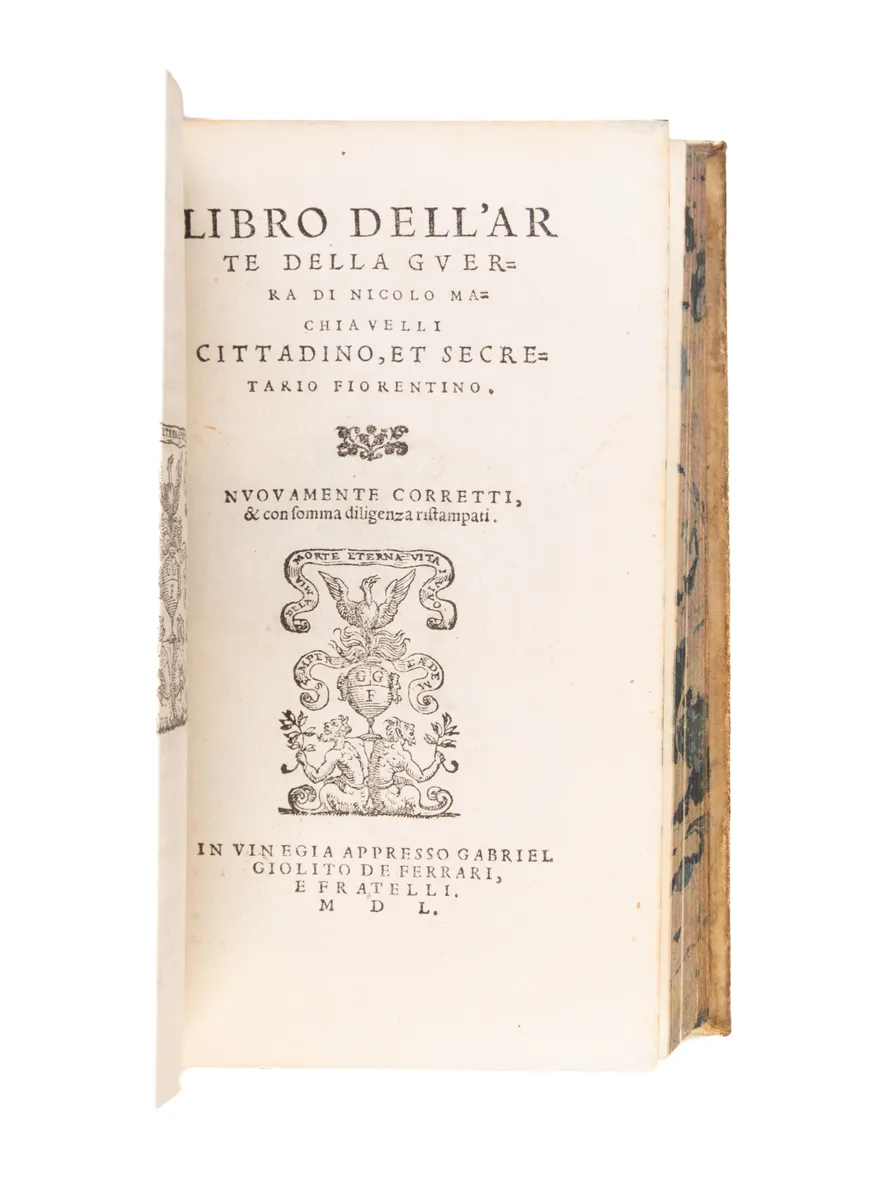
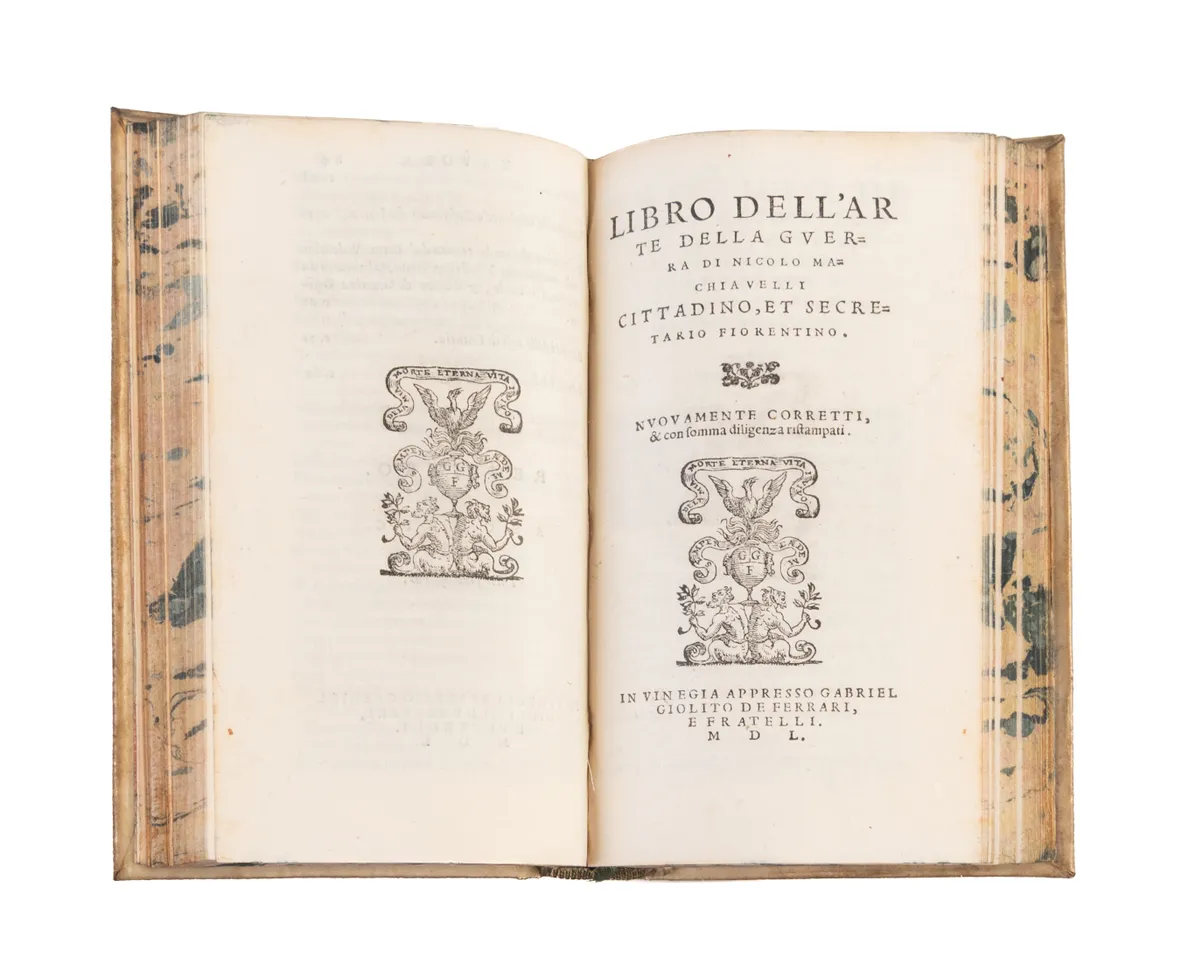
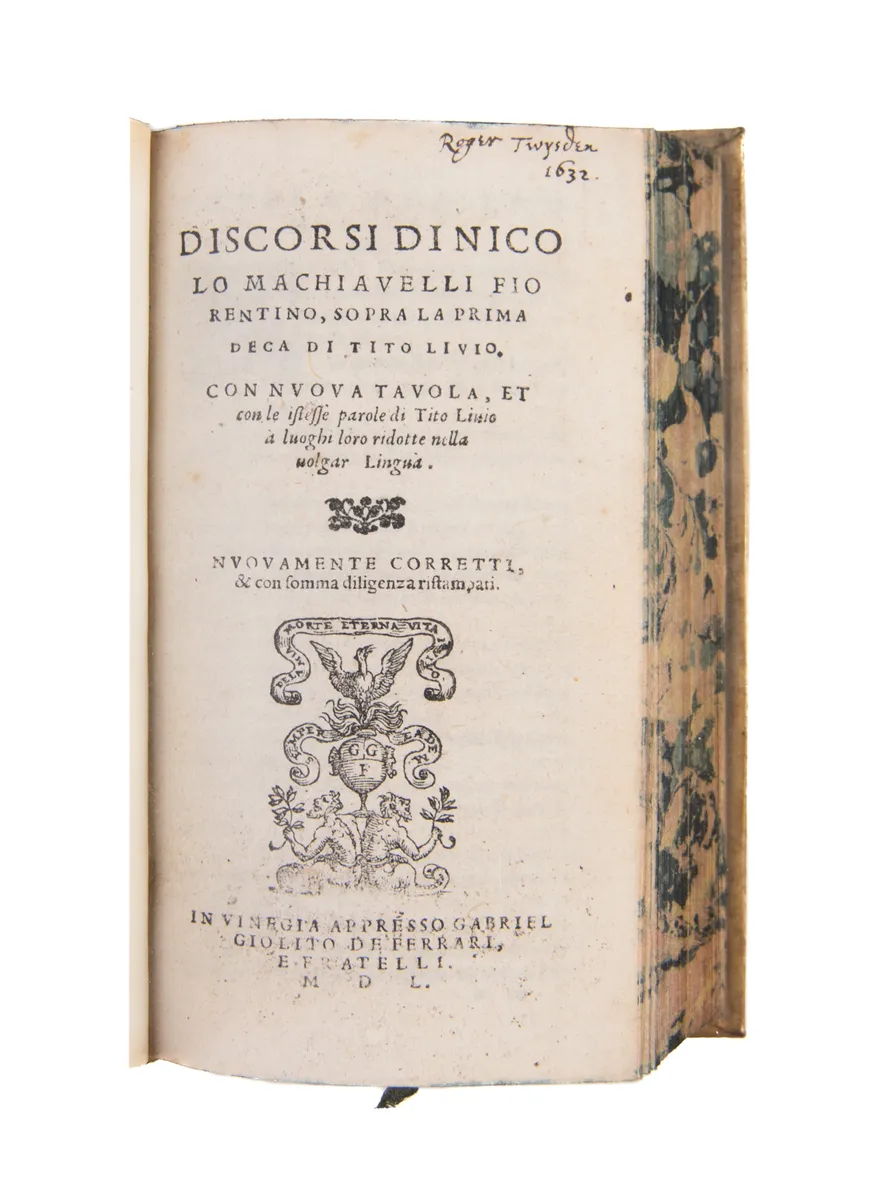
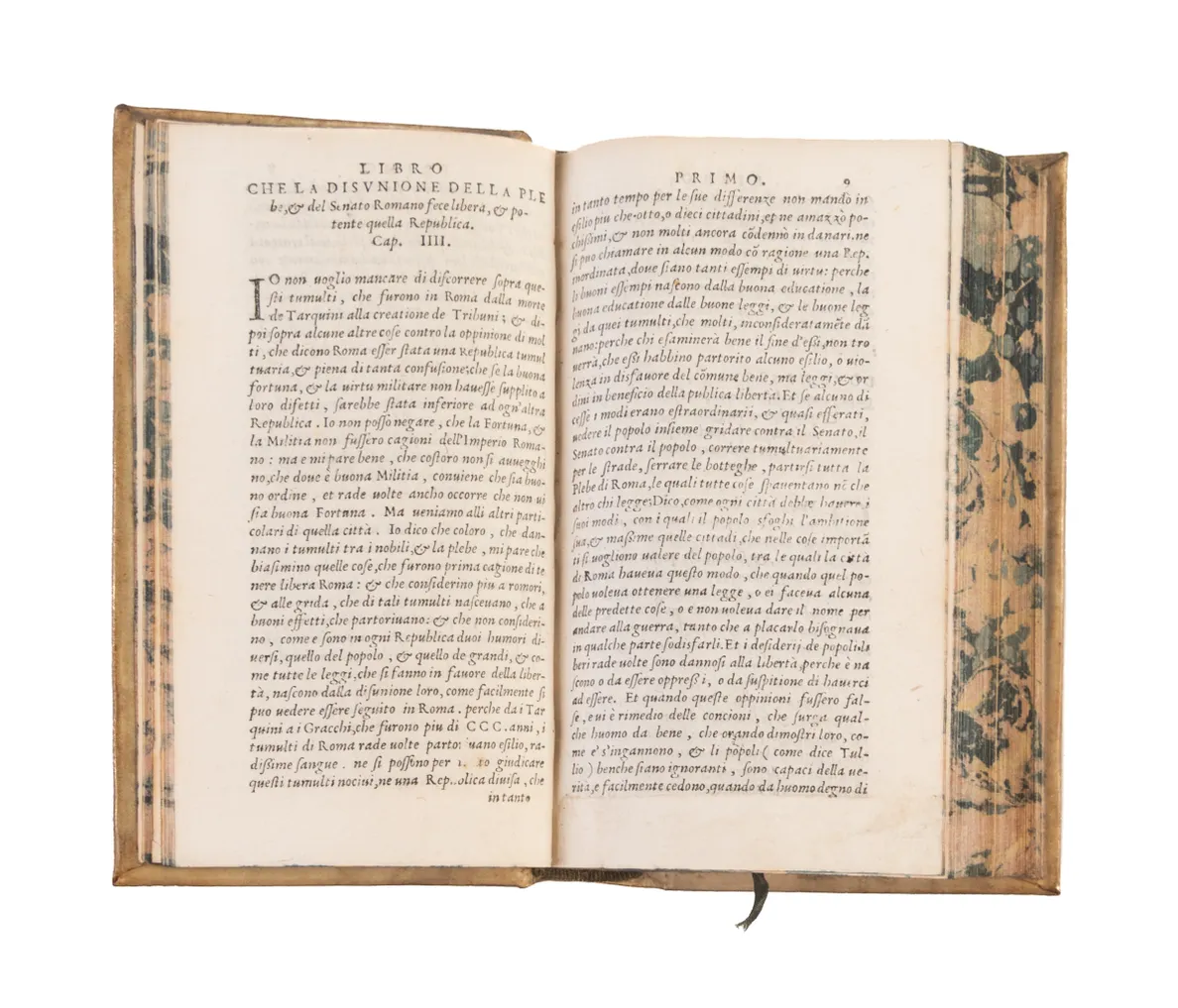
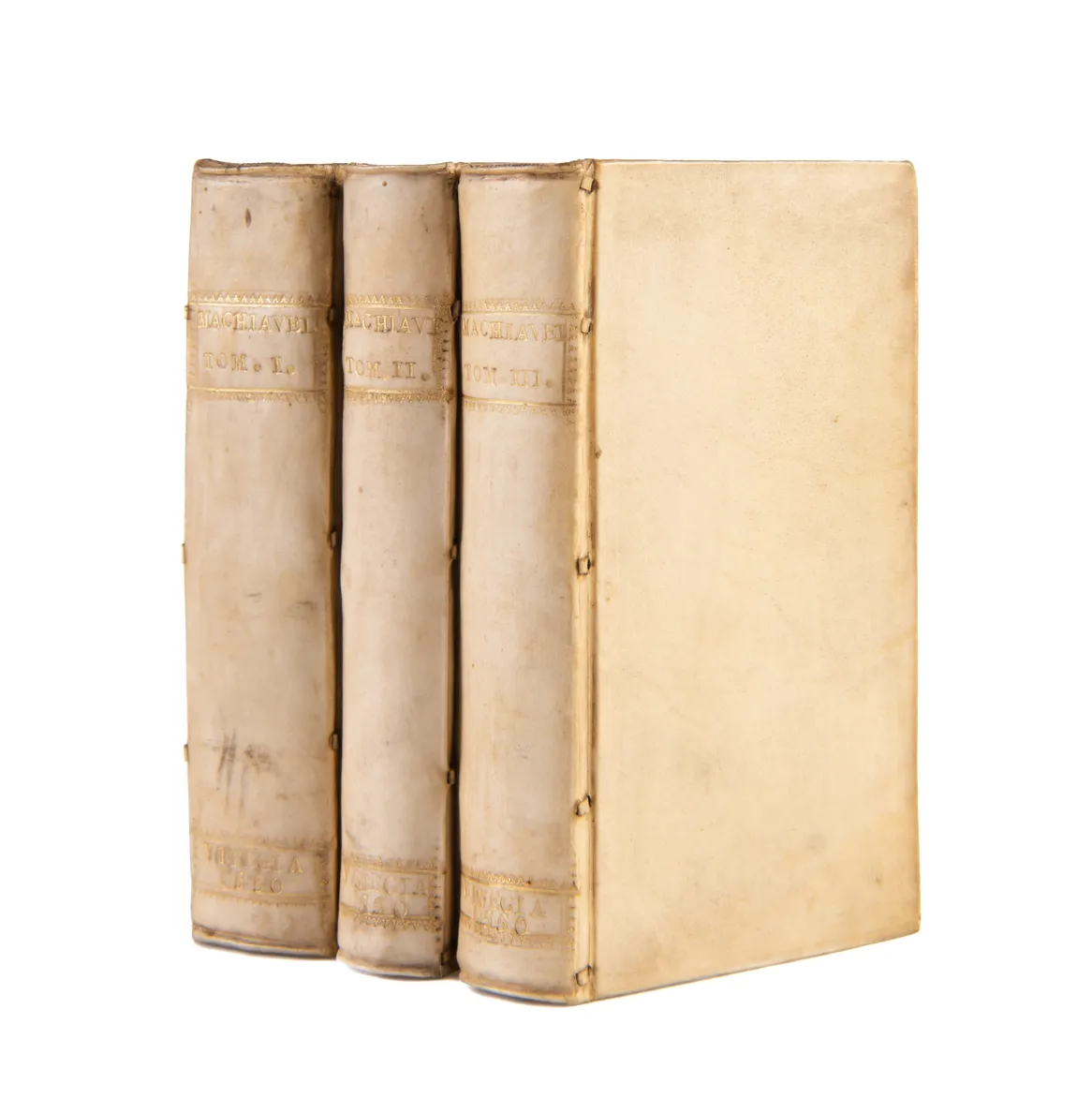
A handsome set of the political and historical works of Machiavelli, printed by Giolito in Venice in 1550, and one of the last full editions printed prior to Machiavelli's writings being placed on the Index. These works are uncommon individually and extremely rare found together: we have identified just one institution worldwide that holds all four titles (BL), and not in a uniform set as here. This attractive set is from the library of seventeenth-century antiquary, lawyer, constitutional enthusiast and baronet Sir Roger Twysden (1597-1672), with his ownership inscription, dated '1632', on the title pages of each of the three volumes.
Initially published separately between 1529 and 1532 in Rome and Florence, the historical and political works of Machiavelli (the Historie, Discorsi, Prencipe and Arte della Guerra as here) were reprinted fairly constantly in the first half of the sixteenth century. It was only in 1540, however, that they were printed together for the first time, offered in four volumes by the Aldine press (and again by them in 1546). It was a significant step in the printing history of Machiavelli's corpus that prompted immediate imitators (Bertelli & Innocenti, L), though the present edition, rather than simply an exercise in slavish imitation, separately confirmed Giolito's status among the editors of Machiavelli's works.
Giolito's would be among the last of the Italian editions of the collected works to be printed in the sixteenth century, along with Giunta (1551) and Domenico Giglio of Venice (1554); all of Machiavelli's writings were placed on the Index and banned, first by Pope Paul IV (1558-9) and again by the Council of Trent in 1564 (B&I, XLVII). Even prior to their formal placement on the Index, his books were beginning to appear on catalogues of libri proibiti elsewhere on the continent (as early as 1543, in Paris) and inquisitorial penalties and punishments were already in the air in the 1550s that discouraged and slowed their publication, particularly in Venice (B&I, LIII). Their prohibition, when it came, 'was rigorously maintained for more than two centuries' (Bongi, p.319). While some C16th and C17th editions of the works did appear they were all printed elsewhere in Europe, often falsely giving Italian cities in their imprints (John Wolf, of London, printed his under the false imprint of the 'heirs of Giolito'); even the work-around employed by printer Jacopo Sansovino, who continued to print Machiavelli's works and simply removed the writer's name, was impossible by the end of the century (B&I, XLIX).
Provenance: 1. Sir Roger Twysden, 2nd. Bt. (1597-1672), M.P., antiquary, of Roydon Hall, East Peckham, Kent, with his signature on each of the three titles, "Roger Twysden 1632". A lawyer by training, his commitment throughout his life 'to the rule of law and constitutional propriety' (ODNB), might explain his academic interest in and possession of the works of Machiavelli but meant, rather unfortunately, that he was treated with suspicion by both sides in the English Civil War; "He was an advocate of balance and peace in a time of turmoil and violence, and he paid a high material price for refusing to compromise his ideals. Throughout, he remained devoted to his family and magnanimous towards his enemies. Twysden's sufferings and his steadfast attachment to the known laws were typical of many moderate gentry in mid-seventeenth-century England."
"Twysden was of a deeply scholarly temperament [and] he numbered such scholars as Sir Simonds D'Ewes, John Selden, Sir Henry Spelman, and Sir William Dugdale among his friends. Twysden read widely in original sources, and wrote extensively: three of his works were published during his own lifetime, and others appeared posthumously." (ODNB). Unsurprisingly, given his scholarly interests, Twysden was an avid collector of both printed books and medieval manuscripts, including in Greek and Hebrew; "he inherited some books from his father and acquired his own from booksellers and from his numerous antiquarian contacts. He documented a wish that his library should become a family heirloom and bequeathed all his books to his eldest son William with a stipulation that they be kept together at Roydon" (Pearson, Book Owners Online). Twysden's library would eventually be sold by his grandson to Sir Thomas Sebright around 1715; Sir John Sebright of Beechwood Park would in turn sell the family library, including various books formerly belonging to Twysden, through Sotheby's on 6 April, 1807. The Grolier Club has a mid-C19th manuscript copy of an earlier (1816?) Catalogue of the books and pamphlets being part of the library of Sir Roger Twysden, Bart. of Royden Hall (NYGG01-A38) from the collection of Richard Heber, and subsequently Thomas Phillipps; both Heber and Phillipps owned books from Twysden's library.
2. Sandys family of Ombersley Court, with the armorial bookplate of Lord Sandys, likely Edwin, 2nd Baron Sandys (1726-1797) to the front pastedown of all three volumes. Edwin Sandys was a noted scholar, classicist, founding Trustee of the British Museum, and member of the literary circle known as the Streatham Worthies, along with hosts Henry and Hester Thrale, Samuel Johnson, Joshua Reynolds, Edmund Burke, and others. Built over five centuries, the Sandys' library at Ombersley Court remained intact before its recent dispersal at auction.
Refs: Bongi, Giolito, vol. I, pp.319-321. Historie: Bertelli & Innocenti, Bibliografia Machiavelliana, Sec. XVI, no.84. Discorsi: CNCE 46650. Bertelli & Innocenti, no.83. Il Prencipe: CNCE 54729. B&I, no.86. L'arte della Guerra: CNCE 26991. B&I, no.82.
OCLC: Rare; all four volumes, though not in uniform set, at BL only (Guerra, Principe, Discorsi: 8005.a.46.(1-3), Historie C.109.aaa.7).