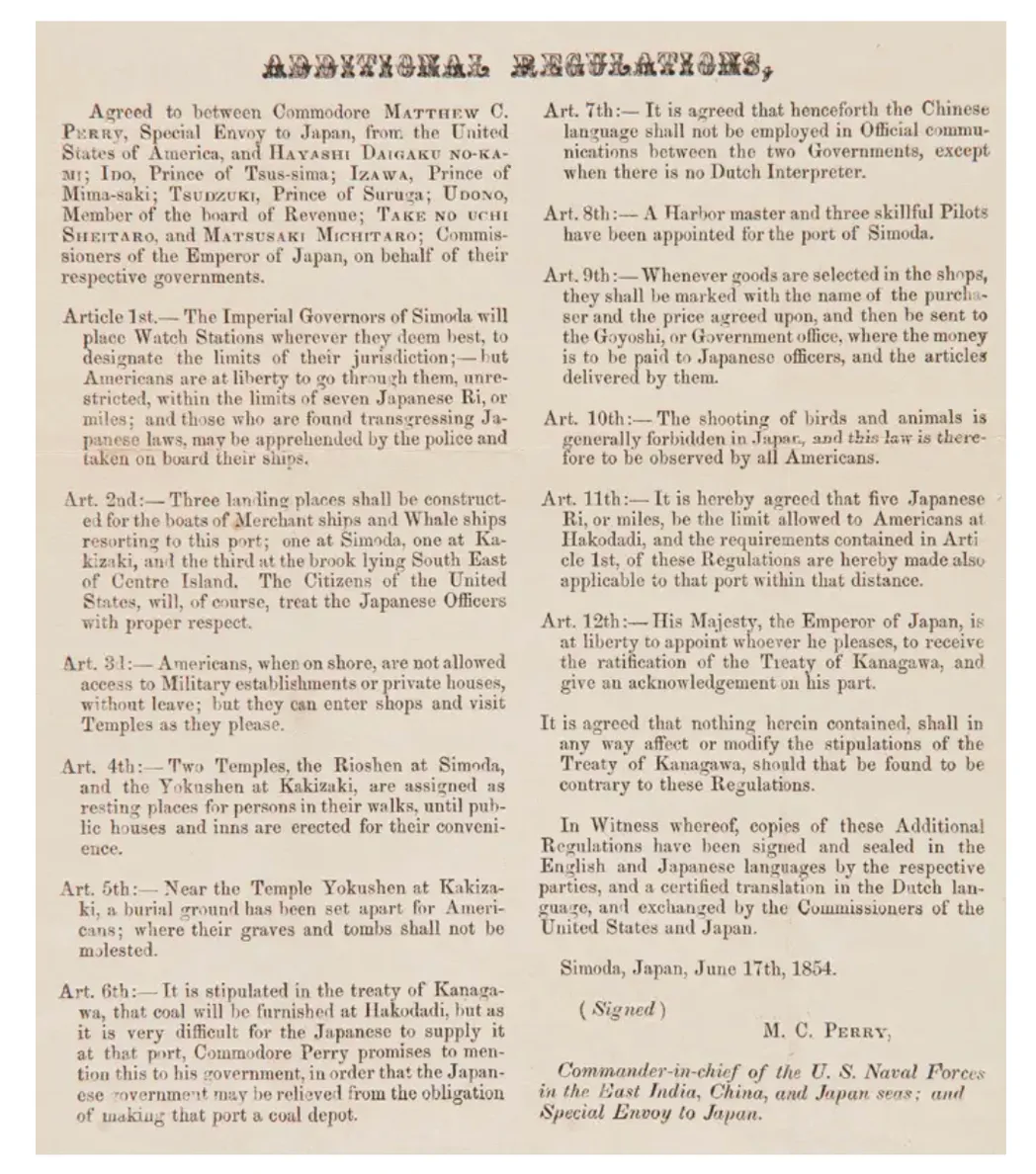
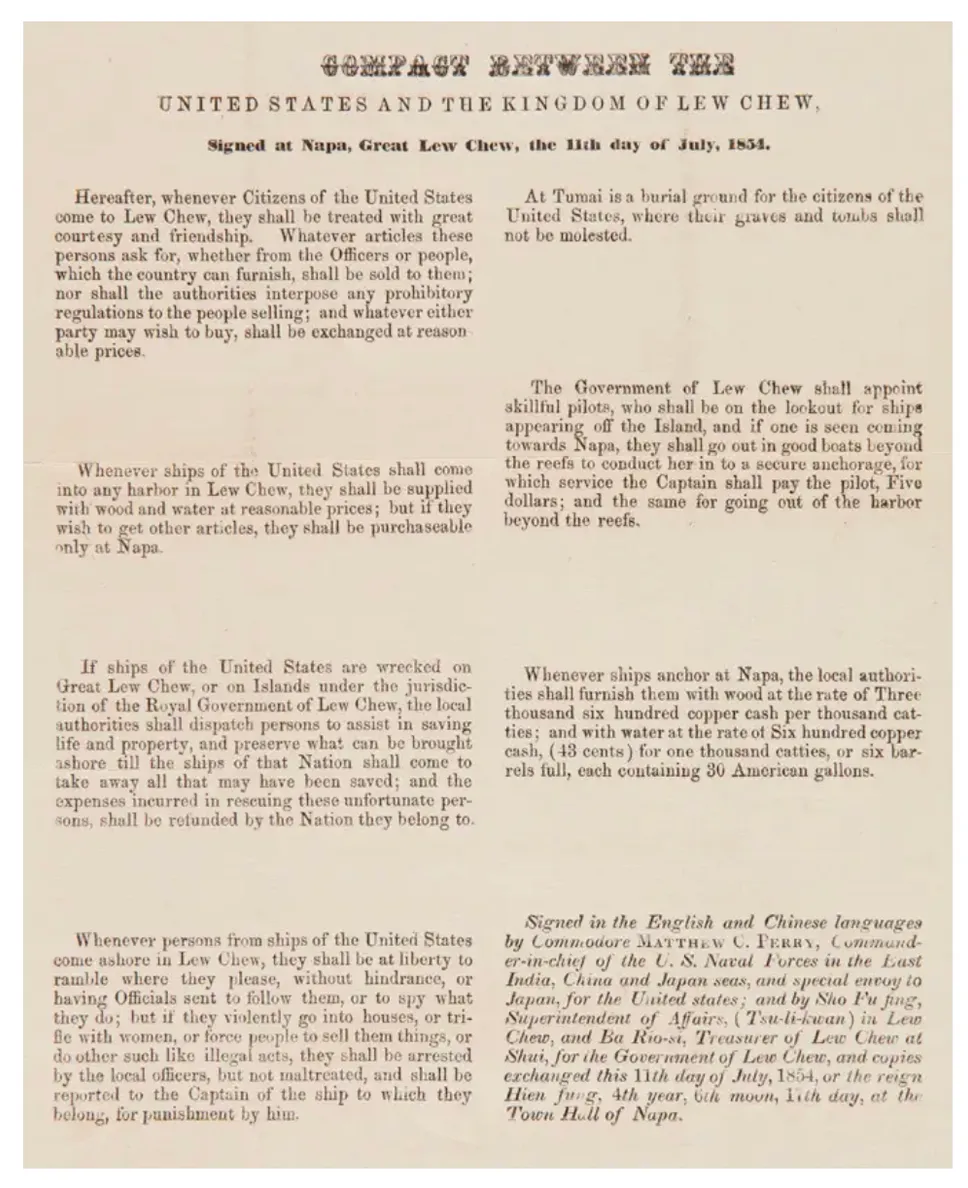
Rare and important: Three broadsides printed on board the United States Steam Frigate Mississippi in July, 1854, detailing treaty agreements between the United States and Japan made during the Perry Expedition, as well as giving sailing directions to the port of Hakodadi (Hakodate, Hokkaido). These three rare and ephemeral pieces of shipboard printing are an important record of one of the most significant diplomatic achievements of the United States in the nineteenth century, the "opening" of Japan. Perry’s on-board press was used to publish information for the expedition crew, disseminate sailing instructions and other information regarding harbours and coasts to other ships (including vessels which were not part of the expedition) and to print important official agreements, as here. It was also used to publish playbills for onboard theatrical productions. All of the material from the Press is rare.
In 1852, Commodore Matthew C. Perry was appointed head of a naval expedition charged with inducing the Japanese government to establish diplomatic relations with the United States. On March 31st 1854 the Japanese were finally forced to accept the terms in the Treaty of Kanagawa ending over 250 years of national isolation (sakoku). "The most important result, however, was that the visit contributed to the collapse of the feudal regime and to the modernization of Japan." (Hill).
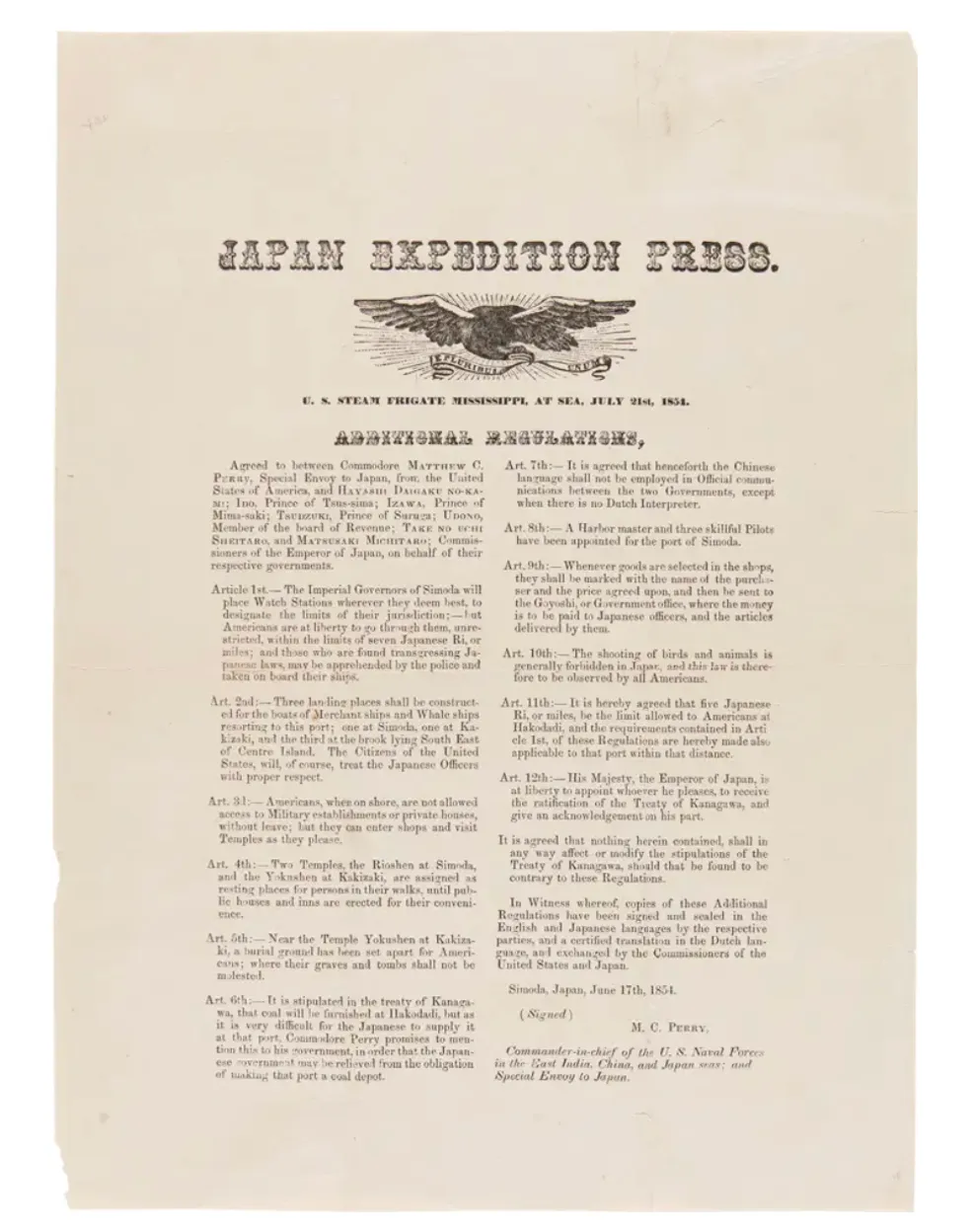
The first broadside in this group, printed on board the U.S.S. Mississippi on July 21, 1854, is of the great importance, being additional regulations to the Treaty of Kanagawa. The twelve additional articles were negotiated and signed at the Convention of Shimoda on the southern tip of the Izu Peninsula (also known as the Shimoda Supplementary Treaty) on June 17, 1854. They establish some of the practicalities for the new interaction between the Americans and the Japanese: A six-mile radius is declared around three locations of Shimoda, Kakizaki and (curiously!), an unspecified place 'at the brook lying South East of Centre Island’, where Americans would be allowed to move around, and it establishes the limits of access of Americans ('Americans... are not allowed to access Military Establishments or Private Houses, without leave. But they can enter shops and visit Temples as they please.' article 3). Article 6 seems to allow for a re-negotiation regarding the use of Hakodadi (Hakodate) on the South coast of Hokkaido as a loading port for coal because of Japanese claims that it would be difficult to supply coal there, article 10 prohibits Americans from shooting birds and game, and finally, article 12 establishes that the Japanese Emperor will appoint whoever he chooses as his commissioner for the final treaty. This is of particular interest because from the outset of the negotiations the Americans laboured under the misapprehension that it was ultimately the Japanese Emperor who they were negotiating with. This was not the case, because the Shogun at Edo ruled over Japan and the Emperor had no political power.
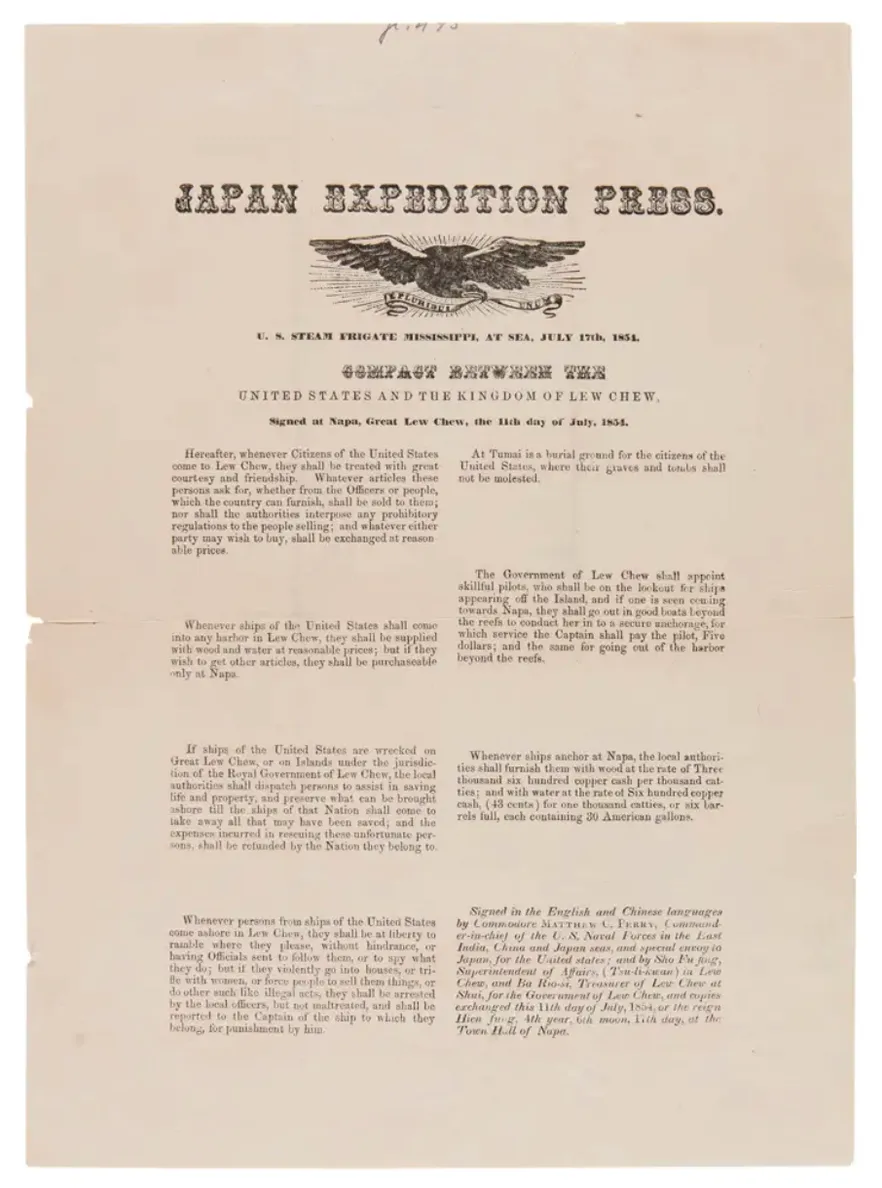
The second broadside here, printed aboard the Mississippi on July 17, 1854, is the text of the compact between the United States government and the Kingdom of Lew Chew (today the Ryukyu Islands, a part of Okinawa). The agreement indicates that Americans will be allowed to wander freely in the kingdom without being followed or spied upon, and will be "treated with great courtesy and friendship ... but if they violently go into houses, or trifle with women, or force people to sell them things, or do other such like illegal acts, they shall be arrested by the local officers, but not maltreated, and shall be reported to the Captain of the ship to which they belong, for punishment by him." Americans would be allowed to buy goods, and to procure wood and water for their ships, and local authorities would assist wrecked American ships.
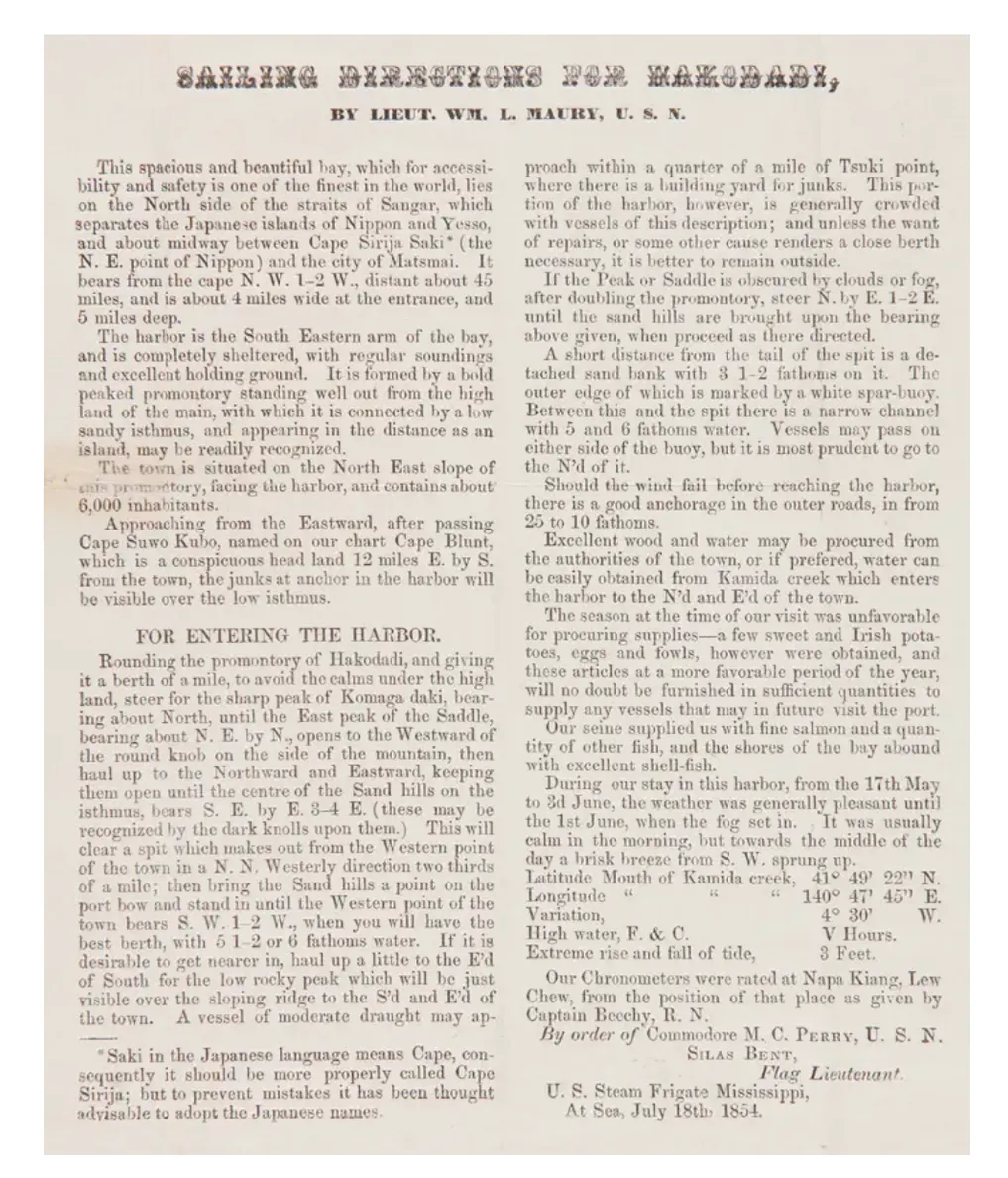
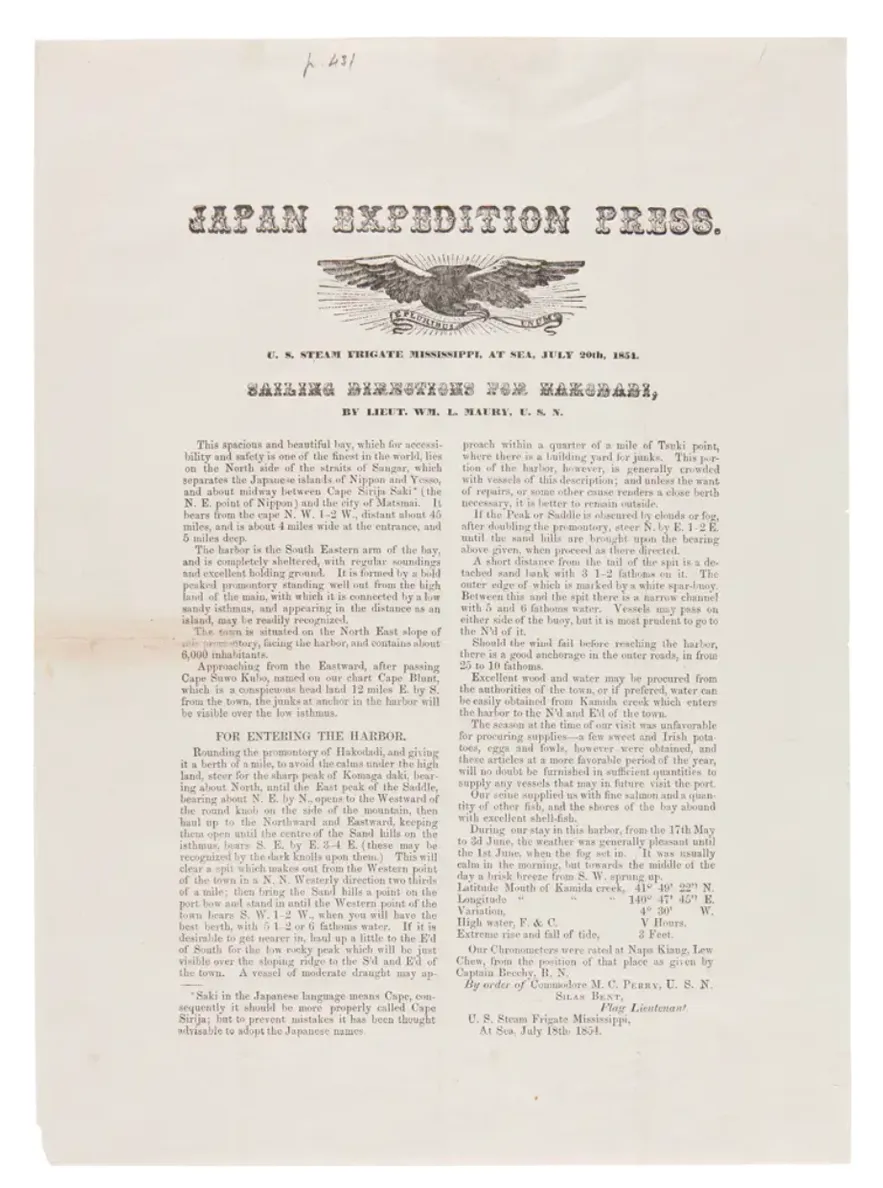
The third broadside printed aboard the USS Mississippi on July 20, 1854, describes the location of and navigation into the port of Hakodadi (Hakodate). The directions are attributed to Lt. William Maury, previously a member of the Wilkes Expedition and then assigned to the Perry Expedition. The location of the port (a “spacious and beautiful bay, which for accessibility and safety is one of the finest in the world”) is described in great detail, as are the directions for sailing into it. It is noted that supplies of wood, water, and fish are readily available there. Hakodate was crucial for the American whaling industry because its location offered safe anchorage for its vast fleet and access to rich North Pacific whaling grounds. Commodore Perry secured it as one of Japan's first treaty ports for coal refuelling and refuge, providing an important base for its whaling fleet.
Of Perry’s shipboard press, Morison writes "Since the State Department had not seen fit to supply paper for the press, the Commodore wrote to his flag interpreter, the sinologist S. Wells Williams, 'in great haste' on 4 January 1854 begging him to procure paper at Canton. Perry’s paymaster had already purchased a 'quantity' of European-made paper at Hong Kong but not enough for probable needs. Williams procured a lot of the flimsiest sort of mulberry-leaf paper and some blue rag paper, which Perry used to splice out his insufficient supply of low-quality white stock bought in Hong Kong. The press was capable of printing only single sheets of about 205 by 150mm, but by running double sheets through twice, a number of two-page leaflets were produced ... The sailing directions are evidence of Perry’s desire to help all ships of all nations."
We find no copies of any of these three broadsides in auction records. In his census of the output of Perry’s shipboard press, Samuel Eliot Morison located copies of the first broadside at the Philadelphia Maritime Museum and the National Archives; there is also a copy at Yale (as part of a group of seven examples of printing from Perry’s shipboard press). Morison located copies of the second broadside at the Philadelphia Maritime Museum and the Kress Library; no copies are located in OCLC and it is absent from the Yale grouping. Morison located copies of the third broadside at the Philadelphia Maritime Museum and the Kress Library, and there is also a copy at Yale. These three broadsides were sold by William Reese Company to a private collector in 2010; they are the only copies that we have ever handled or can find in the market. Three rare and interesting pieces of Perry Expedition history documenting the dawn of American relations with Japan and the growth of the United States as an international power.
Morison, S.E., “Commodore Perry’s Japan Expedition Press and Shipboard Theatre,” in Proceedings of the American Antiquarian Society (Worcester, Ma., 1967), Vol. 77, No.1, pp.35-43.