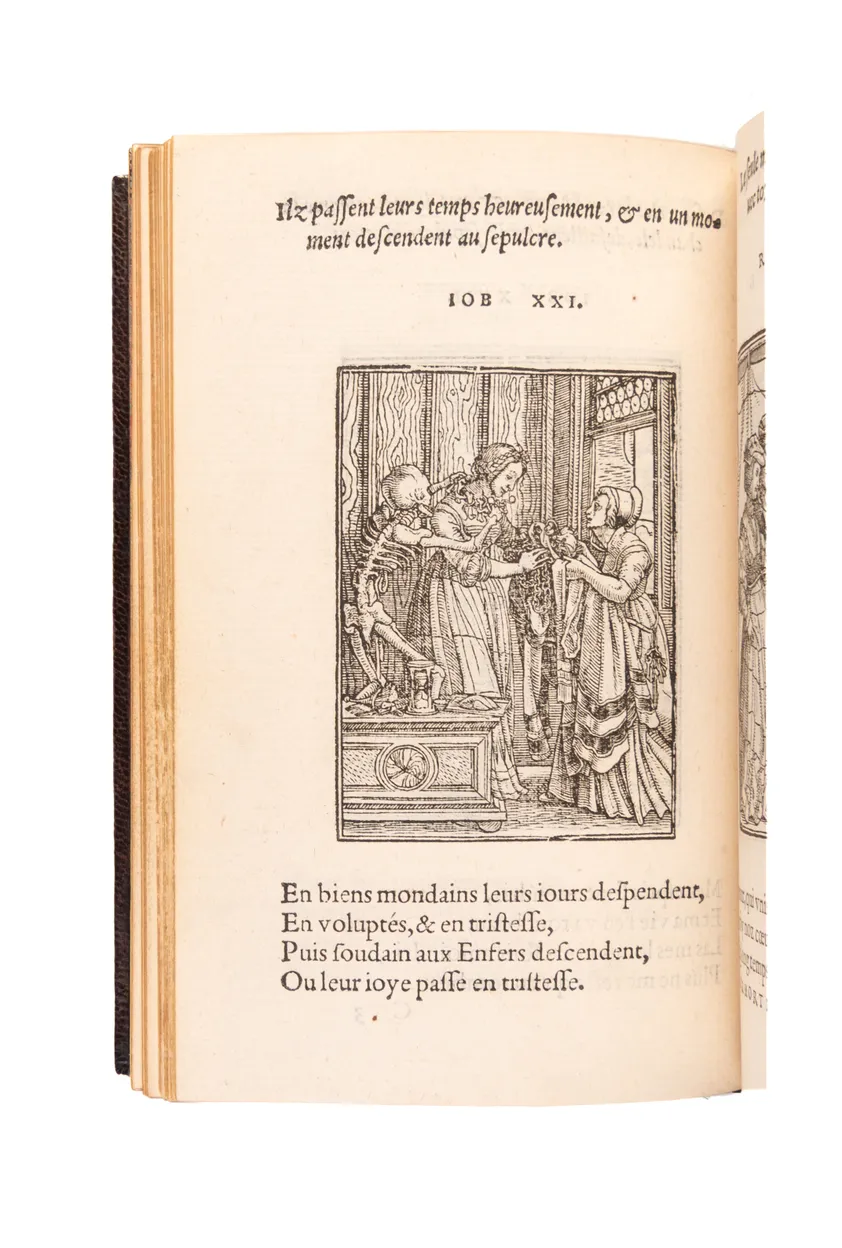
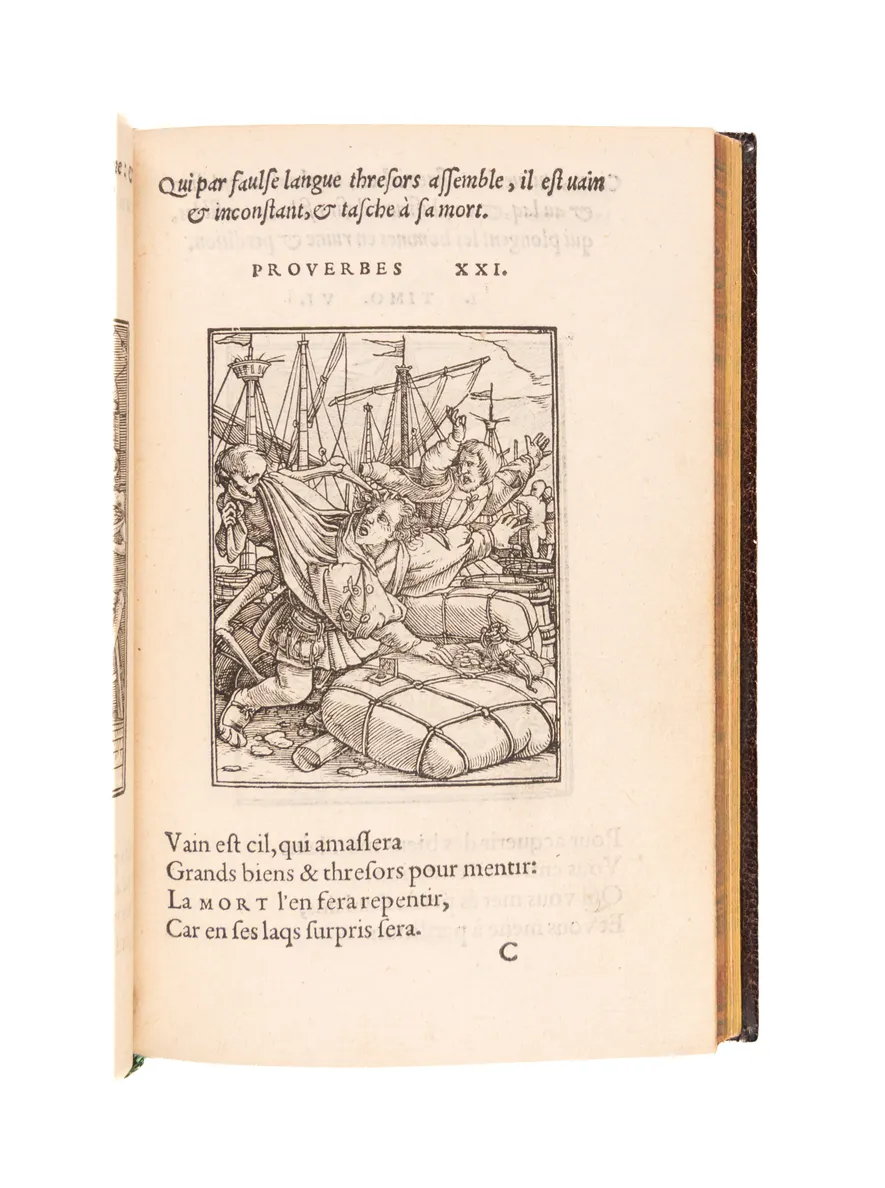
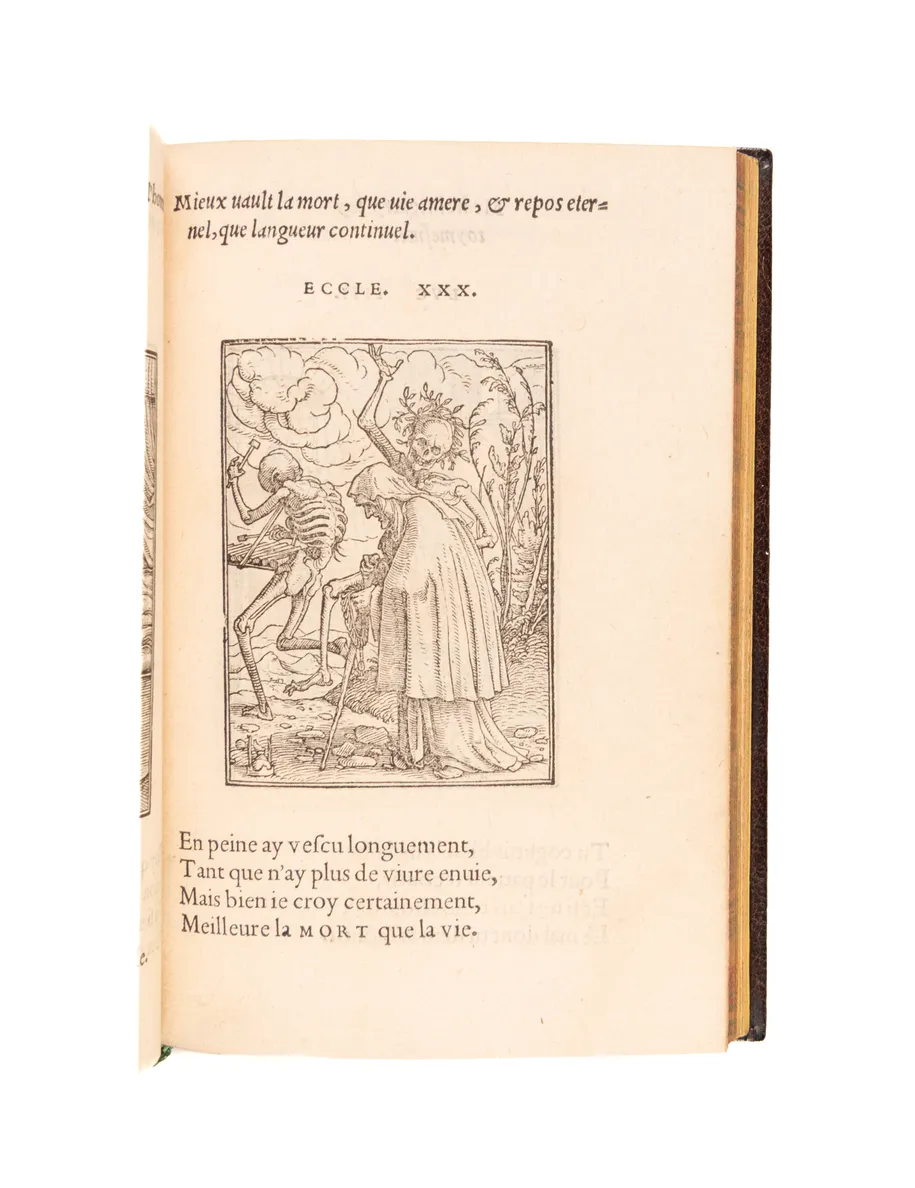
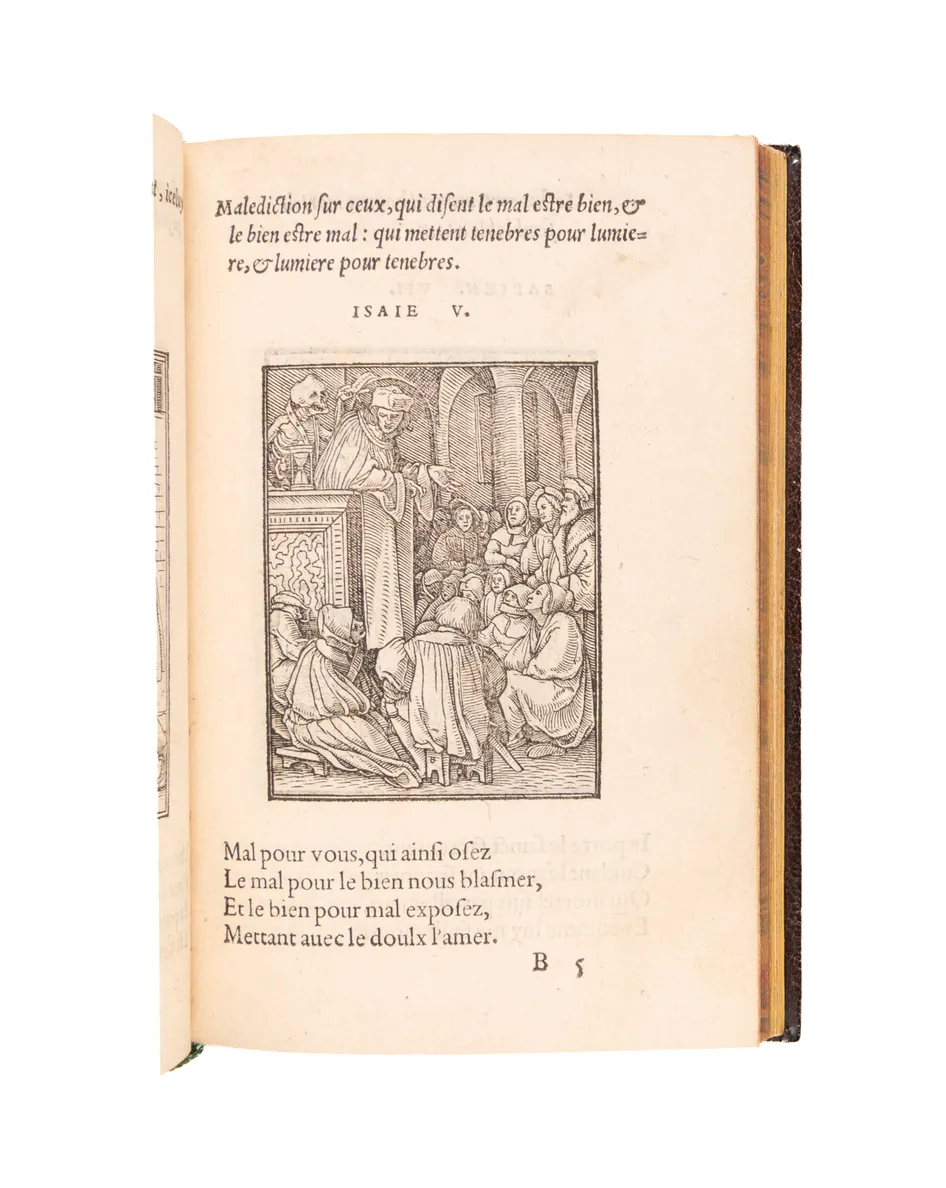
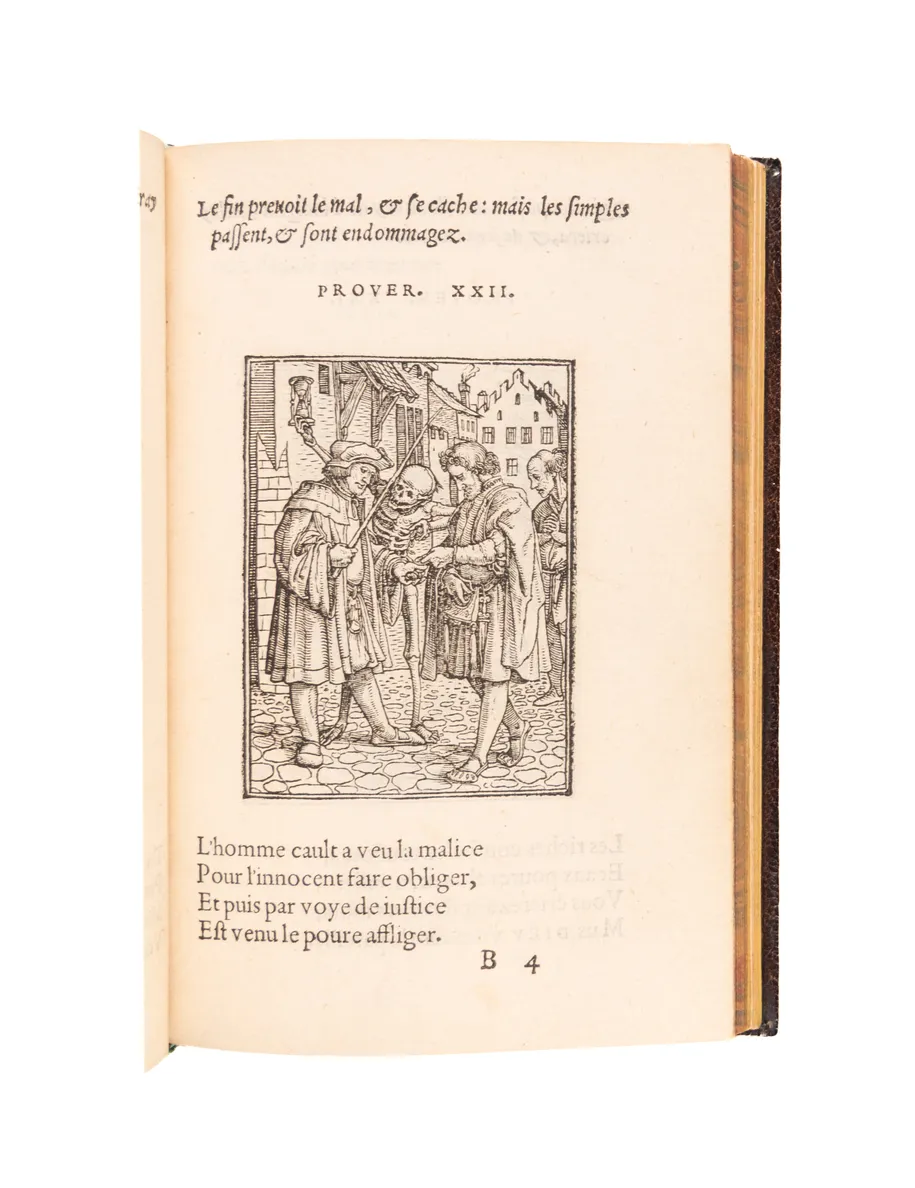
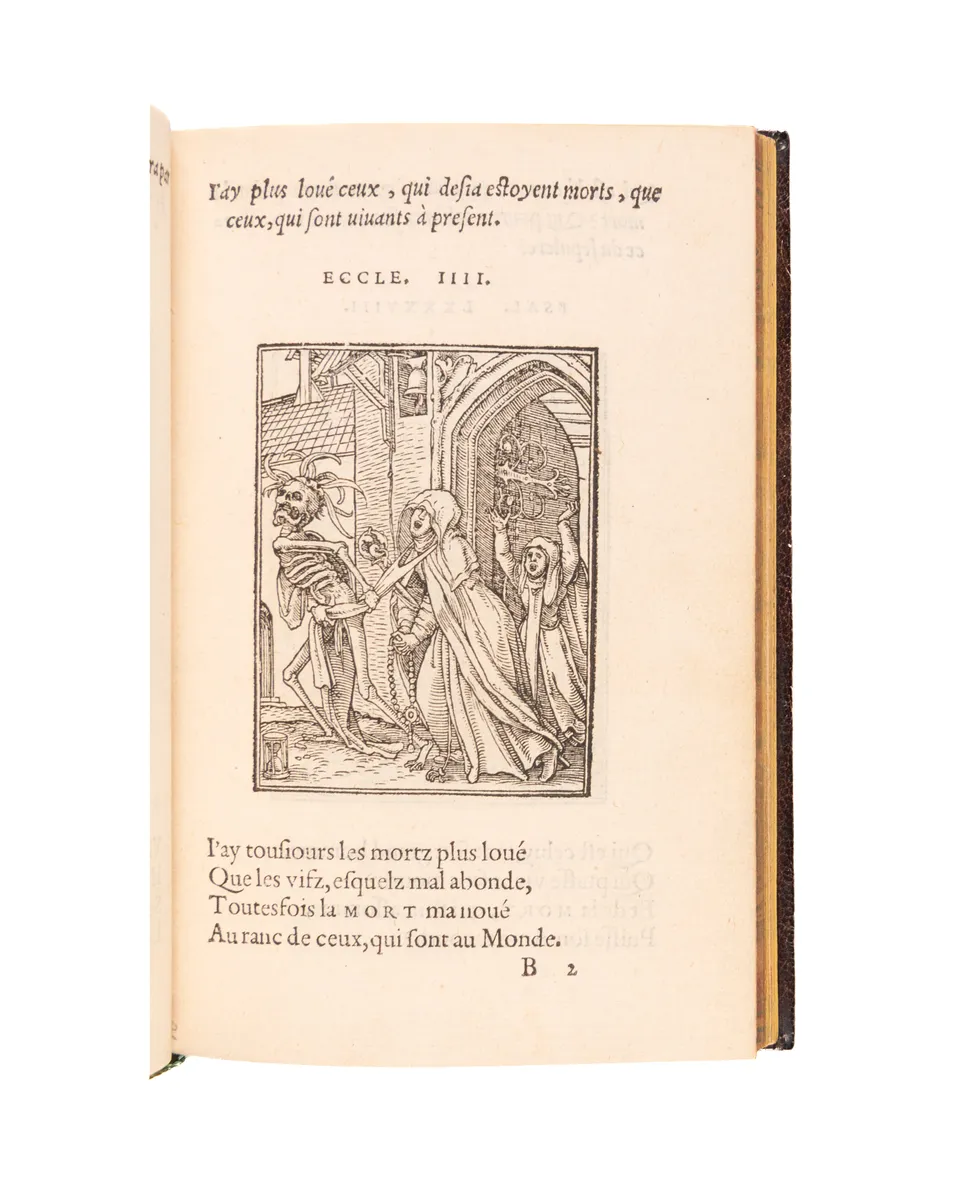
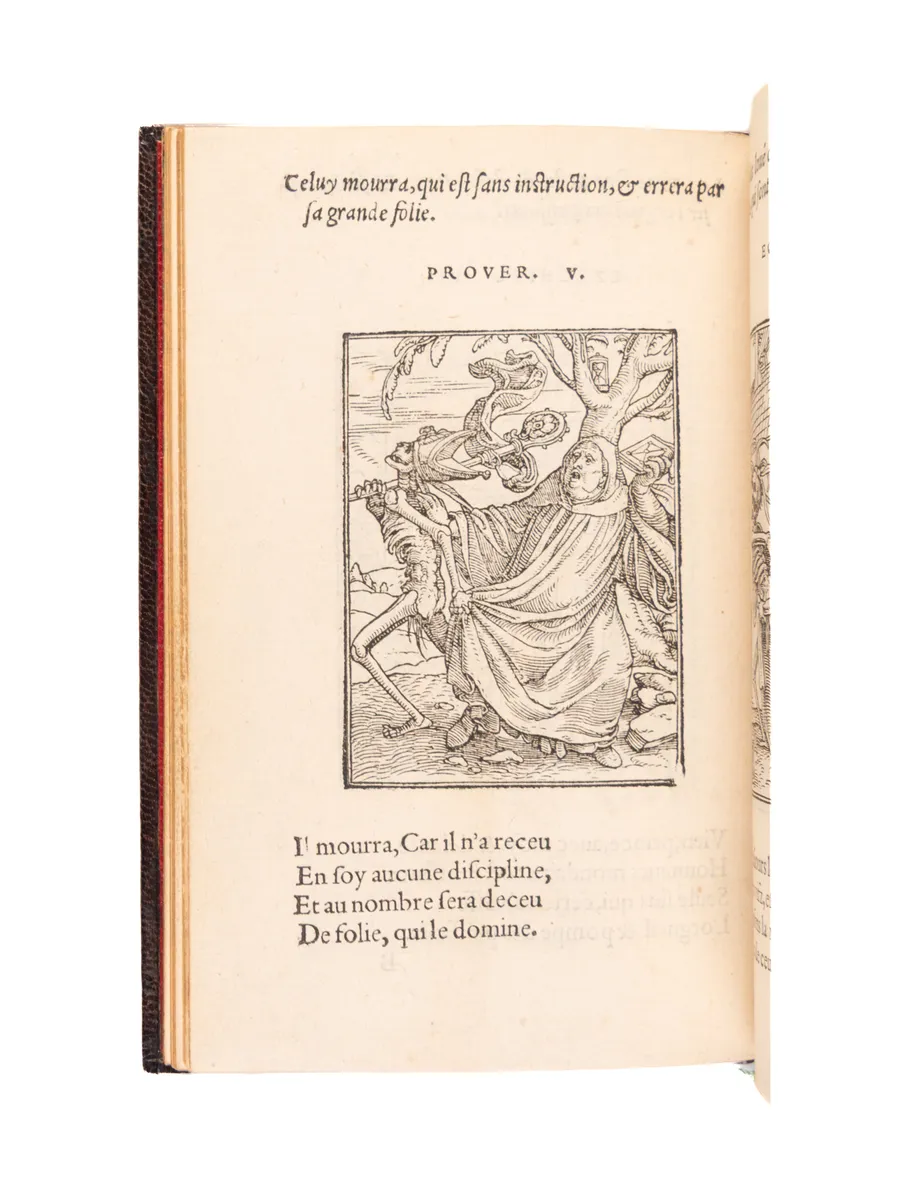
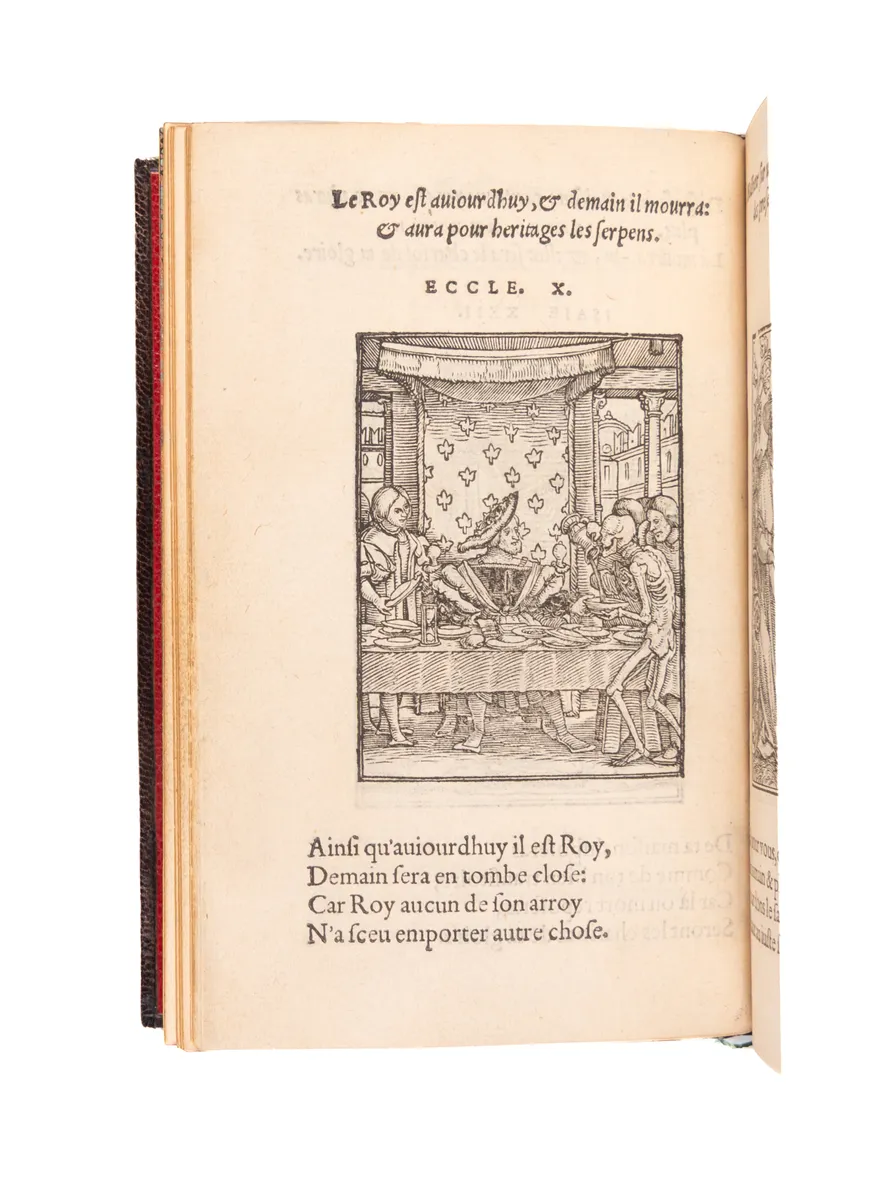
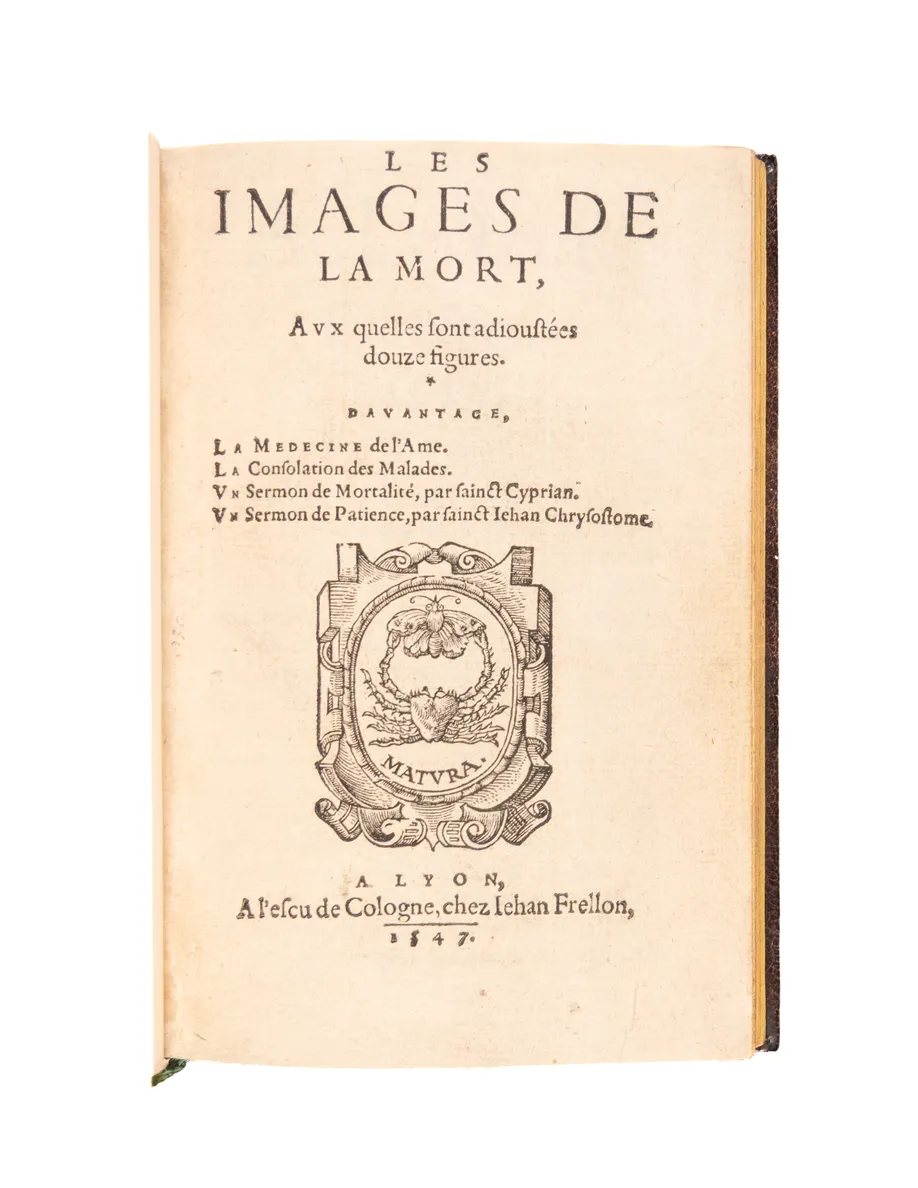
An early edition of Holbein's illustrations of "The Dance of Death", his most celebrated series of woodcut designs, with fine impressions of the woodcuts.
This is the third edition in French, with a new title, but the first to contain the full series of 53 woodcuts, expanding the series by 12, as noted on the title-page. The first French edition was published by the Treschels for the Frellon brothers at Lyon in 1538, followed by a Latin edition and another French edition, both appearing in 1542.
"Holbein's contribution to the traditional Dance of Death was a sharpening of the humour and satire and a heightening of the drama, so that the customary procession of figures becomes instead under his hand a series of fully realized scenes" (Mortimer 284), a point expanded upon by Hyatt Mayor, "In his Dance of Death the skeletons do not mock at stock types as they do in the Gothic Danse Macabre; rather, they assault people like you and me in rooms and meadows where you and I might drop."
"Holbein's designs mark a departure from the original conception of the Dance. He presents individual scenes of each victim rather than the traditional round dance of death and the dying. Holbein's great skill is evident in his ability to inject interest and variety into the scenes. There is great creativity in the depiction of different landscapes and interiors, avoiding monotonous repetition. His Dance of Death is rightfully hailed as a monumental achievement. Each scene bears the same basic elements: Death enters surprising his victim and we clearly see the reaction of the victim. In every scene, the motif of the hourglass is present to signal the approaching end. Holbein retains the formula of presenting victims from a multitude of social positions - from those at the top of the social scale, such as the king, down to those low of status. Frequently his images pass judgement on those at the higher end of the patriarchy who choose to abuse the power their status accords them... Overall, Holbein's Dance of Death may be interpreted as part of the contemporaneous rise of Protestantism with its implicit judgement against indulgence and excess." (Glasgow, Dancing with Death, online exhibition, https://www.gla.ac.uk/myglasgow/library/files/special/exhibns/death/holbein.html).
"Among the Holbein woodcuts may be noted a portrait of François I as the king whom Death is serving, and a possible identification of Holbein and his wife with the figures standing beside the armorial shield of Death (here leaves A6v, D5r)" (Mortimer 284).
Holbein (1497-1543) designed the series in the early 1520's and they were cut by Lützelburger in the years before his death in 1526. Bartrum notes that it is still unclear why Treschel should have waited until 1538 before publishing them in book form since he received the blocks in 1527.
Lützelburger (1495?-1526) was Holbein's most significant collaborator and his talent was instrumental in the success of Holbein's designs... He worked closely with Holbein in Basel from 1522 until 1526, the year of his death and Holbein's departure for England. The collaboration of artist and technician in this instance proved to be one of the most creative in the history of printmaking." (Bartrum). For the importance of Lutzelburger see also Landau and Parshall who remark that he was unsurpassed among the skilled artisans who honed their talents in Emperor Maximillian's print factory.
The second part of the book contains La Medecine de l'Ame and La Consolation des Malades together with sermons of SS. Cyprian on mortality and John Chrysostom on patience.
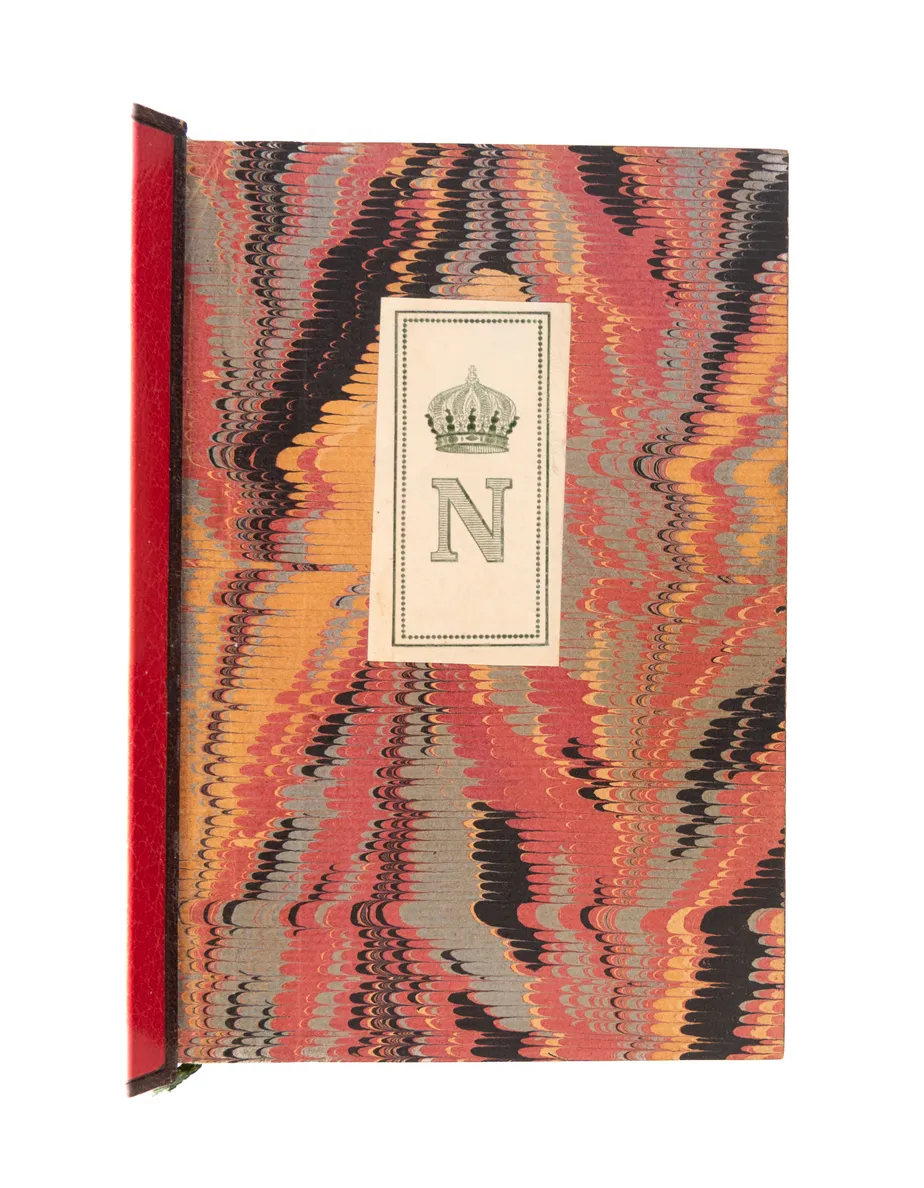
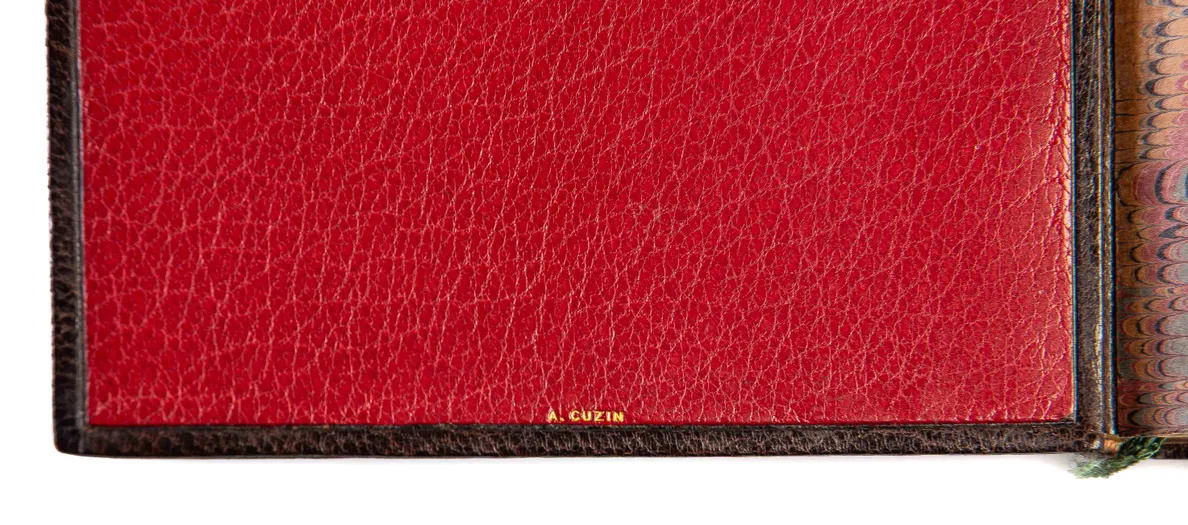
Provenance: Booklabel with crowned inital 'N', possibly that of Napoleon III, Emperor of France? (see Olivier, pl 2659, chiffres 13-15 for similar small monogrammed tools), although he died in 1873 so likely to have been added posthumously as the binder Adolphe Cuzin did not take over his father Francisque's until 1890, at the age of 26.
Mortimer (French), no. 289. Woltmann, Holbein II, p. 177 h. Baudrier, V, 210. Brun, p. 236. G. Bartrum, German Renaissance Prints 1490-1550 (1995), no 233 (1538 ed). A. Hyatt Mayor, Prints and People (1974), 326. D. Landau and P. Parshall, The Renaissance Print 1470-1550, pp. 212-216.