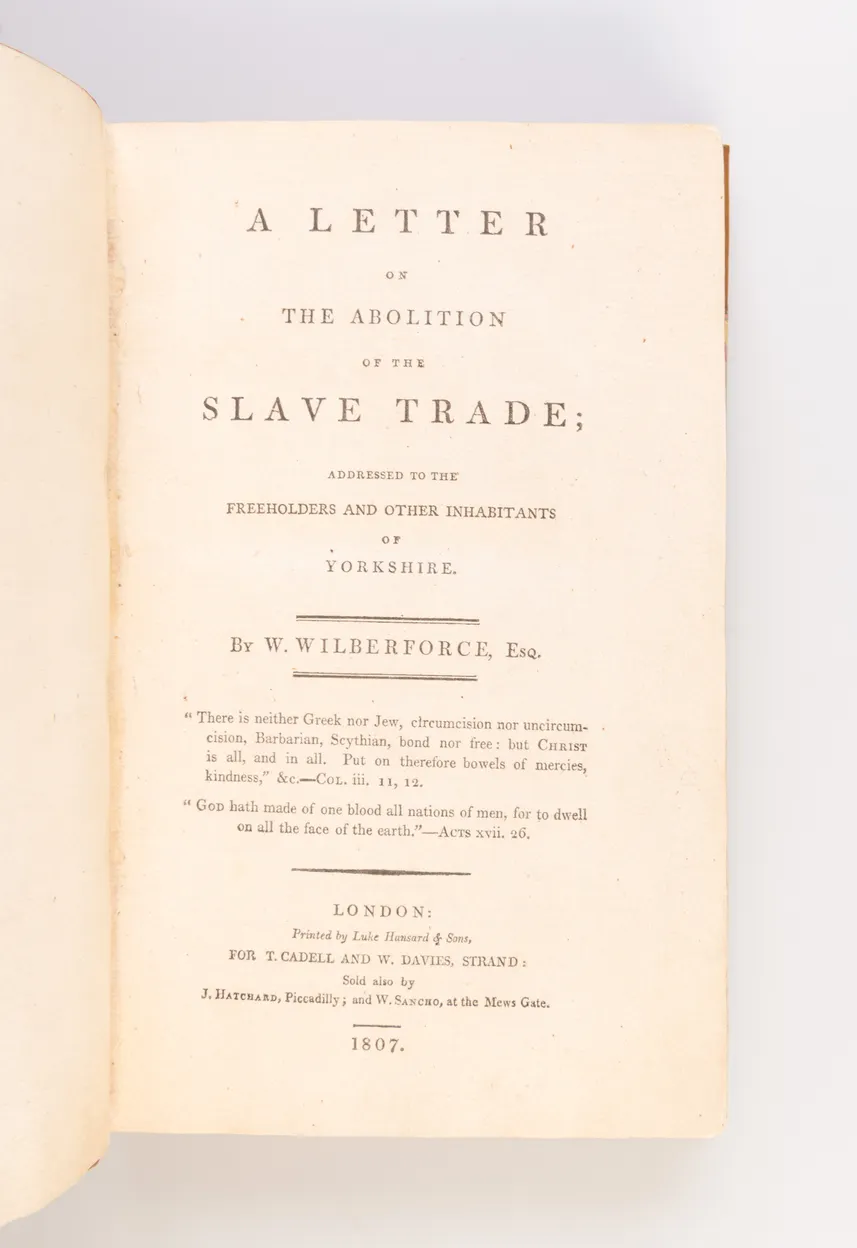
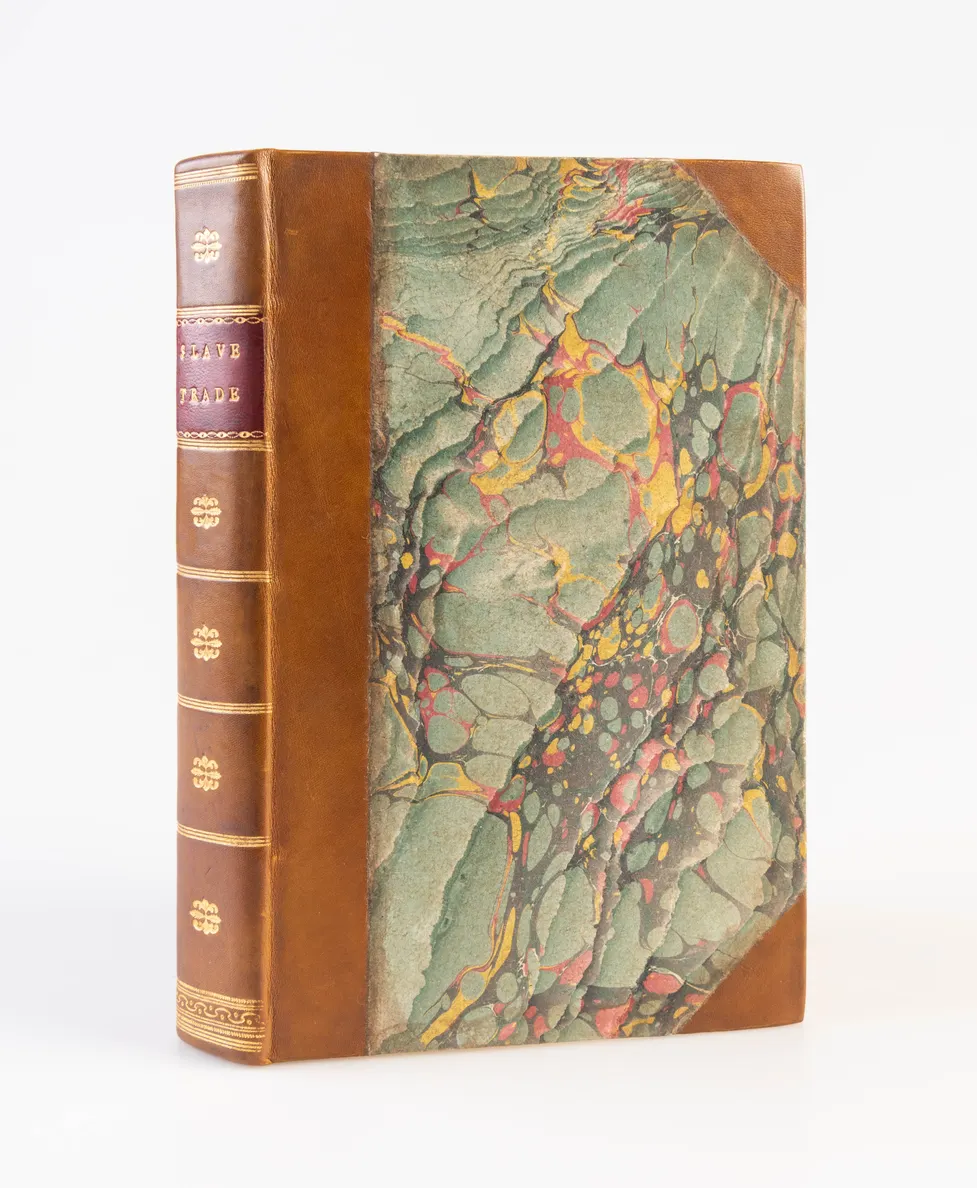
An especially desirable copy of Wilberforce's great statement of the abolitionist position. This under reported second issue of the first edition is co-published by William Sancho (1775-1810) - son of the famous Ignatius Sancho - and the founder of the first Black-owned publishing house in the English-speaking world.
Seen into print while Wilberforce's soon-to-be triumphant bill to abolish the slave trade was in the Lords, the work "consolidated and restated the formidable array of evidence and argumentation against the trade that Wilberforce has developed over the previous two decades" and "served to inform the final phase of the struggle" (ODNB). Wilberforce begins by noting that 14 years have passed since the issue of the slave trade was argued fully in parliament and that "during the intervening period, also, such strange and interesting spectacles have been exhibited at our very doors, as to banish from the minds of most men all recollection of distant wrongs and sufferings." As a consequence, Wilberforce writes that "it may not be useless thus publicly to record the facts and principles on which the Abolitionists rest their cause, and for which, in the face of my country, I am willing to stand responsible."
Wilberforce illustrates his arguments with examples from works as diverse as Hume's Essays and Edwards's History of the West Indies, among others. Pages 353 to 396 contain an appendix of "extracts from the older authors" which mainly describe "depredatory acts occasioned by the slave trade."
William Sancho had only been in business for four years when he published this work. After his father's death in 1780, the family continued to live at 19/20 Charles Street, where Ignatius ran his grocery shop. With some income generated from sales of the first four editions of Letters of the late Ignatius Sancho, an African (London, 1782), Sancho's son and heir William, established himself as a publisher and bookseller in association with his mother Anne. Letters held in the British Library suggest that he was supported and encouraged in this pursuit by long term friend and correspondent of his father's, Norwich based bookseller and painter William Stevenson.
Sancho published an eclectic mix of works ranging from a translation of Voltaire and a treatise on cow-pox, to a few choice abolitionist titles such as this one. He also saw the 1803 fifth edition of his father's letters into print.
A sketch of him provided in the 1807 fifth volume of the Wonderful Museum and Magazine suggests that he was "brought up to the profession of bookseller by Mr. Edward Jeffrey, of Pall-Mall, and at present is the worthy successor of Mr. Henry Paine at the Mews Gate in Castle Street." The same sketch incorrectly calls him librarian to Sir Joseph Banks - with whom he may well have had business dealings. Thomas Frognall Dibdin in his Bibliographical Decameron further supports the fact that William Sancho took over the shop in Mews Gate, Castle Street, previously run by Thomas Payne (misnamed 'Henry Paine' in the Wonderful Museum). That address appears on the title-page here. Dibdin further described Sancho: "our sooty bibliopolist, had the most ardent passion for books: and especially for English topography and black letter ..." (Dibdin, 438).
His father’s fame ensured his own name was known in abolitionist circles and as described in the abstract of unpublished letters in Besterman's book on the Cadell and Davies archive, Wilberforce personally requested that "Mr. William Sancho, a man of colour, to be added to the list of publishers" for the present work (172). In another document described in the Cadell and Davies papers, we see that in February Sancho had sold 12 copies compared to Hatchard’s 75. This may reflect the number of copies allocated to him, or indeed just the relatively small size of his business. The same document also gives the total size of the edition as 1493 copies.
Substantially rarer than the first issue, aside from the title-page, it differs only in the correcting of a misprint of an early signature mark. Indeed, OCLC records copies being held at Indiana, Aberdeen, and York only. We locate two others at Princeton and NYU.
Besterman, T., ed The publishing firm of Cadell and Davies : Select correspondence and accounts, 1793-1836 (London, 1938), p.172; Carey, Brycchan, British Abolitionism and the Rhetoric of Sensibility, (New York, 2005); Dibdin, T.F., Bibliographical Decameron, (London, 1817), p.438; Ellis, Markham, The Politics of Sensibility: Race, Gender, and Commerce in the Sentimental Novel, (Cambridge, 1996); King, Reyahn, Ingatius Sancho: An African Man of Letters, (London, 1997); PMM, 232b; Sabin, 103953.