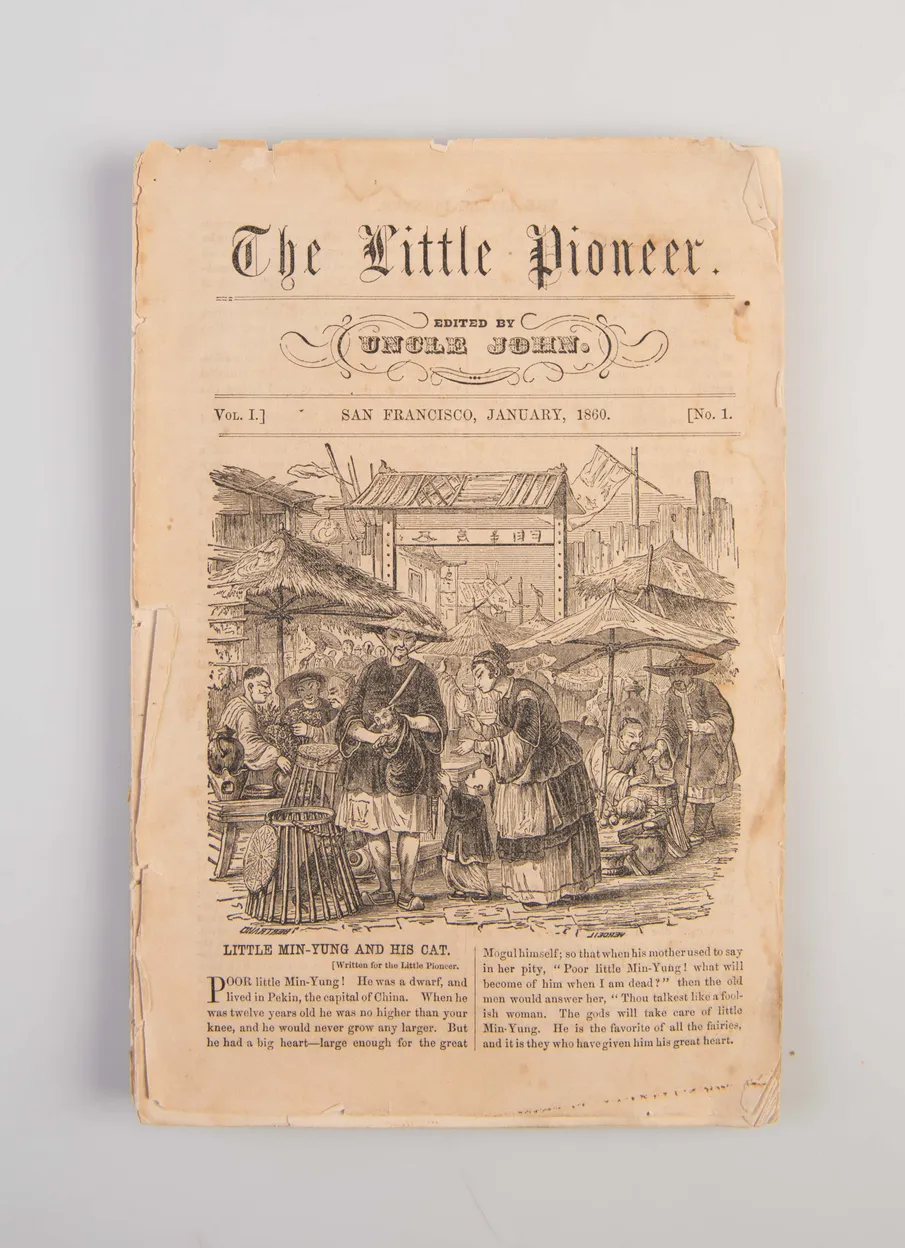
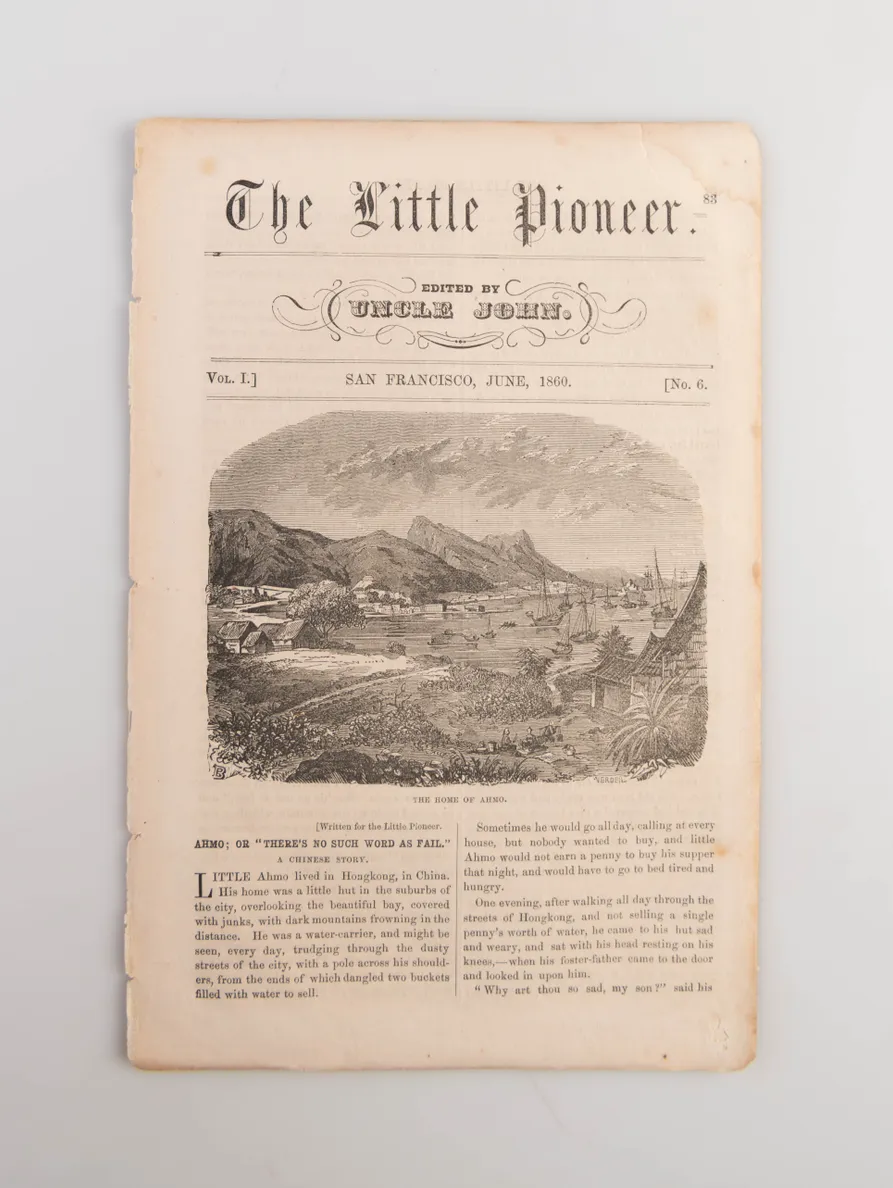
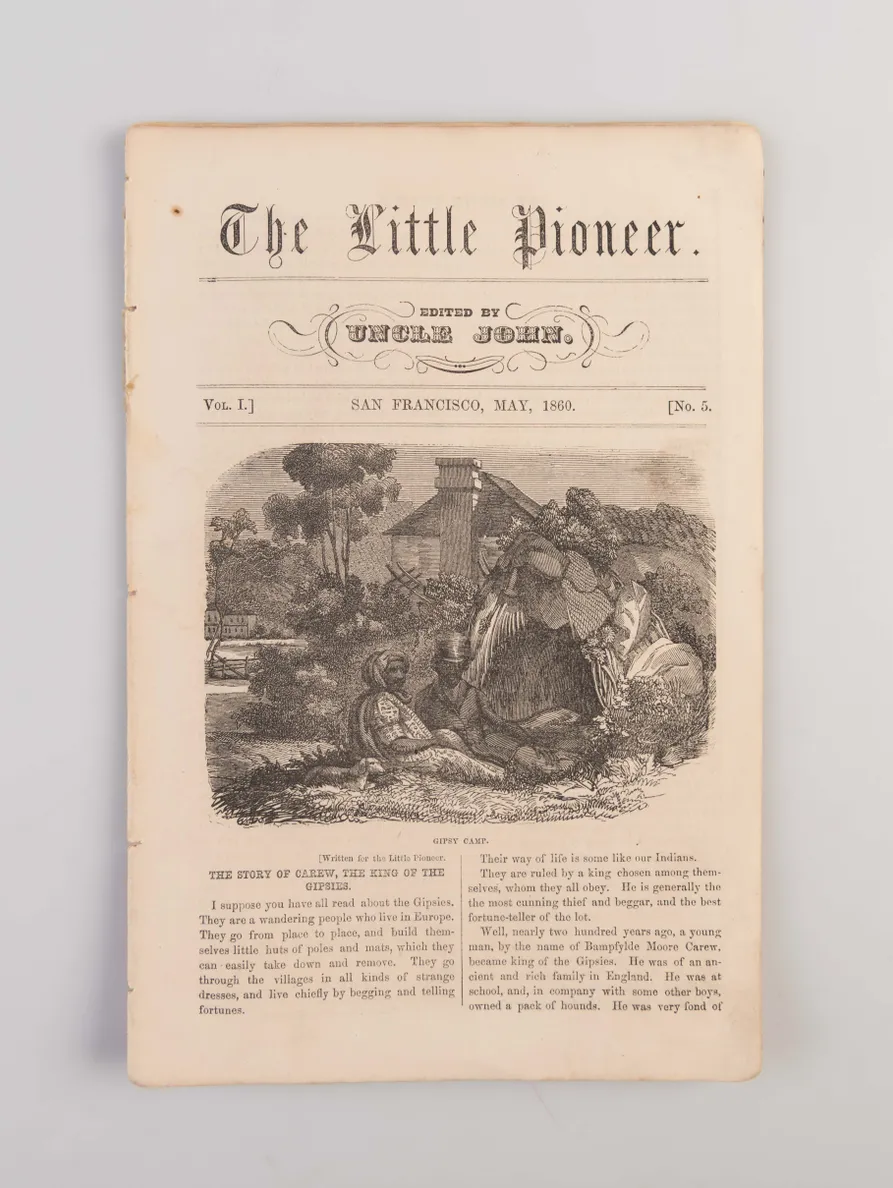
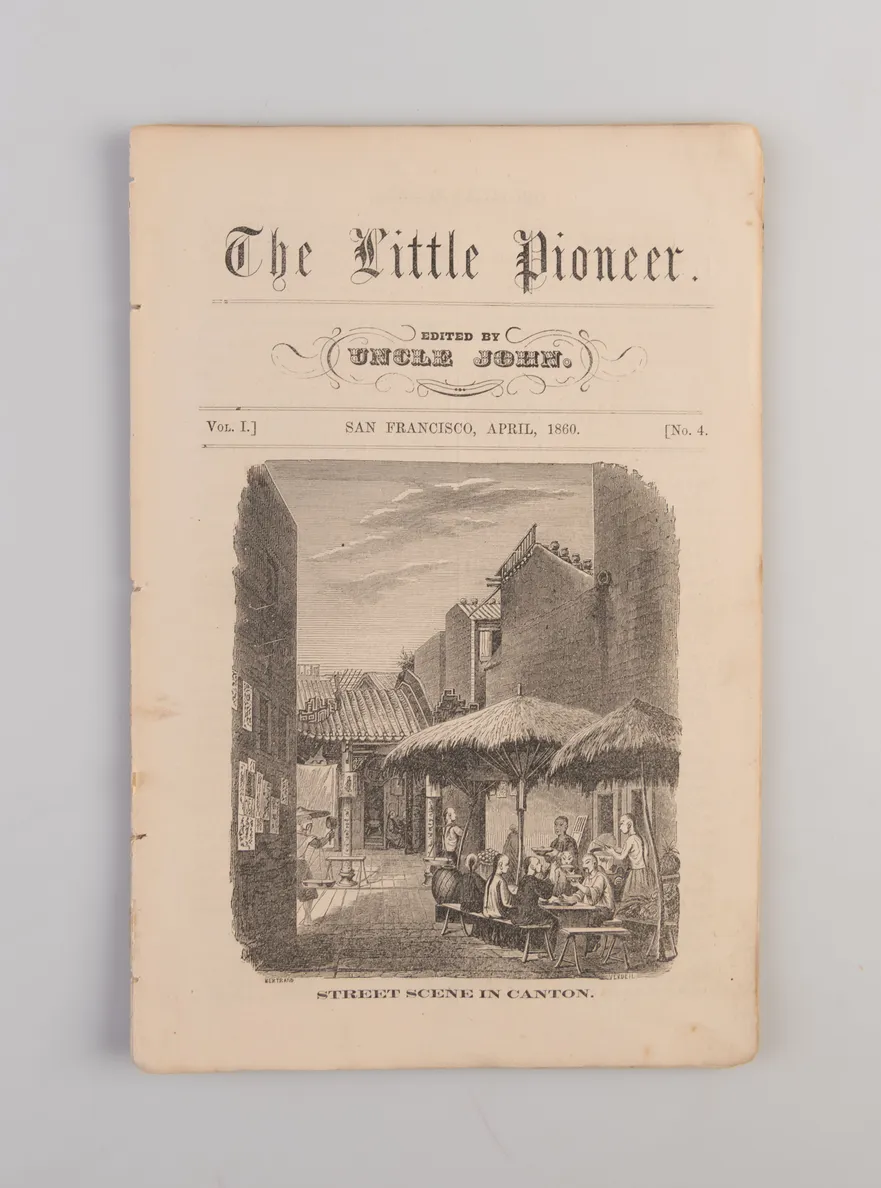
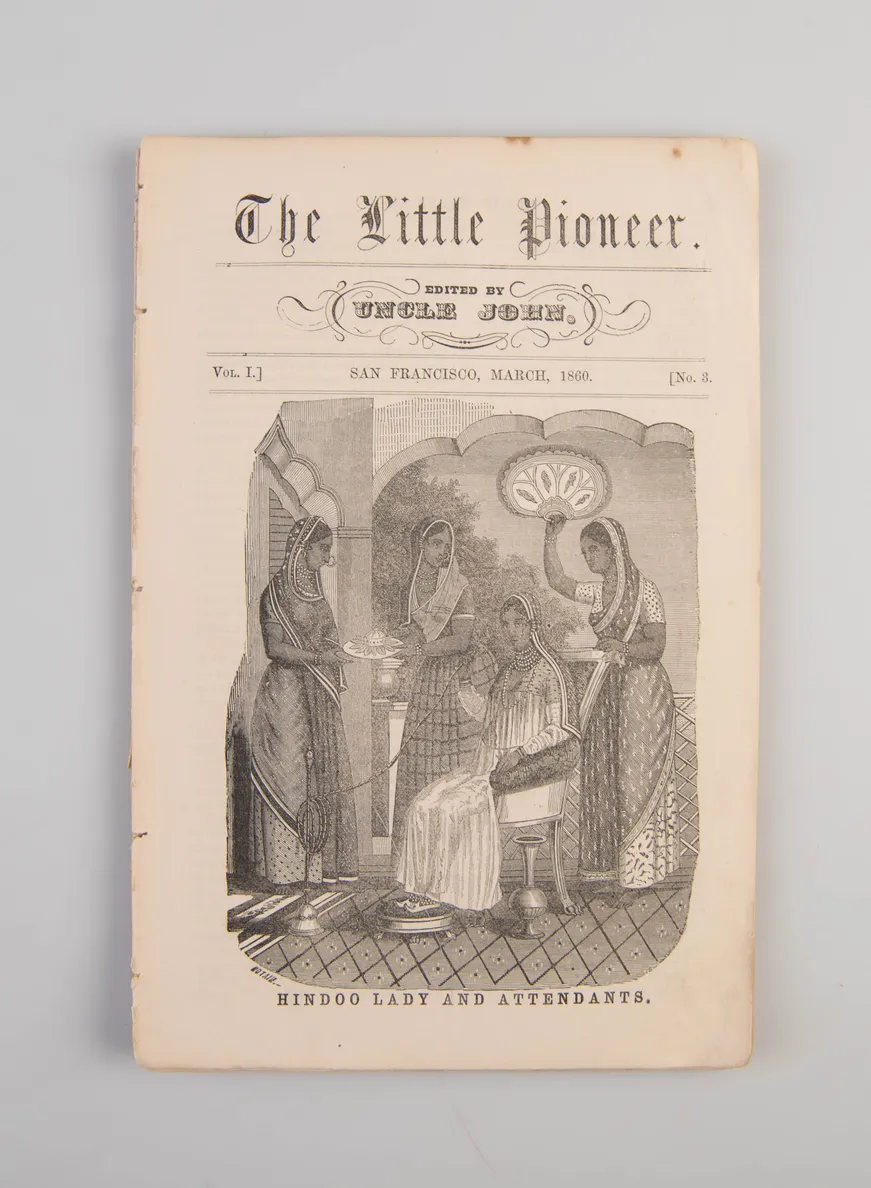
A genuine rarity of California juvenile literature - single issues traced only at Huntington (v1 #3) and AAS (v1 #1), with this being a run of six numbers. The LOC newspapers database show adverts for the publication running in California papers only until August 1860, suggesting that the run could not have far exceeded the present six numbers, the last of which was published in June of that year. Furthermore, in that June number, there is a letter from the editor and from the publishers which strongly suggest that due to low subscription uptake, the publication would be discontinued after that issue. The editor goes as far as to sign off "Children, good bye!" (p.89). As such this is as complete a record of this ephemeral periodical as we know to be extant.
The contents are broadly educational, with most of the articles stating that they were "written for the Little Pioneer", in contrast to the common practice of reprinting extracts from other sources. The articles contain a flavour of life on the west coast, in the immediate aftermath of the gold rush.
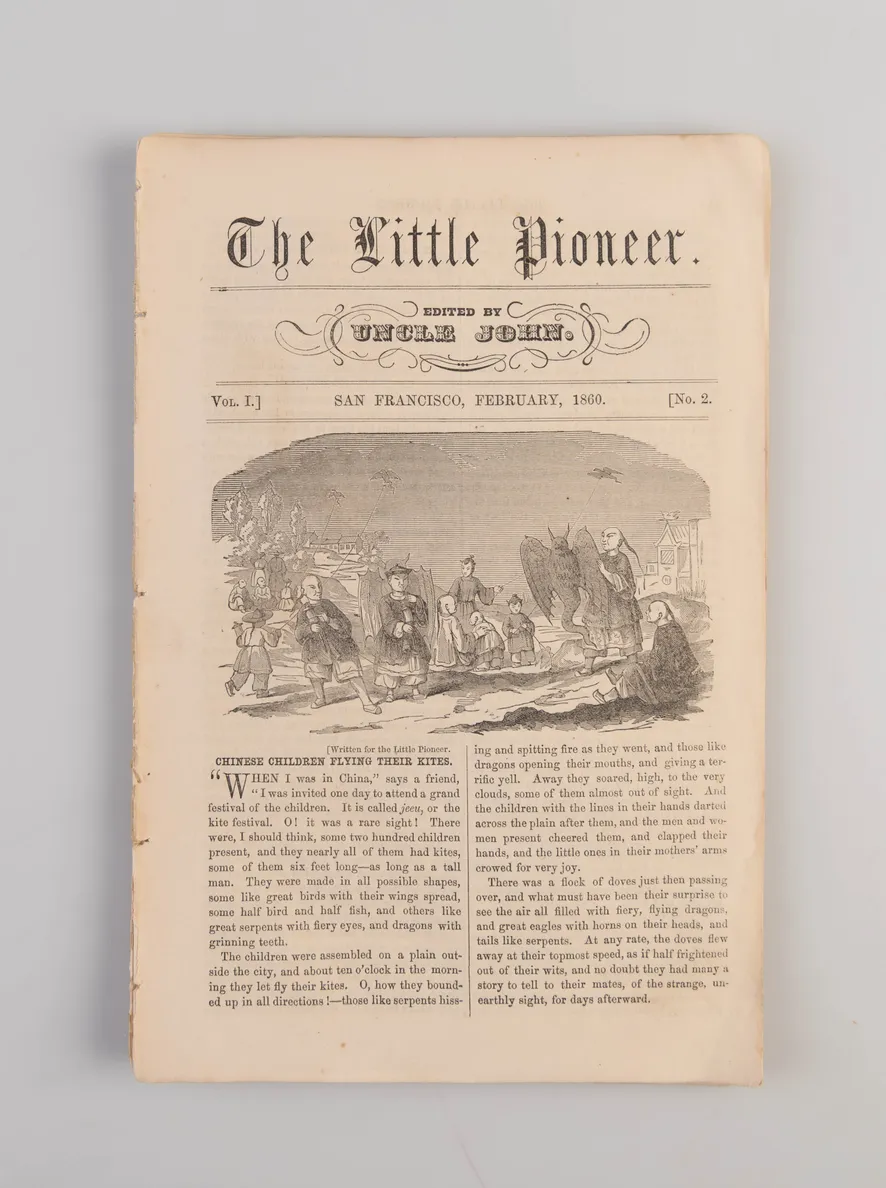
The 1860s saw an influx of thousands of Chinese immigrants through California, in part working on the construction of the Transcontinental Railroad. As such, San Francisco's Chinatown would already have been the largest expat Chinese community in the United States, and Chinese culture would have been visible, if not familiar, to young residents of the city. Indeed, the first issue begins with a story titled "Little Min-Yung and his Cat", set in Peking, and the second with an article on "Chinese Children Flying their Kites".
The west coast location of the publisher positioned this paper well for its own distribution. San Francisco in the nineteenth century was a key gateway to the Pacific, with the natural harbour making it an ideal port city. Hutchings and Rosenfield were clearly supplying packet and clipper ships with their publications, as attested by the fact that The Little Pioneer was advertised for order through the April 14 1860 issue of the Polynesian, printed in Honolulu. The ad reads thus: "The 'LITTLE PIONEER, edited by Uncle John,' San Francisco,--Hutchings and Rosenfield, 146 Montgomery street, 1860, is the name of a new monthly periodical, of which we received the two first numbers by the last mail. It is a sprightly, well-written little magazine, with several illustrations in wood-cut. It is intended for the perusal of the young, and well does it repay its promise. Where there is a family of children, they will be both wiser and better if The Little Pioneer makes one of their set. We recommend it unhesitatingly as the best of its kind to exercise the mind and improve the heart of children. Price, $1 25 per annum, postage paid; single copies, 12 1/2 cents." Further to this, the April 21 issue of The Polynesian also included a poem and story excerpted from The Little Pioneer.
The editor, named only as "Uncle John" outlines the contents of the magazine as thus: "Scraps of Ancient and Modern History, Biography of Distinguished Persons, Natural History of Animals, Wonders of Animal Instinct and Contrivance, Descriptions of Wonderful Places and Accounts of Travelers, Wonders of the Vegetable World, Flowers and their Illustrations, Stories, Anecdotes, Poetry, Enigmas, Charades, Riddles, all will find their place in 'The Little Pioneer.' We also propose to give a few simpl [sic] Lessons on Drawing in each succeeding number" (p. 9). There is a good amount of California-specific natural history content, including an article about identifying trees ("California Mastworts") and flowers native to the region, in some instances including their Mexican names and information about Indigenous uses. For example: "The very first plant we meet with is the Great Hound's Tongue* [*Cynoglosum grande] or Lapilla grande, Lengua de perro, as our Mexican neighbors call it. It is so named because the long leaves are shaped like a hound's tongue. These leaves are eaten by the Digger Indians, while young and tender" (p.12).
Several of the fine illustrations are signed by Bertrand Verdeil, who also appeared to have worked for Le Monde Illustré later in the same decade. The publisher, James Mason Hutchings, is best known for his Hutchings' California Magazine, which ran through five volumes between 1856 and 1861. Hutchings is described as "no literary carpetbagger, nor was he an editor and publisher with the instincts of an accountant. He sought to promote California, what he saw as best in California, not to any narrow end, but for its own sake" (Olmsted, v). The Little Pioneer may well have been conceived as a juvenile companion piece to Hutchings' California Magazine, and as such offers valuable insight into an ambitious but ultimately failed attempt to establish a children's newspaper on the west coast of America.
Olmsted, R.R. ed. Scenes of Wonder & Curiosity from Hutchings' California Magazine 1856-1861. Berkeley, Howell-North, 1962.