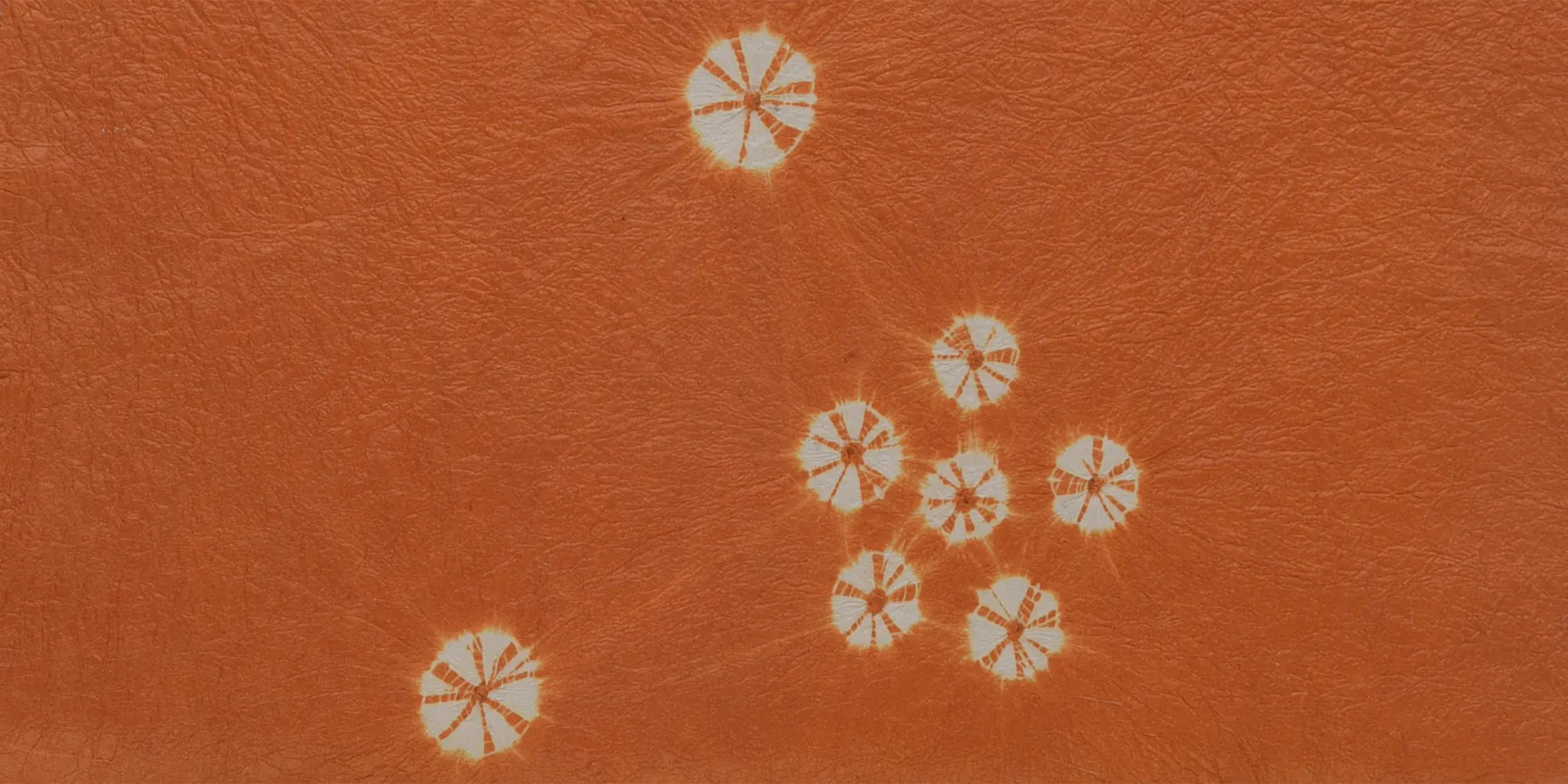
A sumptuous album containing over 220 textile fragments, carefully assembled and labelled by hand onto silver slips of paper. While albums of textile collections are known to exist, the present example is especially fine. It is in fabulous condition, bound luxuriously, protected in a hand-dyed silk wrapping cloth and housed within a contemporary box with beautiful kumihimo woven ties.
Based on the binding, box and quality of the textile samples themselves, we have dated this album to the eighteenth century (mid-Edo period). During the Edo period, Japan had a firm isolationist (sakoku) policy which meant that interactions with the outside world were strictly limited to trade. Dutch, Portuguese, British and Chinese (and by the 18th century, largely Dutch and Chinese) merchants were permitted only on the designated sites in Nagasaki, and it was through this port that foreign goods entered Japan. Merchants brought goods not only from their own countries, but from their colonies too, be it Indian cotton, Indonesian batik or sarasa chintz. This album serves as a time capsule, containing a fascinating range of textiles that were imported into Japan in the Edo-period, as well as beautiful textiles made in Japan.
In the Edo heyday of iki sensibilities, a great signifier of sophistication was the adoption of imported textiles. Textiles imported by foreign merchants were incredibly expensive, and for those who could afford such cloth, they usually fashioned them into small accessories such as tobacco pouches and cloth coverings for inro (small cases used by men to carry things). Precious fragments were also collected and pasted into albums or folding screens. Such examples can sometimes be found in the archives of textile workshops in Kyoto, as they were used as reference materials for the artists, dyers and weavers. In the case of the present album, the luxuriousness of its production would indicate that it originally belonged to an individual private collector.
What is very special about the album is that each fragment is accompanied by a handwritten label identifying the textile type (only two samples lack a description). Many labels say where the textiles are from and they represent a remarkable range of places: China, Indonesia (inc. Sumatra), India, Kashmir, Persia, Syria, Bukhara (in Uzbekistan) – and from Europe – France, Italy, Spain and Greece. Within the Japanese range of textiles, there are gorgeous examples of Nishijin woven silk, sashiko stitched cotton, nishiki brocades, and very fine silk embroidery. One page shows seven types of kumihimo cords including those used for for samurai armour and specific types of katana swords. There is still much more fun to be had researching the textiles of this album.
Provenance & possible use
One mark of provenance is a (later) ownership stamp reading 'Kano Shuho', which can be found on the front endpaper. We have much reason to believe that this was the same Kano Shuho (dates unknown) who was a Kyoto-based artist, writer and collector of decorated papers and textiles.
There are a few published books accredited solely to Kano, including a book of chiyogami paper designs he published with Unsodo 1936 (Chiyo-irogami). For this book he selected fine examples of chiyogami paper from his own extensive collection, which were then finely reproduced in woodblock. A similar title is Kano's Ukiyoe kosode hyakusen [One Hundred ukiyo-e kimono sleeve designs], published by Happodo in 1936, which also shows woodblock printed designs. As a collector, his scholarly approach is perhaps most reflected in Meibutsu kinshu¯ ruisan [Collection of special brocades], published in 1939 by Benrido and co-authored with Akashi Senjin (1887-1959). This book contains photographic reproductions of antique brocade textiles, with accompanying essays.
Crucially, Kano was one of the artists involved in Unsodo's great 10-volume series Ayanishiki (1916-1925), which partly shares its title with the current album. This was an extraordinary project that coincided with the opening of the Nishijin Textile Center in 1915. Working with Kyoto's finest woodblock printers at the time, Unsodo, the Nishijin Textile Center commissioned artists to paint precise facsimiles of important textiles, which were then reproduced in colour woodblock printing for each book. Kano was one of the artists who painted facsimiles, and worked on issues 1, 2, 4, 5 and 7.
For nearly a decade after its founding, the Nishijin Textile Center held exhibitions of textiles from its own collection as well as examples borrowed from well-known collectors. These formed the basis of the Ayanishiki series, with many of the exhibited textiles reproduced in the book. One of the prominent lenders was Nezu Kaichiro (1860–1940), who was particularly known for his collection of Noh costumes. Recently the Nezu Museum in Tokyo held an exhibition of twenty items from the Nezu collection which were reproduced in Unsodo's Ayanishiki, in an exhibition titled Ayanishiki: Textile Beauty Appreciated in Nishijin (December 2025 – February 2026).
It is highly possible that Kano's contribution to Ayanishiki was not only as an artist, but as a distinguished collector of textiles too. One avenue of research would be to examine every volume of Ayanishiki against the present album, to see whether any of its fragments were reproduced in woodblock.
Unique.
![Meibutsu aya nishiki [Special textiles designs and brocades].](https://api.maggs.com/image/40780480-217a-4d12-9d9f-c1d2a5405867/1248x1248.webp)
![Meibutsu aya nishiki [Special textiles designs and brocades].](https://api.maggs.com/image/ba5aab23-7cbf-4fa4-b6f5-c50db53798f7/1188x1188.webp)
![Meibutsu aya nishiki [Special textiles designs and brocades].](https://api.maggs.com/image/576a32d0-4f64-428f-ba39-99685c718000/1188x1188.webp)
![Meibutsu aya nishiki [Special textiles designs and brocades].](https://api.maggs.com/image/48769c10-e80f-4778-b736-ba85d0e6cbd6/1188x1188.webp)
![Meibutsu aya nishiki [Special textiles designs and brocades].](https://api.maggs.com/image/188d6932-51d1-4db9-83cd-9bbc770405bc/1188x1188.webp)
![Meibutsu aya nishiki [Special textiles designs and brocades].](https://api.maggs.com/image/152ea973-c486-4c63-bbd0-b947c44fc1dc/1188x1188.webp)
![Meibutsu aya nishiki [Special textiles designs and brocades].](https://api.maggs.com/image/c6c6a5eb-9c32-4eac-b798-563c64c44fb9/1188x1188.webp)
![Meibutsu aya nishiki [Special textiles designs and brocades].](https://api.maggs.com/image/7f1ba40f-6fb2-4f58-b38f-3bcbb0df97e9/1188x1188.webp)
![Meibutsu aya nishiki [Special textiles designs and brocades].](https://api.maggs.com/image/7bb9a4f8-dd6a-430f-a2db-5fd1a9da907b/1188x1188.webp)
![Meibutsu aya nishiki [Special textiles designs and brocades].](https://api.maggs.com/image/b8a2e404-acc4-4482-8810-35f25a6ae9ec/1188x1188.webp)
![Meibutsu aya nishiki [Special textiles designs and brocades].](https://api.maggs.com/image/9868ca56-5ce8-4cbd-a55f-49b902c854f2/1188x1188.webp)