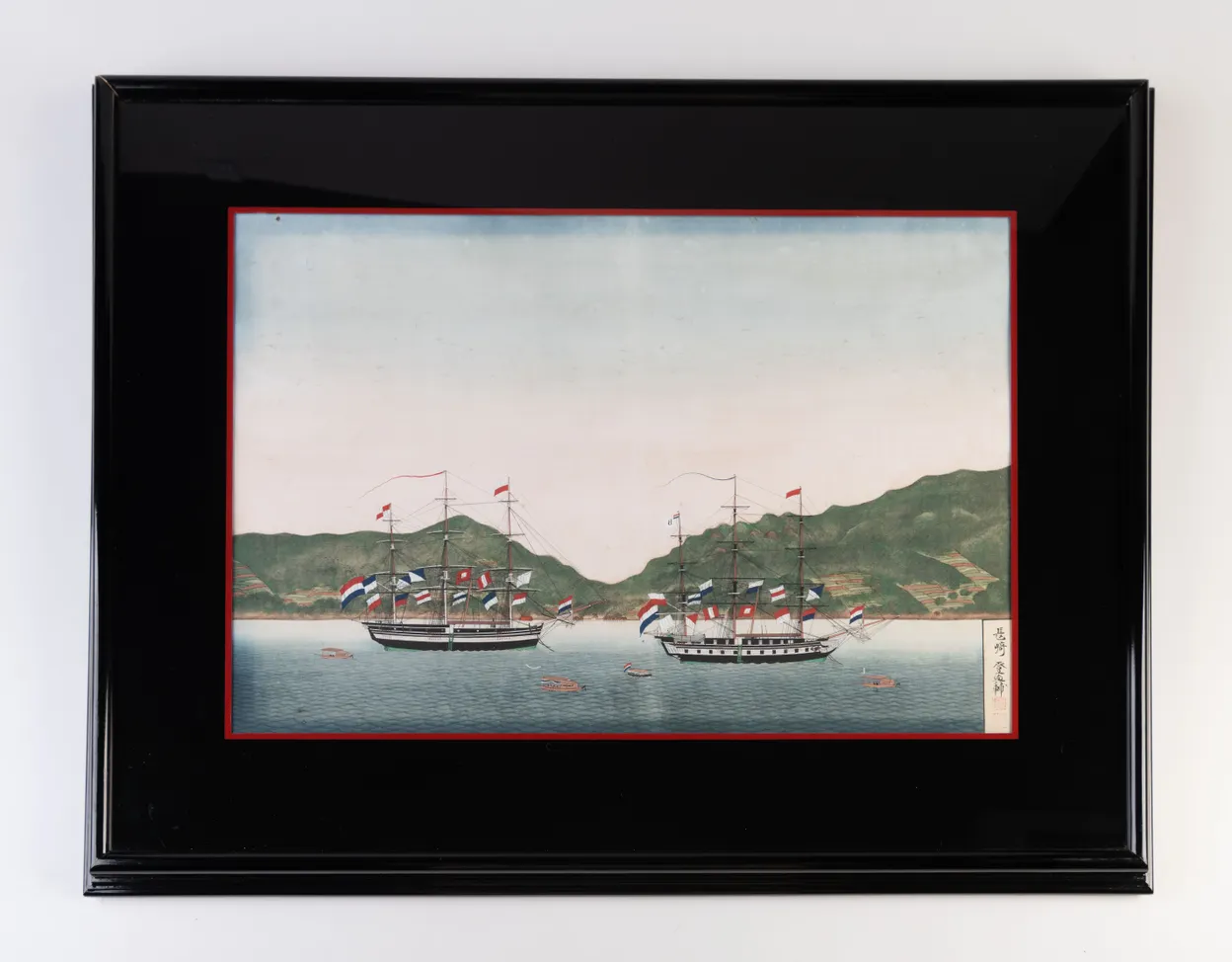
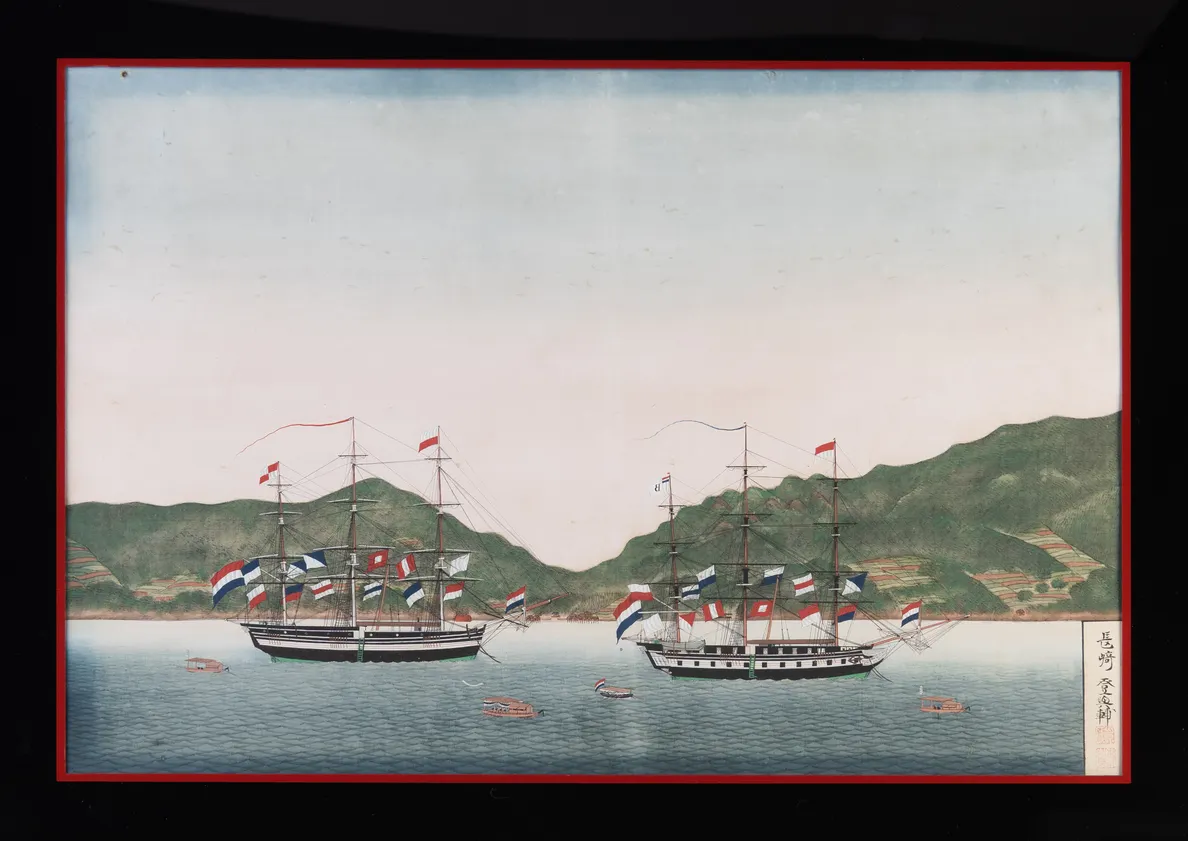
A beautifully preserved painting by Kawahara Keiga with his rare signature. The painting depicts two Dutch ships, the ‘Fortitude’ & ‘Java’, and it comes with an interesting provenance.
Kawahara Keiga (1786-1860?) is one of the best-known painters in Nagasaki in the first half of the 19th century. From 1811 onwards he got security clearance from the metsuke censorship office of the Nagasaki Magistrate’s Office to become a “Dejima de-iri eshi”, which allowed him to enter the artificial island of Deshima with the aim to produce visual records of the Dutch. Essentially, this was part of the surveillance operation of Dutch activities in the harbour.
Kawahara initially trained under Ishizaki Yushi (1768-1846) and was working almost entirely in gouache colours in a style that was clearly influenced by the company school paintings of India and China. From the 1820s onwards he accepted commissions from Dutch traders to paint portraits of ships and of Nagasaki harbour. In 1823 he met Philipp Franz von Siebold (1796-1866), the great Japanologist and medical doctor, and they became close friends. Ironically, Siebold managed to persuade him provide an accurate visual record of Japanese customs, natural history, and scenery in and around Nagasaki - not in order to spy for Holland but purely because of his personal interest in Japan. He also asked for his help to collect Japanese maps and this eventually led to Kawahara’s arrest in during a journey to the Shogun in Edo in 1829 and again in 1845 resulting in his banishment from Nagasaki for divulging military secrets to the Dutch. He had committed the mistake of accurately including the crests of two clans on patrol boats in the harbour. Keiga had been painting similar scenes for many years, but he was made an example of because the political situation had changed and the Tokugawa became increasingly concerned about their national security in the wake of demands from Russia as well as the news of British operations in China.
The present painting is a very accomplished and finely detailed portrait of two Dutch ships anchoring in Nagasaki, both of them sailing under the Dutch flag. They are accompanied by 3 small Japanese surveillance vessels (bansen) as well as a small rowing barge flying the Dutch flag. This was presumably used to transfer the captains to Deshima island. The coastline to the west of Nagasaki is clearly outlined with the village of Senowaki and Ebisu Shrine. The tiny red island called Hadakashima can be made out to the left of the village.
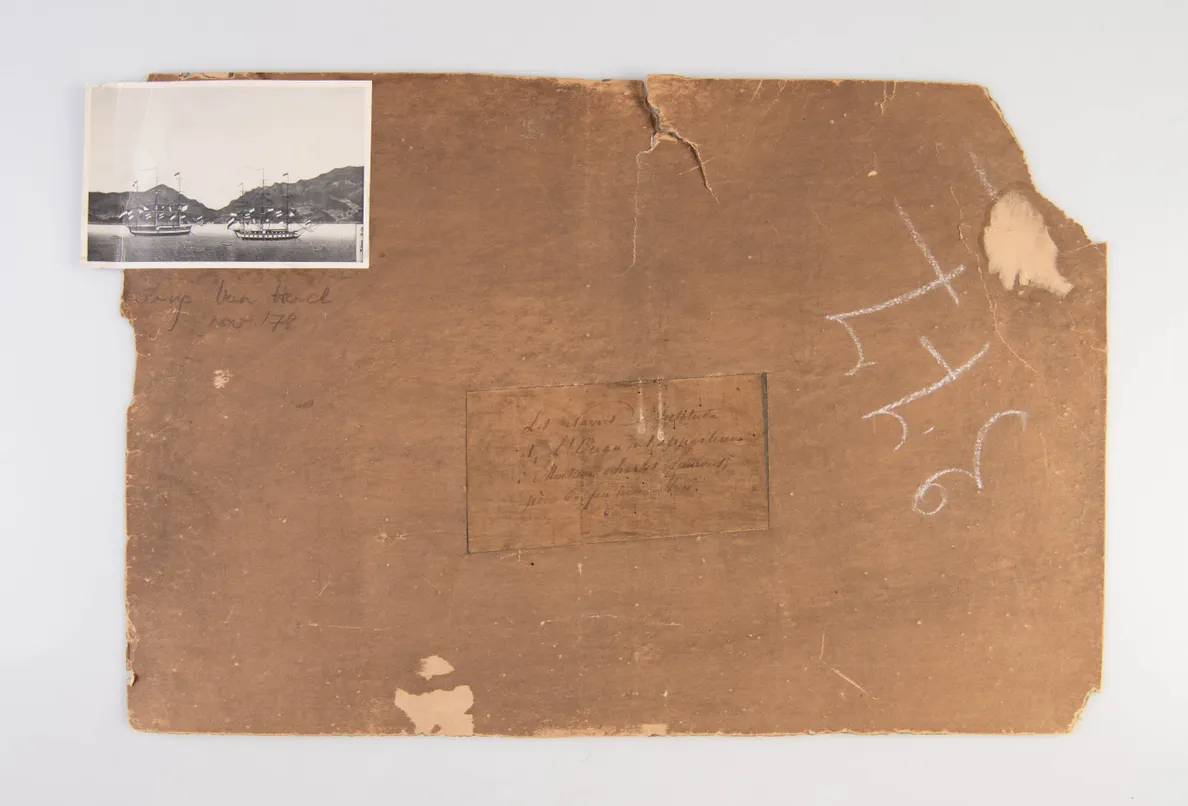
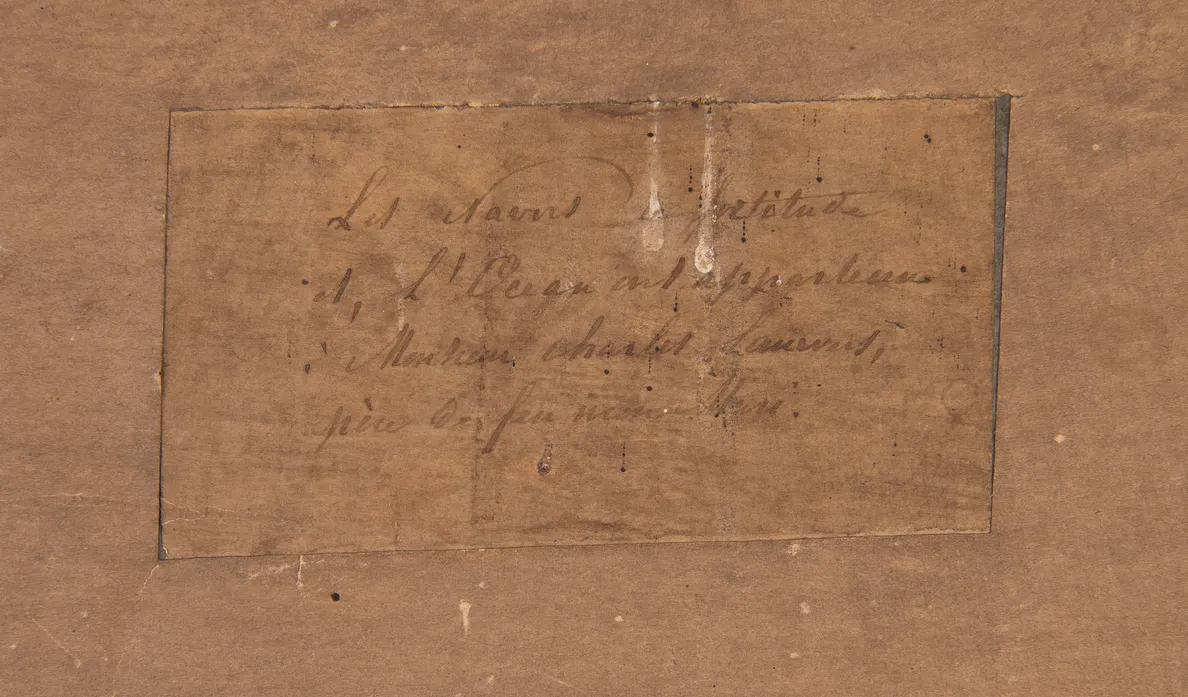
Our painting is accompanied by an old backing sheet bearing a French handwritten note: ‘Les navires La Fortitude et L’Océan ont appartenu à Monsieur Charles Lauwers, père de feu mon mari.’ [transl: ’The ships Fortitude and Océan belonged to Monsieur Charles Lauwers, father of my late husband’]. This note is very likely to have been written by Mélanie-Jeannette Lanszweert (1802-?), who married Lauwers’ son, Richard Marie Lauwers (1805-1842) in 1832. The note is slightly puzzling because there is no record of the ’Fortitude’ and the ’Ocean’ making a journey together to Nagasaki. There is also no record of Lauwers owning the ’Ocean’ and we can only assume that the daughter-in-law was misinformed.
What is correct and well documented is that the owner of the ’Fortitude’ was Charles Francois Lauwers (dates unknown). He was born in Belgium (Torhout) in 1763 was operating out of Ostende. After the collapse of the Napoleonic Empire in 1815 this region became incorporated into the United Kingdom of the Netherlands which gave Lauwers the opportunity of operating under the Dutch flag. He bought the three-mast frigate ’Fortitude’ in 1819, length 34.9 meters with a net tonnage of 615. The only time the ’Fortitude’ came to Nagasaki was under Captain Sievert Lieves arriving on July 29th 1821, together with the frigate ’Java’ under the command of Capt. Andries Schott, and we can assume that this is the scene that is being shown here. This voyage was a particularly famous because the ’Fortitude’ carried two live camels which were intended as Dutch presents for the Shogun Tokugawa Ienari.
Most of Kawahara Keiga’s work is unsigned but in this case he signed it using his common name ’Toyosuke’ in the white cartouche below the title ’Nagasaki’. This is surely a mark of special favour for the person who commissioned the painting, likely to have been the Opperhoofd of Deshima at the time, Jan Cock Bloomhof (1779-1853), on behalf of Capt. Sievert Lieves who may in turn have acted for the owner Charles Lauwers.
Sources: Jacques van Wijnendaele, ’De familie Lanszweert en de stad Oostende’, 2008. Stichting Maritiem-Historische Databank.