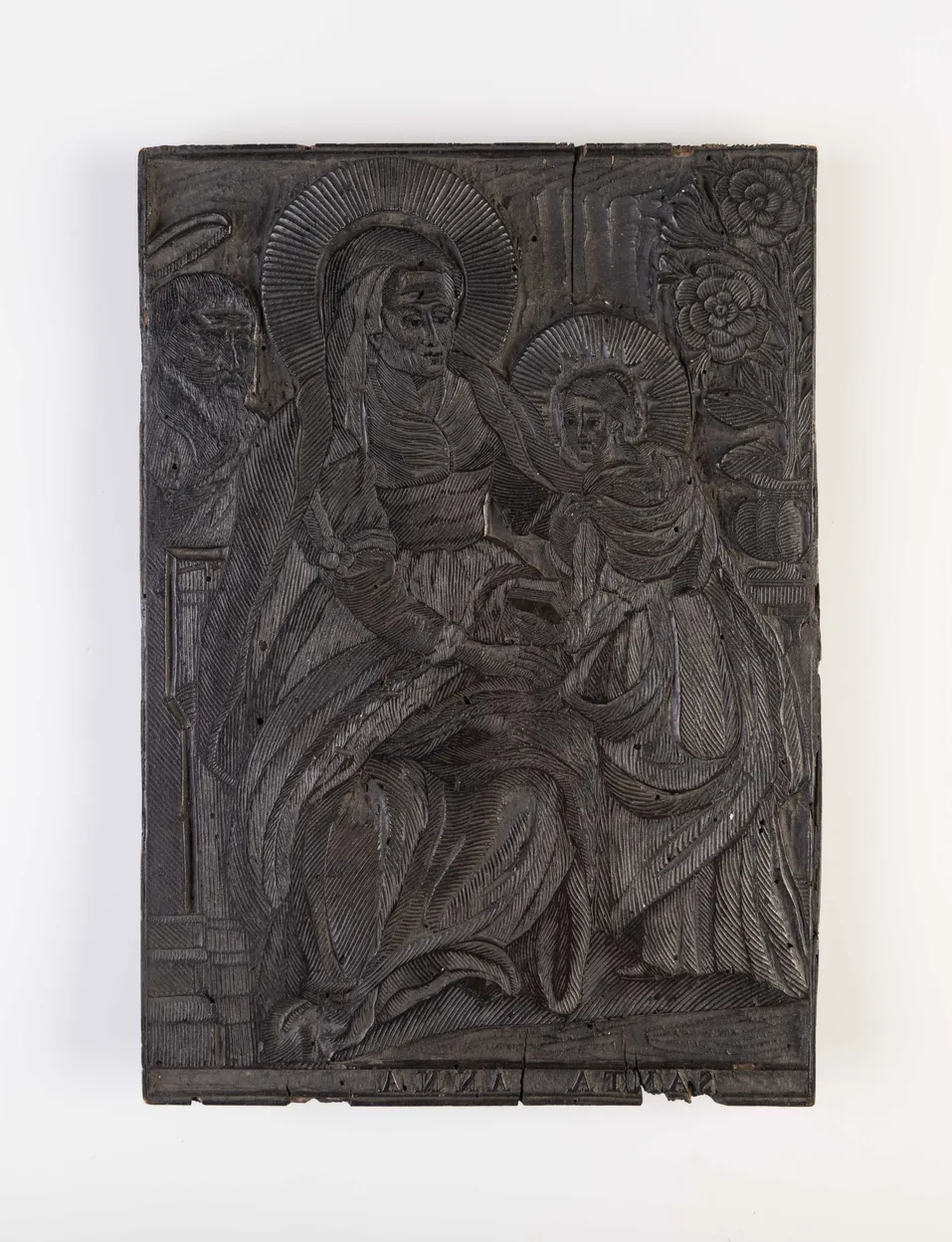
An exceptional survival: a large woodblock, impressively intact, for the printing of a full-page devotional image of Saint Anne teaching her daughter, the Virgin Mary to read. St Anne has one shoulder around Mary, who stands at her knee holding a book, while Anne's husband, Mary's father, St Joachim, looks on from the background. Santa Anna rather than Ana in the caption, suggests Italian origins.
'Mary modelled an ideal of female devotional reading in the Middle Ages', and the iconography of her reading, particularly in scenes of the Annunciation in which she is often depicted holding a book - Isaiah's prophecy, according to St Ambrose - was popular and much used. 'But if the Virgin is depicted reading at the Annunciation, this led to the question of how and from whom she learned to read, and the answer to this question seems to have been the iconography of St Anne teaching the Virgin to read. This image appears to have emerged in the late thirteenth century...linked both to a desire to understand Mary's book at the Annunciation, and increasing representations of female literacy' (Wilmore). 'In devotional contexts the scene [of Anne teaching Mary to read] not only survives but flourishes. In fact, it serves as the major devotional image of Anne, who is virtually never represented alone, but rather with her daughter and her book. This grouping implies that Anne's act of teaching carries singular importance, as does the fact that the book is virtually always open...Anne empowers her daughter, and encourages other mothers to follow her example.' (Sheingorn).
For a wood printing block of this size and condition to have survived is unusual; while reusing and recycling wood blocks was standard in the early modern print trade, circulating amongst printers for decades, even centuries, for one of this size to have been saved, which shows such evidence of use, and is evidently a slightly more crudely carved block for the production of popular prints, is uncommon. It reveals a little of the practice of woodblock printing - from the deep, crude gouges for areas of blank space, to the splits in the wood where the block is thinnest, formed from overuse. Old holes from wood worm frequently didn't prevent a block's continued use, visible in the form of small white holes peppered over the printed image.
P. Sheingorn, '"The Wise Mother": The Image of St Anne Teaching the Virgin Mary', Gesta 32.1 (1993). pp.69-80. A. Wilmore, 'On St Anne teaching the Virgin to Read', Sedes Sapientiae [substack, online access].