A rare statement on the anti-slavery movement by one of its most important figures.
"Gerrit Smith was a figure of national prominence in politics and social reform movements including temperance, abolition and the underground railroad, and women's rights ..." (Wurst, 159).
"At first Smith supported efforts to colonize [relocate] slaves in Africa, but in 1835 he joined the more militant abolitionist movement that demanded immediate emancipation of the slaves. He also supported self-improvement efforts of northern free blacks as a means of combating pervasive racial prejudice. He distributed thousands of acres of unimproved land in upstate New York to poor black families to help them become economically independent. Smith initially believed that the abolitionist mission was exclusively one of moral suasion: to 'publish the truth about slavery'" (ANB).
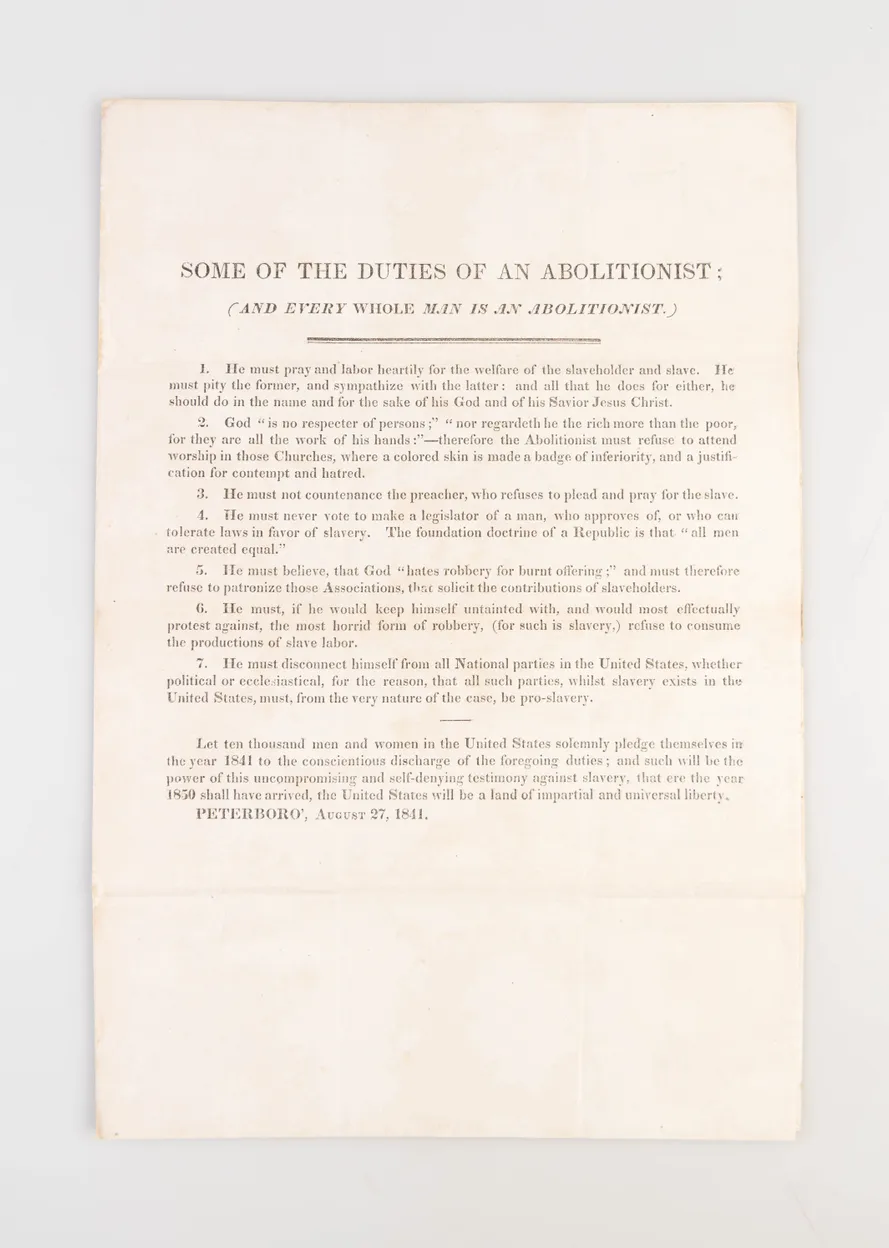
The front page sets forth the seven key duties of the abolitionist as follows:
1. "He must pray and labor heartily for the welfare of the slaveholder and slave."
2. "[T]he Abolitionist must refuse to attend worship in those Churches, where a colored skin is made a badge of inferiority, and a justification for contempt and hatred."
3. "He must not countenance the preacher, who refuses to plead and pray for the slave."
4. "He must never vote to make a legislator of a man, who approves of ... laws in favor of slavery. The foundation doctrine of a Republic is that 'all men are created equal.'"
5. "[H]e must refuse to patronize those Associations that solicit the contributions of slaveholders."
6. "[H]e must refuse to consume the productions of slave labor."
7. "He must disconnect himself from all National parties in the United States ... for the reason that all such parties, whilst slavery exists in the United States, must, from the very nature of the case, be pro-slavery."
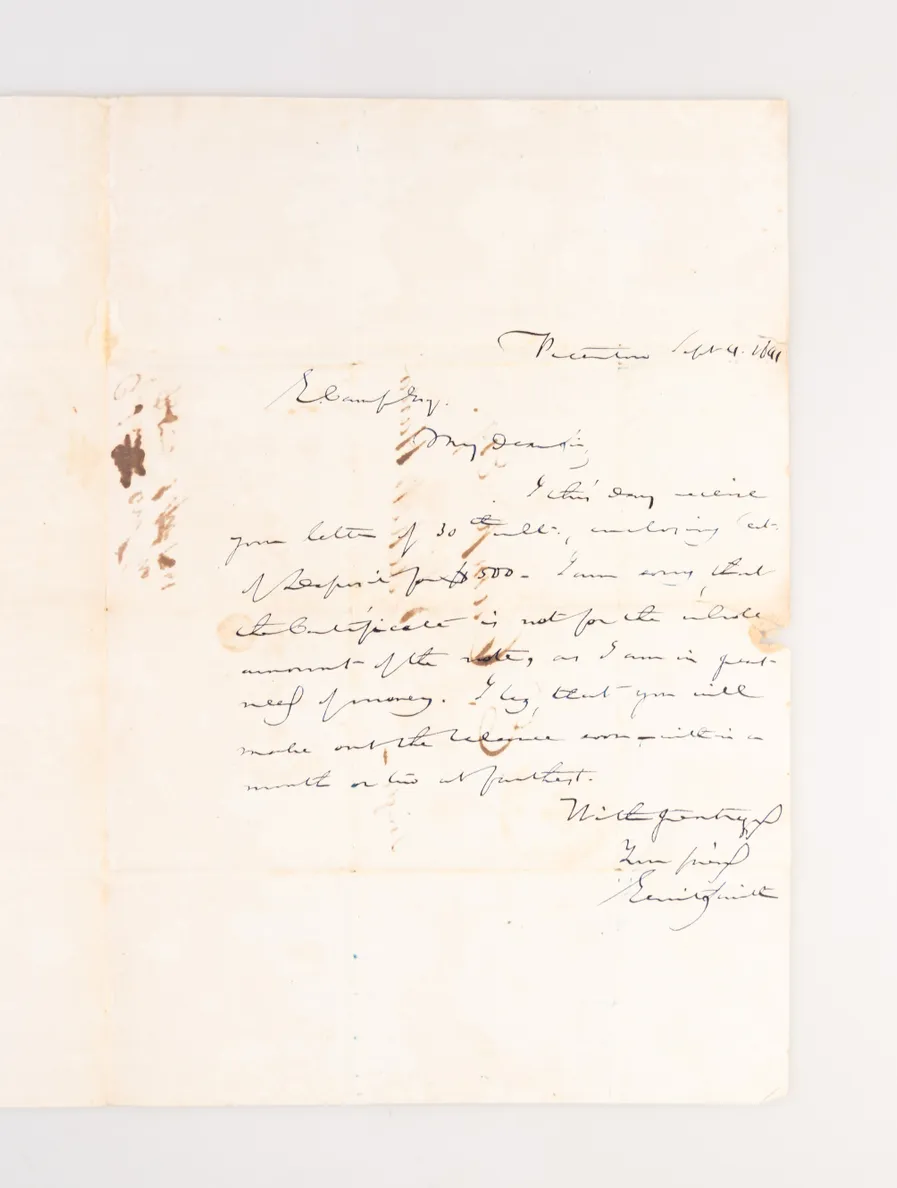
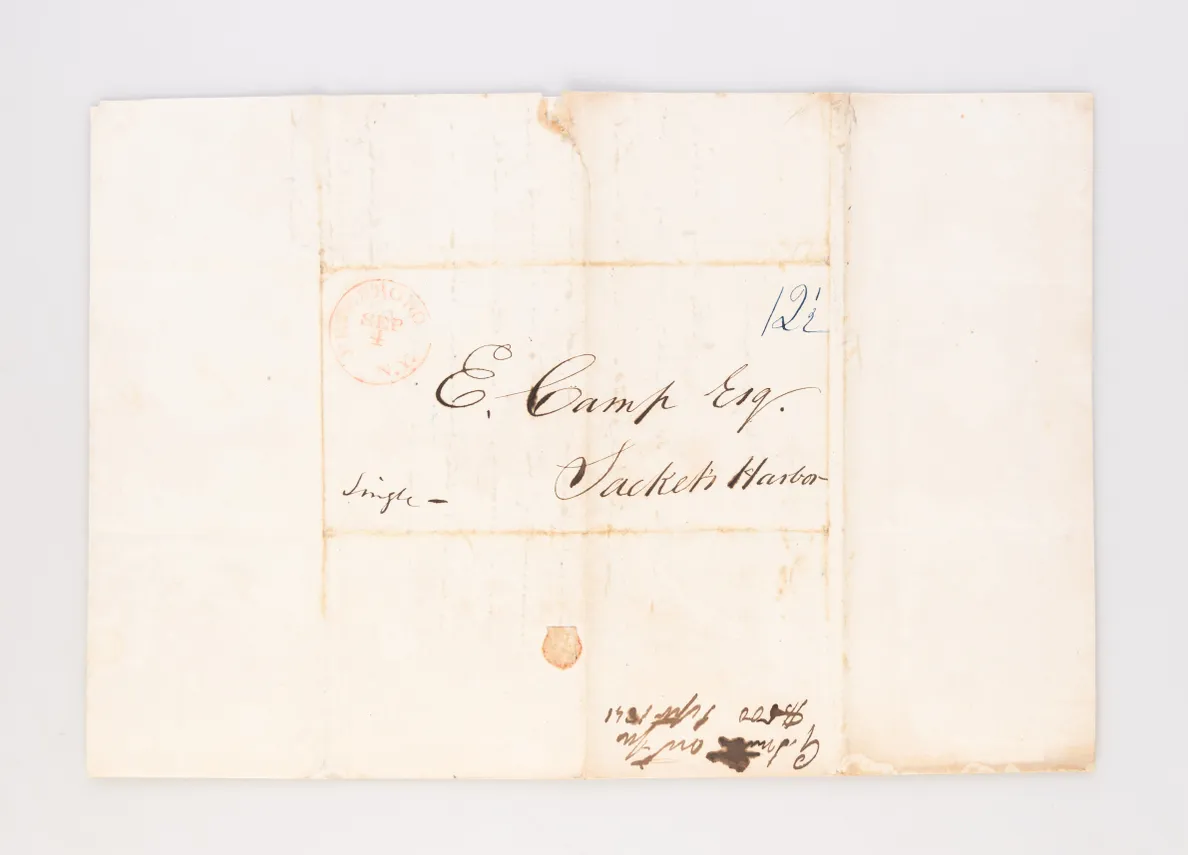
In the long note on the note on the second blank, Smith addresses Camp on the matter of an outstanding debt.
His position on abolition only hardened in the snsuing years. "Smith’s growing despair concerning the failure of political antislavery tactics converted him into a proponent of violent abolitionist tactics by the mid-1850s. In 1851 he played a prominent part in the mob that stormed a police station in Syracuse, New York, and freed the escaped slave Jerry McHenry. Smith donated an estimated $16,000 to the free-state movement in Kansas, which frequently employed armed means to resist efforts to establish slavery there. It was through his contacts with the Kansas free-state guerrillas that Smith drew close to the militant abolitionist John Brown (1800–1859). Although he publicly denied it, Smith gave warm encouragement and financial assistance to Brown’s attempt to incite a large-scale slave insurrection at Harpers Ferry, Virginia, in 1859."
OCLC locates four copies at AAS, Mass Historical Society, UVa, and the University of Rochester.
Wurst, L., "'For the Means of Your Subsistance ... Look Under God to Your Own Industry and Frugality': Life and Labor in Gerrit Smith's Peterboro" in International Journal of Historical Archaeology, Vol. 6., No. 3 (September, 2002), pp.159-172.