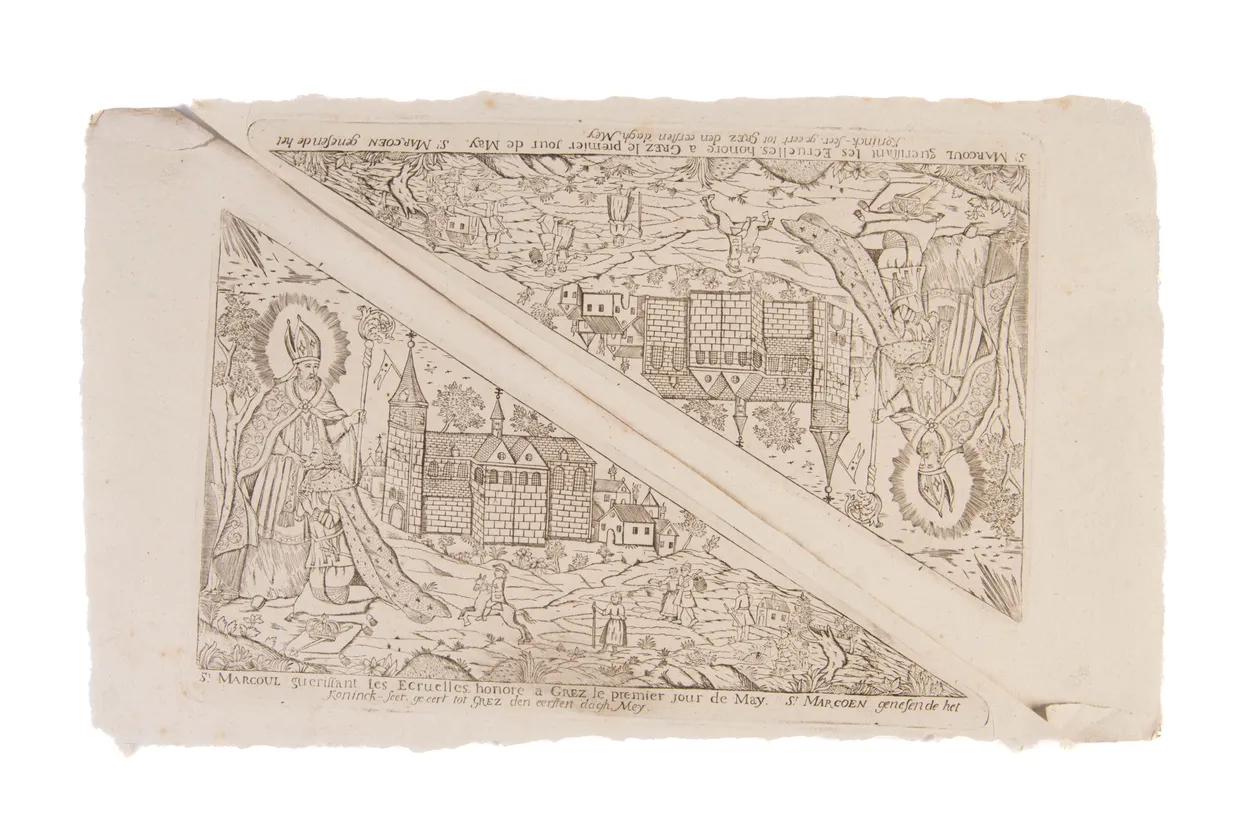
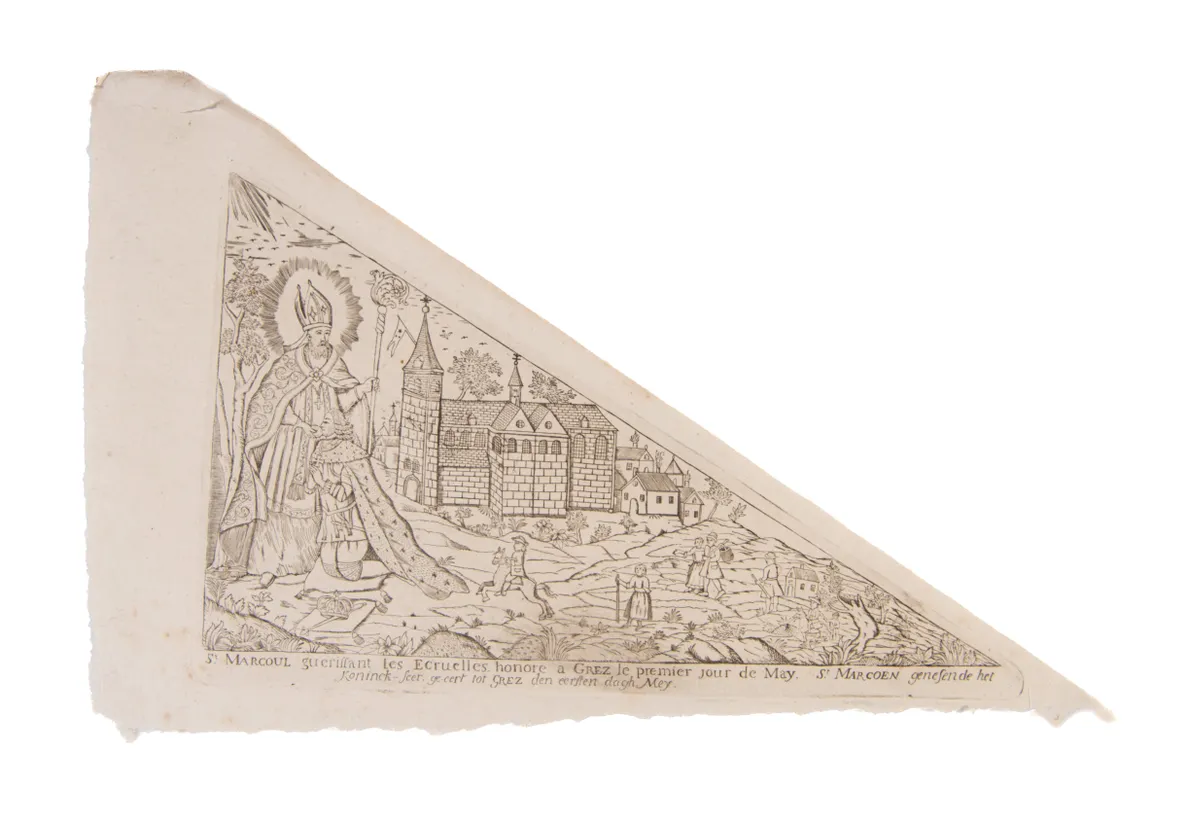
Remarkable survivals: two provincial pilgrimage pennants, or draperie, to be carried by pilgrims on the feast day of St Marculf (d.558) in Grez-Doiceau in Walloon Brabant, northern Belgium, in the eighteenth century.
St Marculf, or Marcoul is commonly associated with the healing of scrofula; his relics at Reims were believed to impart this power to French medieval kings on their coronation, hence scrofula became known as 'the king's evil', to be cured by 'the king's touch', or 'the royal touch'. Accordingly, here, a monarch kneels to the left, being blessed by the saint; pilgrims make their way across the countryside to Grez Doiceau and the Church of St George - specifically depicted here - for their cure.
In his groundbreaking study of 'the king's touch', early twentieth-century Annales historian Marc Bloch referred to the celebration of this saint in Grez-Doiceau in particular, and with specific reference to this particular votive pennant design: "On 27 April 1683 a confraternity had been founded at Grez Doiceau in Brabant, in honour of our saint. According to the Low Countries' custom, pilgrims were given pictures in the form of pennons known as drapelets; and we still have a Graz-Doiceau drapelet dating apparently from the eighteenth century. At the feet of St-Marcoul, and kissing a round object - no doubt a reliquary - held out to him by the saint, is a French king, dressed as usual in a long cloak embroidered with fleur-de-lis. Beside him on a cushion are the sceptre and crown. ...Everywhere iconography was spreading the idea that this ancient saint, of whom so little was known - hermit founder of an abbey, and the devil's antagonist in Merovingian times - had been instrumental in the origin, and was active in the continuance, of royal healing power" (Bloch, p.165).
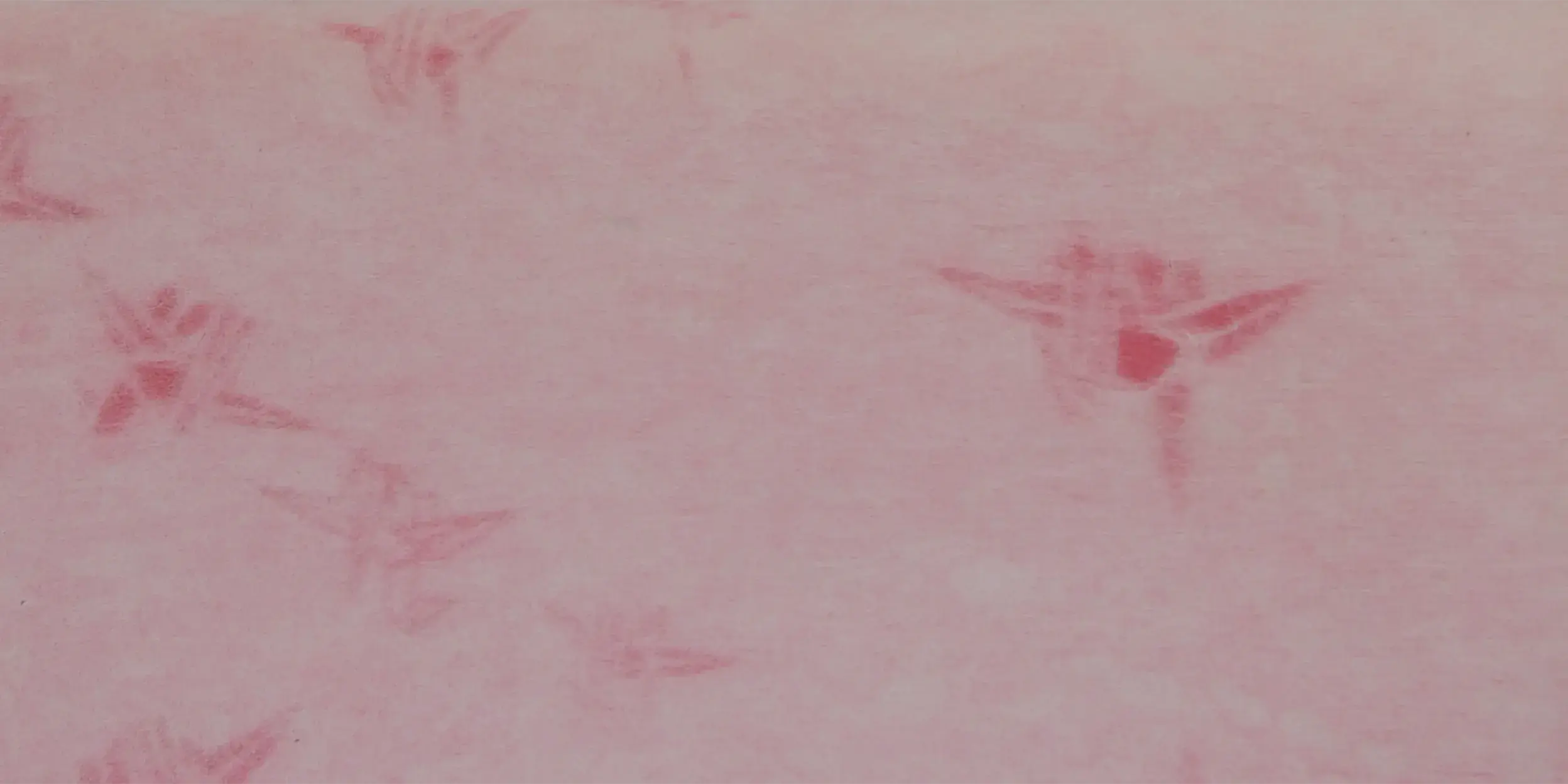
By the eighteenth century, when this draperie was printed, the role of votive pennants in pilgrimage was well established - examples survive from the seventeenth century, and there are sixteenth-century depictions, like that in Peter Aertsen's (1508-1575) 'The Return from a Pilgrimage to St Anthony' of pennants like these, some printed in red, attached to sticks and waved by children, tucked into hats, and, underscoring their ephemerality, lying discarded by the side of the pilgrims' road home. 'On the pilgrim's return, the drapelet should be hung in the pilgrim's home above the fireplace, the bed, in the stable, or in the barn (the flag will have been carried to the place of pilgrimage and touched the relic, and therefore carries some of its power). Upon returning, pilgrims also tied the flags to their hats, held them in their hands, and riders would attach them to their horses' harnesses' (Janssen, p.32).
According to draperie collector René Janssen, the copper plate from which these pennants were printed survives at the rectory of St George's church, and is dated 1735.
Closed tear to the top of one pennant, outside plate lines, otherwise in excellent condition.
M. Bloch, transl. J. E. Anderson, The Royal Touch: sacred monarchy and scrofula in England and France (1924; this translation 1973, McGill-Queen's University Press). R. Janssen, 'Les drapelets de pelerinage a Bruxelles et environs et dans le Brabant Wallon', in Tradition Wallonne: Revue annuelle de la commission royal Belge de Folklore, Vol. II, 1985, pp.31-74.
OCLC: US: Iowa, Chicago, Harvard, Wellesley, Cornell, Pennsylvania. UK: Oxford.