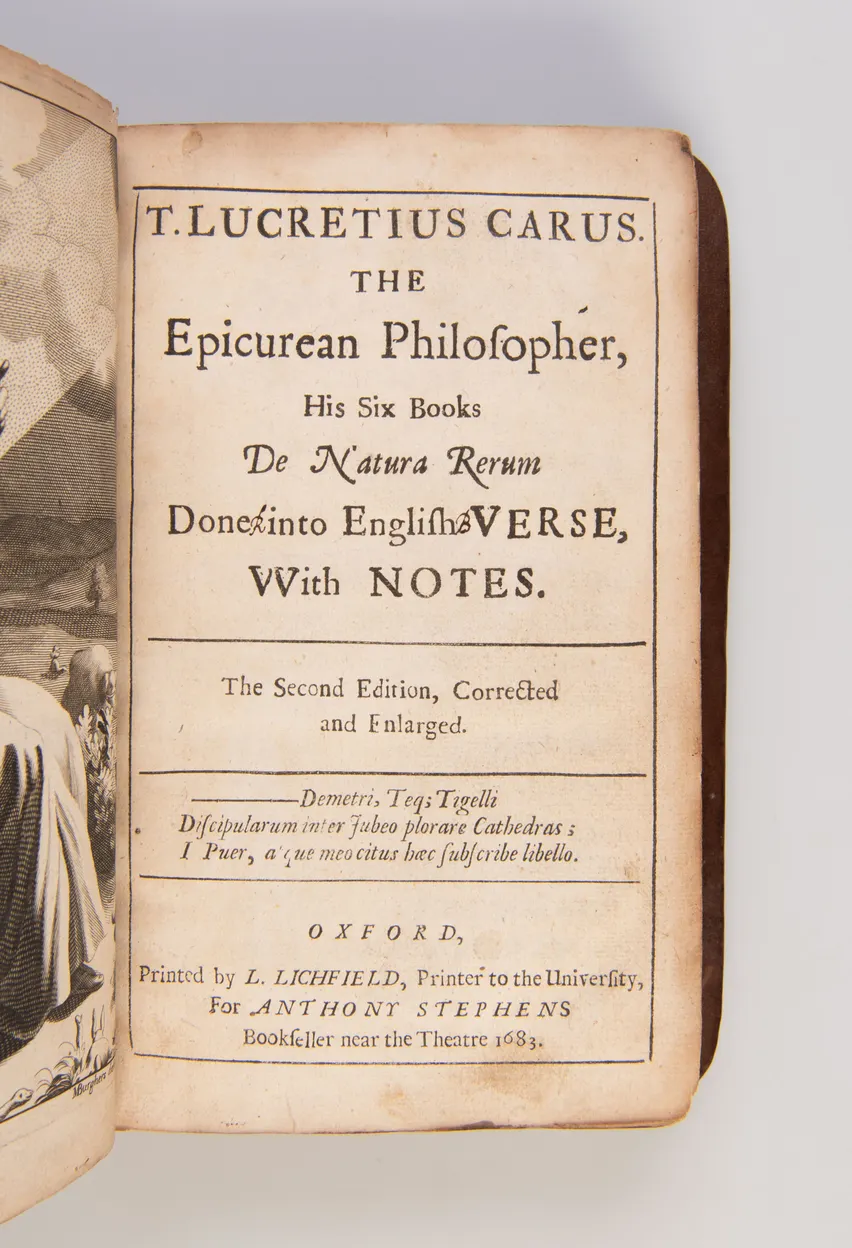
Wing L3448. First published the previous year but this is the first with verses by Evelyn and Behn et al.
The important second edition of Thomas Creech's translation of Lucretius' De rerum natura with commendatory verses by John Evelyn (who had himself translated the work but concedes that Creech "deserve[s] the Crown") and, in a long poem "on his excellent translation", Aphra Behn, who praises Creech for making the work available to female readers.
Thomas Creech (1659-1700) produced this (almost) complete translation of Lucretius' De natura rerum during his time at Wadham College Oxford. The translation was an enormous and immediate success and subsequent editions were published into the 18th-century. The present edition is the first to contain commendatory verse by Aphra Behn, Tom Brown, John Evelyn, Thomas Flatman, Thomas Otway, and Nahum Tate, among others.
John Evelyn had produced a partial translation of the first book which was published in 1656 as An Essay on the First Book of T. Lucretius Carus De rerum natura, but Evelyn was so disappointed with the numerous printer's errors (for some reason he did not see it through the press himself) that his translation of Books II-VI remained unpublished: "Never was book so abominably misused by printer, never copy so negligently surveid by one who undertooke to looke over the proofes with all exactness & care, namely Dr Triplet, well known for his abilitie, & who pretended to oblige me in my absense, & so readily offer'd himselfe. This good yet I receiv'd by it, that publishing it vainely its ill successe at the printers discourag'd me from troubling the world with the rest." (written in his own copy and printed by Keynes, p. 42).
In his verse here, Evelyn congratulates Creech on the success of his translation whilst also lamenting his own failings, he admits: "I boldly Launch'd, and would new Worlds explore / Deep Mines I saw, and hidden Wealth to lie" (C2r) but concedes: "I turn'd my Prow, and the Disco'vry made, But was too Weak, too poor my self to Trade, / Much less to make a Conquest and Subdue..." (C2v).
Aphra Behn's verse, "To the Unknown Daphnis on his excellent Translation of Lucretius", is much longer (142 lines) and praises "Divine Lucretius, and Diviner You [Creech]!." Behn describes how reading Lucretius shaped her education and her own verse and "Form[ed] my mind." Behn describes:
"And when I would Thy Glories sing,
What in Strong Manly Verse should be exprest
Turns all to Womanish Tenderness within..."
She continues:
"Till now I curst my Sex and Education,
And more the scanted Customs of the Nation,
Permitting not the Female Sex to tread
the Mighty Paths of Learned Heroes Dead"
But Behn rejoices that Creech's translation has opened the possibility of a woman writing verse equal to a man:
"So Thou by this Translation dost advance
Our Knowledge from the state of Ignorance;
And Equallist Us to Man! Oh how shall we
Enough adore, or Sacrifice enough to Thee!"
Whilst celebrating Creech's translation Behn emphasised the unchristian aspects of the ancient poet which Creech had been at paints to conceal: "Behn saw the poem as a triumphant assertion of rationalism and materialism, a victory of reason over faith." (ODNB)
Behn celebrates her assertion that "Poets by Nature Aw, and Charm the Mind / Are born, not made or by Religion, or Necessity" but her suggestion - in her original version of the poem (only published later in Behn's own Poems upon severall occasions (1684) that Lucretius' verse:
"...Pierces, Conquers and Compels,
Beyond poor Feble Faith's dull Oracles.
Faith the despairing Souls content,
Faith the Last Shift of Routed Argument"
Was deemed too much by Creech who significantly softened Behn's verse when it was reproduced in the present volume and offered instead:
"...Pierces, Conquers, and Compells
As Strong as Faiths resistless Oracles,
Faith the Religious Souls content,
With the secure Retreat of Routed Argument"
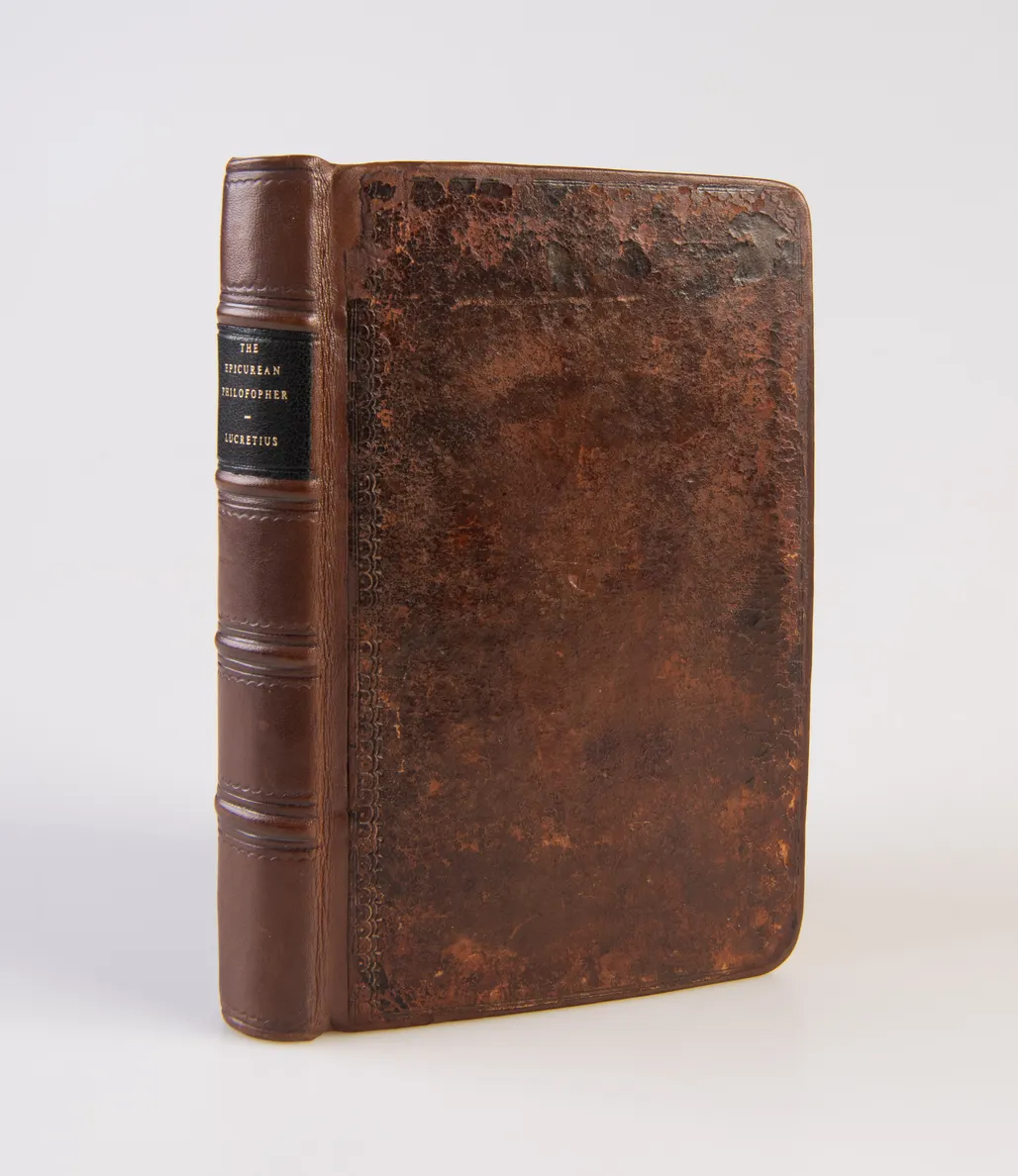
A very good clean copy with wide margins but unfortunately rebacked and repaired by a binder who struggled with the long s.
Provenance: Alfred Theodore Arber-Cooke (c.1905-1993), signature of the old front flyleaf.