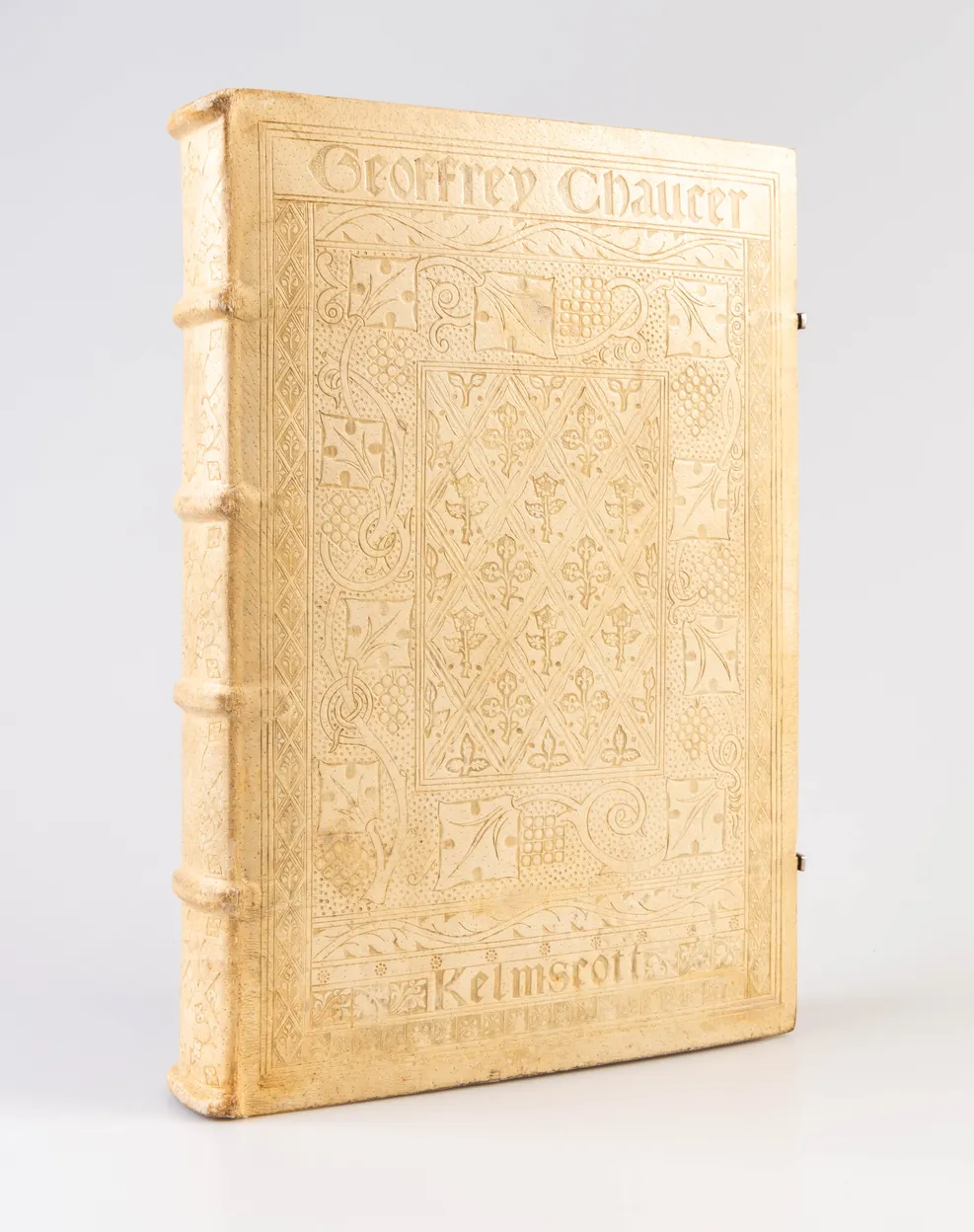
Bookplate of Clarence B. Hanson, Jr. to upper pastedown. Very good, the slightest of rubbing to the pigskin at extremities, covers in original unrestored condition as Morris would have wanted but nonetheless remaining bright, internally fine.
The most ambitious and magnificent book of the Press, this being one of only 50 copies in the superior binding of intricately tooled full pigskin designed by William Morris.
Unarguably the most ambitious and remarkable achievement of the Kelmscott Press, in which William Morris brought his philosophy of design and ornamentation to its logical conclusion. Edward Burne-Jones did not hold back from praising his own work, declaring the Chaucer to be ‘the finest book ever printed and it’s more than likely there’ll never be such another’. He was far from alone in his praise, The Athenaeum declared the book to be ‘the crowning achievement of the Kelmscott Press’, and F.S. Ellis ‘the grandest book that has issued from the press since the invention of typography.'
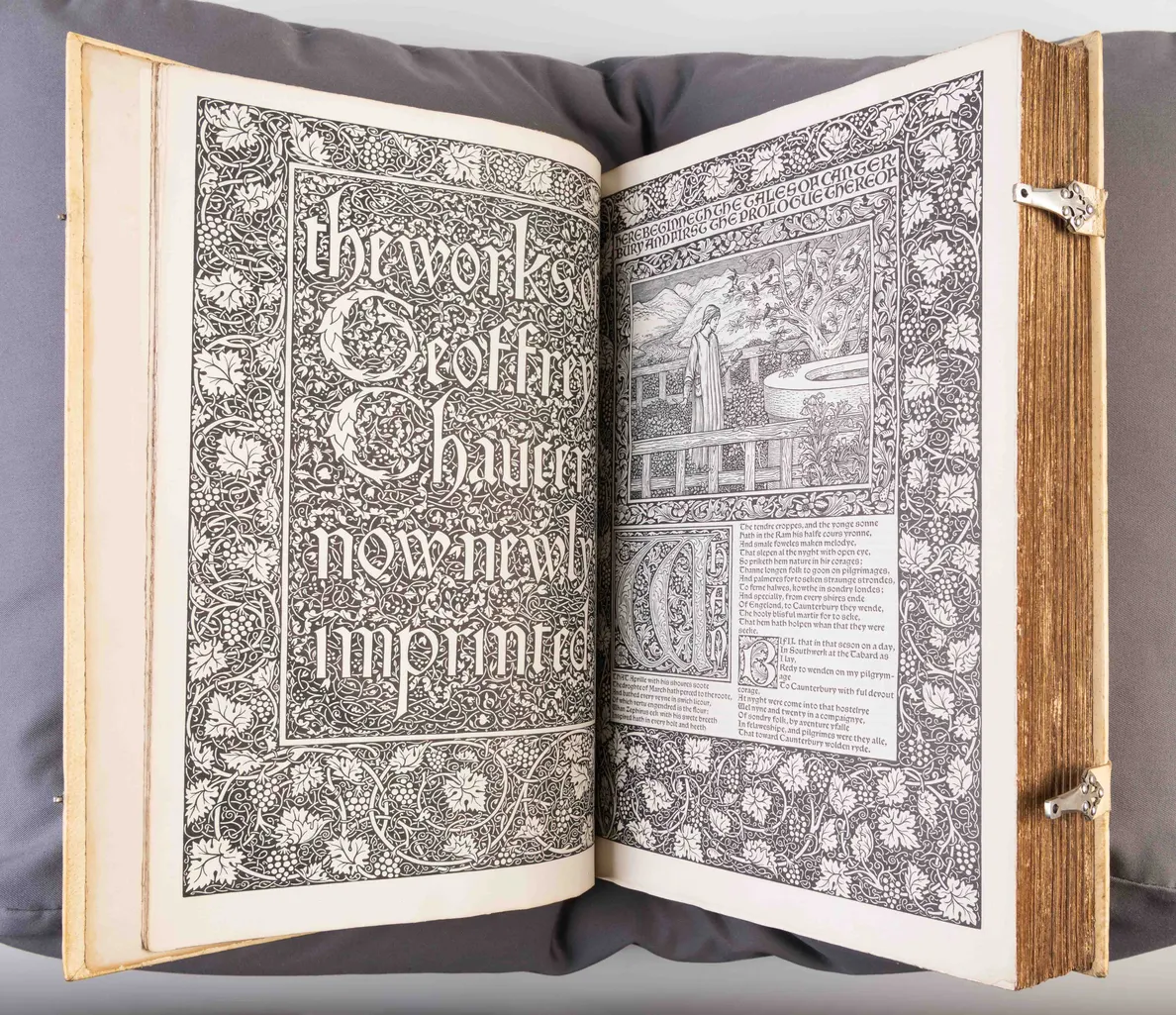
Publication of an edition of Chaucer had been on William Morris' mind since the very beginning of the Kelmscott Press, and Chaucer had been central to both he and Burne-Jones imaginative development since their time at Oxford. Sydney Cockerell noted Morris' intention to print an edition of Chaucer in his diary in 1891, and an announcement was very nearly included in the first prospectus for the press in 1892, only to be removed at the last moment. Morris understood that this was a book which he had only the one chance to get right, and that it would require an investment in time and resources unlike any other. Not least of these challenges was the choice of type, with Morris eventually conceding that to print the volume in his Troy type would result in a book of staggeringly unmanageable proportions; instead, the choice was made to create a reduced size version of Troy, which he named Chaucer.
When it came to illustration, however, no attempt was made to minimise the scale. Beginning in February 1893, Morris dedicated three years to designing the title page, borders and initial letters. ‘It was a staggering accomplishment, and it took its toll on Morris’s health. By the spring of 1896 Burne-Jones was terrified that Morris might die before he could complete the engraved title-page’ (Peterson, The Kelmscott Press). Burne-Jones initially planned for 60 illustrations, but as Emery Walker later recalled 'when the book was printed no one, not even Burne-Jones, knew how many pictures were in it. He had gone on putting in as many as he liked, knowing that the more he drew the better Morris would be pleased.' The scale of the Chaucer was so unprecedented that, in 1894, it was necessary for Morris to purchase a second, specially reinforced Albion press to handle the increased pressure of printing such large borders and woodcuts.
Although work on the book had consumed the best part of Burne-Jones time for two and a half years, he was pleased to say in a letter to Frances Horner that 'it has never tired me but refreshed me always' and regretted only that the book had not been created when he and Morris were undergraduates at Oxford, upon which they "should have lost our senses with bliss." Peterson. A40.
The binding of full pigskin with silver clasps was executed by the Doves Bindery, but 'William Morris himself designed the cover, so that he launched his great book on the world as he himself desired it to appear' (Cobden-Sanderson). The design was inspired by fifteenth century German bindings, with many of the tools copied from books in Morris' own library; indeed, the lower cover is taken directly from an early German binding, a 1478 Koberger Bible bound by the Salzburg binder Ulrich Schreier. A number of sketched designs survive, which show that, despite his rapidly declining health, Morris spared no effort on the intricate design of the binding for his Chaucer. With each tool painstakingly stamped by hand, it was initially estimated that it would take six days of work to tool a single binding, although no doubt this decreased as the finishers, Douglas Cockerell and Charles McLeish, became more familiar with the design.
The earliest examples of the binding show a stamped date of 1896, but binding continued until as late as 1919 when Cobden-Sanderson returned the tools to May Morris. There is great variety between the bindings, both in the depth and quality of the tooling, which required great strength, accuracy and judgement, and in the choice of tools. The present example, dated 1899, shows particularly crisp and confident tooling, with the entire design clearly legible; in the opinion of Marianne Tidcombe, this makes it likely to be the work of Charles McLeish, who was the senior finisher at the bindery.